
Who’s eating New Zealand? | Stuff.co.nz

If you imagine New Zealand’s sheepmeat as a plate of 10 meatballs, Kiwis would get to eat half of a meatball. So where’s the rest going? Farah Hancock crunches more than 30 years of data to find out who’s eating New Zealand.
ANALYSIS: New Zealand produces enough food to feed about 40 million people, but given our population is just 5 million, who are these people we’re feeding and what are they eating?
And in the land of milk and honey, how much is left behind for Kiwis?
RNZ has looked at some of our biggest merchandise export earners and some of our highest profile products to see who has been eating and drinking New Zealand over the past 30 years.
RNZ
New Zealand exports of beef and lamb to China hit $1.5 billion just last year, but the Chinese Government wants to halve meat consumption in the country by 2030.
READ MORE:
* Commodity prices hitting record levels, expected to stay ‘stronger for longer’
* The Monitor: Five things agriculture businesses need to know
* Farmer confidence rises as agricultural sector cheered by higher prices
* Death of a free trade agreement: New approach urged on India New Zealand relations
* Kiwifruit growers set to decide on contentious Zespri-China deal, after major diplomatic push
New Zealand exports a whopping 95 per cent of the dairy it produces, which earned the country nearly $16 billion in 2020.
China has emerged as our biggest customer in recent years, with its spending on dairy growing from $13.5 million in 1990 to more than $5.5b in 2020. China now accounts for about a third of our dairy exports.
Press the red play button on the chart below, or click on the years at the bottom of the chart, to see who’s been buying our dairy products since 1990.
New Zealanders get to eat about 13 per cent of the beef produced in New Zealand. The United States has been our biggest beef buyer since 2010.
However, since 2012 China has entered the top 10 buyer ranking and in 2019 bumped the US out of the top spot, spending more than $1.6b on Kiwi beef. In 2020, the US regained the top spot.
If you imagine New Zealand’s sheepmeat as a plate of 10 meatballs, Kiwis would get to eat half a meatball.
In 1990 the United Kingdom was the biggest buyer of New Zealand sheepmeat, but for the past seven years China has held the top spot, increasing its spending from $119m in 2010 to $1.6b in 2020.
The UK spent $420m in 2020, down from $606m in 2010.
Green, gold and now red
Since 1996 we’ve exported 8.6 billion kilograms of fresh kiwifruit and earned about $25.6b. In 2020, exports were a record-breaking $2.7b.
New Zealanders only get to eat about 10 per cent of what’s grown here. Domestic sales are limited by regulation, says Zespri chief global supply officer Alastair Hulbert.
In 2020, about 2 million trays of green kiwifruit were sold domestically, as well as 800,000 trays of gold and 10,000 trays of the new red variety.
The biggest international customers were Europe, Japan and China.
Seafood earnings rise
There’s no easy answer to what percentage of commercially caught seafood is exported and what percentage is eaten locally. The industry body, Seafood New Zealand, says there’s been no need to collect the information.
Previously published figures include 90 per cent and 77 per cent, and numbers on Seafood NZ’s website say about 450,000 tonnes of seafood is caught each year, with 276,901 tonnes exported.
This comes out at about 63 per cent – but working on caught weight versus exported weight isn’t accurate. Fish is gutted and often filleted before export, so it’s impossible to match up the caught weight with export data.
Sealord, one of the large quota-owning companies, says it exports more than 90 per cent of its catch. Sanford’s 2019 annual report says about 56.1 per cent of its sales are export sales.
In the 1990s, Japan, Australia and the United States were the biggest buyers of our seafood, but by 2011 China emerged as the top buyer. In 2019 China purchased almost $690m worth of seafood, while the second biggest buyer was the US, spending $245m.
Earnings from seafood have largely risen, with a small fall in 2020, while the weight exported has decreased from nearly 300 million kilograms in 2005 to 231 million kilograms in 2020.
Cream of the crops
Our humble onions are hot property abroad. In fact, by value they’ve been New Zealand’s top export vegetable crop since 2012. We send about 85 per cent of them offshore, leaving just 15 per cent to be eaten in Aotearoa. In 2020, New Zealand exported more than 200,000 tonnes, earning $154m.
Their long shelf life makes them ideal as an export product and as we harvest at the opposite time of year to northern hemisphere growers, our onions fill a gap in global production.
Indonesia and Malaysia are big onion buyers, along with Germany and the Netherlands.
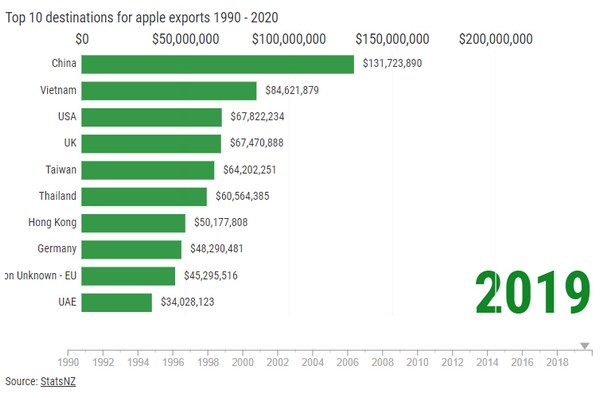
About 86 per cent of apples grown in New Zealand are sold overseas. In 2020 they earned a record $910m, tantalising close to the industry’s goal for 2022 of $1b. The goal was set in 2012, when exports were sitting at $340m.
China was our biggest apple buyer in 2020, followed by Vietnam and Taiwan. The United States and United Kingdom slipped into fourth and fifth spots.
High-profile goods
Lockdown tipples may have been behind the record-breaking $2b worth of New Zealand wine sold to the world in 2020. Of the wine we produce, 85 per cent is drunk offshore.
Wine is one of the few New Zealand exports that isn’t dominated by Chinese buyers. We mainly produce sauvignon blanc, which sells well in the United States, the United Kingdom and Australia.
With news stories about mānuka honey selling for nearly $3000 a jar in London, you might think New Zealand would be exporting a huge proportion of our honey.
In fact, in 2019 we exported less than half what we produced. Adding in honey purchased by tourists visiting our shores in 2019, about 46 per cent of honey ended up offshore. Without tourists, this figure would have been 38 per cent.
China is our biggest buyer, followed by the US and Japan.
Despite high-profile controversy about global beverage giants bottling our water, exported New Zealand water actually represents a small proportion compared to what’s sold locally.
An exact figure for local sales is hard to come by, but 2018 information published on the Ministry for the Environment’s website suggests only 17 per cent is exported.
In recent years China has emerged as the top buyer of our water. Previously the US and Australia were the biggest purchasers.
How much do they earn?
Dairy outstrips all our other food and beverage exports. Since 1990 it has earned $231b. Sheepmeat comes in second with $71b, and beef third at $59b.
The fall of the UK and the rise of China
Between the 1870s and 1940s, the UK was our main export market, taking between 60 per cent and 90 per cent of our exports. This began to wane and by the time the UK joined the European Economic Community (now the European Union) in 1973, it was taking less than 30 per cent of our goods.
Since China and New Zealand signed a free-trade agreement in 2008, China’s contribution to our export earnings has significantly increased. In 2007 China accounted for 5 per cent of our earnings from dairy produce. Now 35 per cent comes from China.
For sheep, there’s been a jump from 3 per cent to 42 per cent, and for beef it’s gone from 0.09 per cent to 33 per cent.
Photography by Claire Eastham-Farrelly. Visuals by Vinay Ranchhod.
Where the data came from
Dairy: Dairy Companies Association of New Zealand and StatsNZ trade data items with a harmonised system description containing “dairy produce”.
Beef: Beef + Lamb New Zealand from September 2019 to September 2020 and StatsNZ trade data for items with a harmonised system code between 201100000 to 202331999.
Sheep: Beef + Lamb New Zealand from September 2019 to September 2020 and StatsNZ trade data for items with a harmonised system code between 204100000 to 204431000.
Kiwifruit: Zespri International 2019 data and StatsNZ trade data items with a harmonised system description containing “fruit, edible; kiwifruit”.
Seafood: Various sources and StatsNZ trade data for items with a harmonised system code between 301910000 and 308909000.
Onions: Onions New Zealand Inc and StatsNZ trade data items with a harmonised system description containing “vegetables, alliaceous; onions”.
Apples: New Zealand Apple and Pears and StatsNZ trade data items with a harmonised system description containing “fruit, edible; apples”.
Wine: NZ Wine and StatsNZ trade data items with a harmonised system description containing “wine”.
Honey: Apiculture NZ and StatsNZ trade data items with a harmonised system description containing “honey”.
Water: Ministry for the Environment and StatsNZ trade data items with the following harmonised system descriptions: “Waters; mineral and aerated, including natural or artificial (not containing added sugar or other sweetening matter nor flavoured), other than in metal containers”, “Waters; other than mineral and aerated (not containing added sugar or other sweetening matter nor flavoured), ice and snow, other than in metal containers”, “Waters; mineral and aerated, including natural or artificial (not containing added sugar or other sweetening matter nor flavoured), in metal containers”, “Waters; other than mineral and aerated (not containing added sugar or other sweetening matter nor flavoured), ice and snow, in metal aerosol containers, not containing chlorofluorocarbons”, “Waters; other than mineral and aerated (not containing added sugar or other sweetening matter nor flavoured), ice and snow, in metal containers, not aerosol”.
Source: Fresh Plaza