

Soil moisture ‘precarious’ in parts of Saskatchewan
The good news for farmers in Saskatchewan’s northern grain belt is that showers are forecast over the Father’s Day weekend.
The bad news? If those showers don’t arrive, as expected, rain will be desperately needed in the last two weeks of June to maintain the yield potential of crops and preserve pasture growth.
“We’re in a very precarious situation at this point,” said Andrew Ireson, a professor in the University of Saskatchewan’s school of environment and sustainability.
Read Also
Weather outlook is for dry summer
As we move into summer, it is time to look at the latest and greatest summer forecasts.
“It’s unclear what’s going to happen.”
Ireson is part of the Global Institute for Water Security at the U of S.
He also participates in something called the Global Water Futures Observatories, where scientists collect data from dozens of water observation sites across Canada, including a location east of Saskatoon near St. Denis.
Data from St. Denis shows that the surface soil moisture (the top 25 centimetres of soil) was unusually dry as of June 8.
“Observations from a grassland … 40 kilometres east of Saskatoon … (show) shallow soil moisture right now hasn’t been this low in the past 11 years of measurement,” Ireson wrote in an email.
The surface soil moisture was even worse last month in the forested region northwest of Nipawin, Sask., where a massive forest fire has been burning this spring.
“The last readings we got from the site on 8th May showed that shallow soil moisture… were the lowest they’ve been since records began in 1997, priming the forest for the devastating fires we are now seeing,” Ireson said.
The explanation for dry surface soils in many parts of Saskatchewan is pretty simple — insufficient rain in April and May.
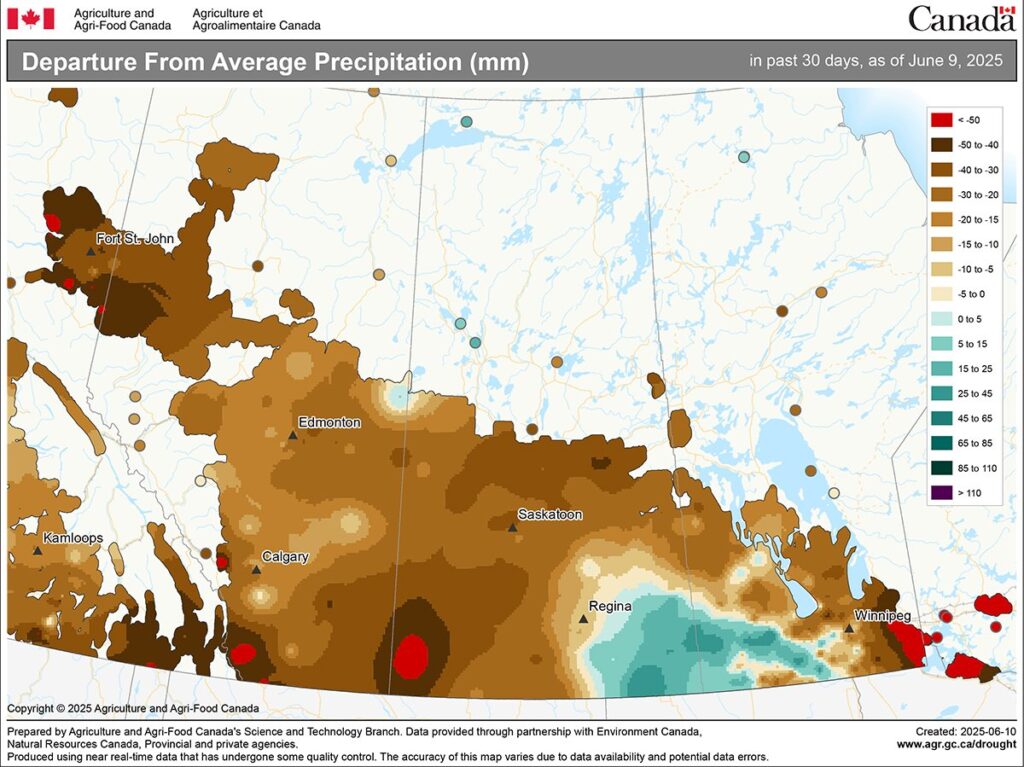
A map from Agriculture Canada’s Drought Monitor shows that the amount of rainfall between May 10 and June 9 was significantly below normal for almost the entire Prairies, with the exception of southeastern Saskatchewan and southwestern Manitoba.
Many regions received 35 to 45 millimetres less rain than typical for the period. Compounding that shortfall, April was also a dry month in places like Nipawin, Prince Albert and the Battlefords.
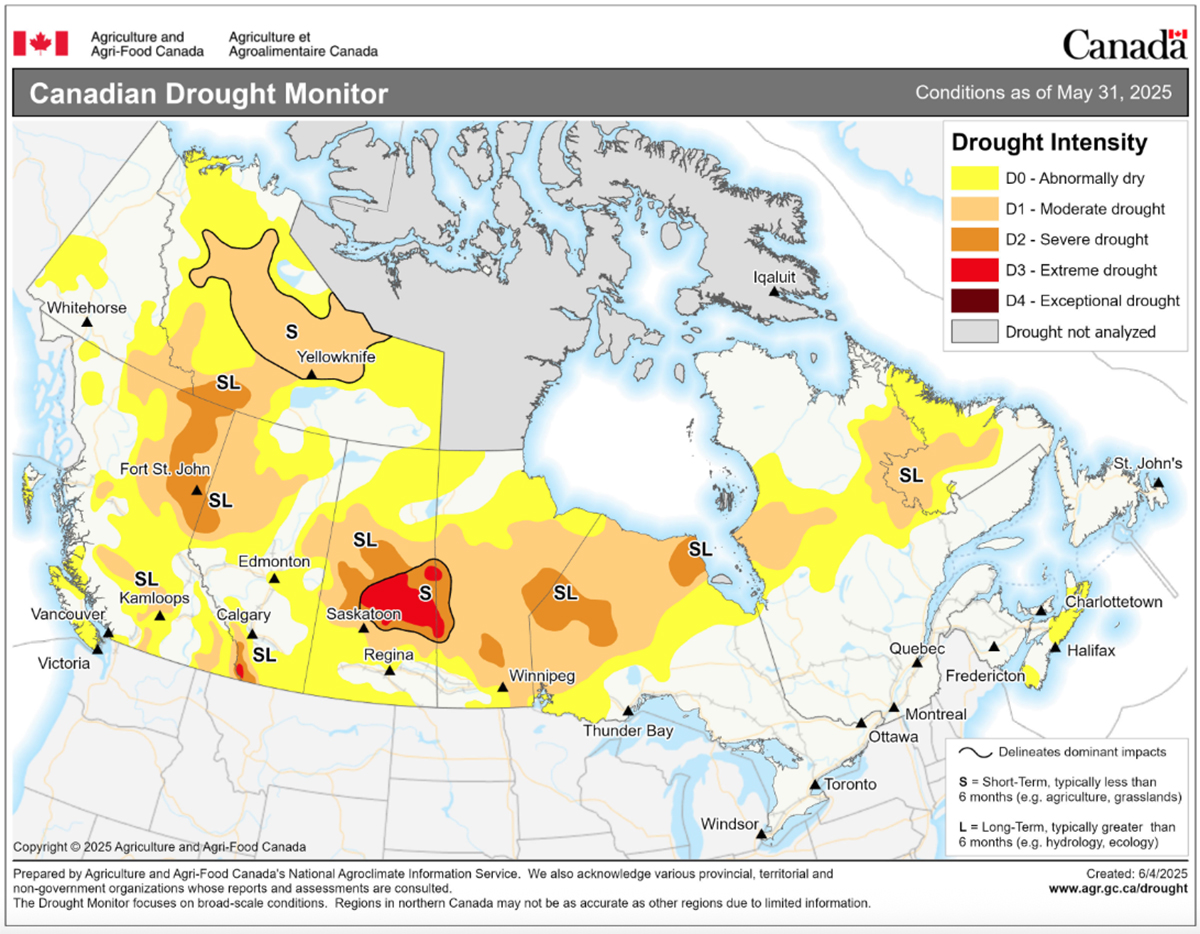
A Drought Monitor map, depicting conditions as of May 31, shows that much of the agricultural region in northeastern and north-central Saskatchewan was in an extreme drought.
The moisture situation isn’t all bad. Data from the St. Denis site indicates that deeper soils are relatively wet, Ireson said.
Probes at the site keep track of soil moisture from the surface to five metres of depth.
“These deeper moisture levels are also starting to drop, but are still within the typical range,” Ireson wrote.
“What will determine our fate is rainfall in the coming days and weeks. A wet June could still turn this around.”

Source: producer.com