
AM Market Report – November 5, 2025
GOOD MORNING…HERE IS YOUR MORNING MARKET NEWS
OVERNIGHT GRAIN TRADE
ICE canola futures are trading narrowly mixed this morning…less than $1/tonne either side of unchanged, but perhaps with a slightly positive bias. Chicago soybean futures are trading 2 to 4 cents/bu higher this morning, supported by small gains in the products (oil/meal).
Beans are seeing some modest rebound after dropping 12 cents/bu yesterday…coming back off a 16-month high this week. Considered technically overbought, the bean market was ripe for a correction lower. Traders await Chinese purchases of US cargoes following last week s trade truce agreed by the world s two largest economies.
Read Also
AM Market Report – November 4, 2025
GOOD MORNING…HERE IS YOUR MORNING MARKET NEWS OVERNIGHT GRAIN TRADE After a solid rally posted on Monday, oilseed markets are…
The White House says China will buy millions of tonnes of US soybeans under last week s agreement to de-escalate the countries trade war, but comments from Beijing remains subdued on the topic. Traders have yet to confirm large purchases of US soy supplies, while Chinese soybean importers have stepped up purchases of cheaper Brazilian cargoes.
Chicago corn futures are steady to fractionally weaker this morning…still being pressured by brokerage StoneX raising its forecast of the US corn yield slightly, a move that countered recent expectations of declining yield potential.
US wheat markets are dipping 1 to 4 cents lower this morning, but maintaining hope that Chinese interest in US wheat is developing…though traders cautioned it was unclear if any purchases have been made. I don t think anything fundamentally has changed in the wheat market that is going to push it higher on a sustained basis.
In Other News
– Budget 2025 includes trade focus, boost for agriculture risk management…Prime Minister Mark Carney s government yesterday unveiled a blueprint to counter rising US protectionism and bolster a sluggish Canadian economy through tax incentives to spur corporate investment, targeted federal spending and cuts to the public service.
Carney s first budget, presented to the House of Commons by Finance Minister Fran ois-Philippe Champagne, lays out new spending of $89.7 billion over five years and roughly $56 -billion in savings from cuts to the public service and program spending. Champagne said the budget could spur $1 trillion of investment.
The budget says the 2025-26 deficit will be $78.3 billion and is projected to drop to $56.6 billion by 2029-30.
Agriculture Sector-related Highlights:
– The budget includes about $1 trillion in investment and posts a deficit over $78 billion.
– The government set a goal of doubling non-US exports over 10 years.
– The federal government proposes to increase the AgriStability compensation rate to 90% from 80% and the payment cap per farm to $6 million from $3 million.
– The Advance Payments Program for canola will see $97.5 million spent over two years to increase the interest-free limit on advances to $500,000 for the 2025 and 2026 program years.
– Agriculture Canada will wind down, streamline or realign some of its research to better fit government priorities. Agricultural Climate Solution Living Labs will be phased out.
– Beijing lifts some tariffs on US farm goods… China will suspend retaliatory tariffs on US imports following last week’s meeting of their two leaders, including lifting duties on farm goods, Beijing confirmed on Wednesday. But imports of US soybeans will still face a 13% tariff. The State Council’s tariff commission announced it would remove the duties of up to 15% it imposed on certain US agricultural goods from November 10, while maintaining the 10% levies introduced in response to US President Donald Trump’s “Liberation Day” duties.
Investors on both sides of the Pacific breathed a sigh of relief when Trump met Chinese leader Xi Jinping in South Korea, easing fears that the world’s two largest economies might abandon talks aimed at resolving a tariff war that has disrupted global supply chains. While Trump and the White House were quick to publish their take on the meeting, the Chinese side did not immediately move to provide a detailed summary of what it had agreed.
“Broadly, it’s a great sign that the two sides are making rapid progress in putting the deal into effect,” said Even Rogers Pay, a director at Beijing-based Trivium China. “It shows they’re aligned and that the agreement is likely to hold up.” The tariff cut nonetheless leaves Chinese buyers of US soybeans facing tariffs of 13%, a cost traders said makes US shipments still too expensive for commercial buyers compared to Brazilian alternatives.
“We don’t expect any demand from China to return to the U.S. market with this change,” said one trader at an international trading company. “Brazil is cheaper than the US and even non-Chinese buyers are taking Brazilian cargoes.”
Following the Xi-Trump meeting, the White House said China would purchase at least 12 MMT of US soybeans in the final two months of 2025 and at least 25 MMT in each of the next three years. Beijing has yet to confirm those figures, and traders are watching closely for signs of large-scale purchases.
In 2024, China bought roughly 20% of its soybeans from the US, down from 41% in 2016…the year before Trump’s first presidential term, customs data showed. This year, China has largely shunned US crops from its autumn harvest due to high tariffs, costing American farmers billions of dollars in lost exports.
– US Supreme Court considers the legality of Trump s use of tariffs... All eyes are on the US Supreme Court starting this morning as it considers the legality of US President Trump s tariff actions. Justices will hear oral arguments on the legality of President Trump invoking the International Emergency Economic Powers Act. The Court of International Trade, the US Court of Appeals for the Federal Circuit, and a Federal District Court in Washington, D.C. have all ruled against the President s actions.
The (Trump) administration was not successful in the lower court or the court of appeals, says Rusty Rumley, a senior staff attorney at the US National Agricultural Law Center. They asked for an expedited appeal from SCOTUS and they received it. We don t know how long it s going to take to get a decision. It could be months and it could be more than a couple of months.
The administration has said it plans to use tariff revenue to fund trade relief payments. But, Rumley says it s unclear if the Supreme Court s final decision could impact the timing of US farmer assistance. When we had the same situation during the first Trump administration, the USDA used the Commodity Credit Corporation to fund those payments, he says. That funding right now is low. The USDA says it will not distribute any emergency relief to farmers until the government reopens.
– US government shutdown now the longest in history… The US government shutdown has become the longest in history, and with no sign of a resolution soon as its economic toll deepens. Now in its 36th day, the US federal government shutdown has surpassed the previous record set in early 2019 during President Trump s first term. Every week that passes costs the US economy anywhere from $10 billion to $30 billion, based on analysts estimates, with several landing in the $15 billion range. Depending on its length, the shutdown could lower fourth-quarter US economic growth by as much as 2 percentage points, according to the Congressional Budget Office. If the stalemate extends to US Thanksgiving week, about $14 billion won t be recovered at all, the CBO said and as reported by Bloomberg.
– India rapeseed plantings to hit record highs… India’s rapeseed planting is expected to hit a new high this year due to record Chinese buying of rapeseed meal and above-average rainfall that resulted in favourable soil moisture for the crop. As the country’s primary winter-sown oilseed, the surge in rapeseed production is also poised to help India, the world’s largest importer of edible oil, limit costly overseas purchases of cooking oils. “Farmers made great profits from last year’s rapeseed crop, so this year, they’re planting even more of it,” said Anil Chatar, a trader based in Jaipur in the northwestern state of Rajasthan.
The combined planting area for rapeseed and closely related mustard is expected to increase by 7% to 8% this year, he said. Indian farmers typically sow rapeseed in October and November. So far this year, they have planted 10.3 million acres, a 13.5% increase compared to the same time last year. The country planted 22.1 million acres of rapeseed last year, higher than the five-year average of 19.5 million acres.
There has been good demand for rapeseed oil domestically this year, while strong export demand for rapeseed meal has come from China, said B V Mehta, executive director of Solvent Extractors’ Association of India. China aggressively began purchasing rapeseed meal from India after Beijing in March imposed a 100% retaliatory tariff on canola meal and oil imports from Canada, its top supplier.
– Prairie dryness, drought likely to persist… As winter approaches, the dry conditions and drought across much of the Canadian Prairies and the US Plains will likely persist, said Drew Lerner, meteorologist with World Weather Inc. in Overland Park, Kan. Lerner said he heard stories of some Prairie farmers saying conditions are drier now than in the spring, but he chalks that up to their very localized conditions. The Prairies caught a break with sufficient rains from June to early August, he said.
We backtracked the last couple of months, and the soil is very short, Lerner added. The bottom line is that we are very dry again, mostly in Palliser s Triangle.
Aside from some light precipitation, the prospects of rectifying the dryness and drought are very poor, he said. Even the La Nina that is taking hold of weather patterns won t have much effect and the phenomenon is to peter out by the end of December. Lerner said a La Nina would most often generate above normal amounts of snow for an area that includes much of southern Alberta, as well as southwestern Saskatchewan and into central Montana. This time around that s unlikely to happen, but that area will still get some build up of precipitation.
The meteorologist said drought conditions are likely to get worse for an area stretching across west-central Saskatchewan to east-central Alberta. Added to that is the Peace country in Alberta, which Lerner noted is especially dry and has gone a full year without a lot of moisture. They re hurting like Palliser s Triangle is, he said.
As for the US, Lerner pointed to droughty conditions for much of the American Plains as the cold weather sets in. It s difficult to get enough moisture during the cold season to change the moisture profile, he said, but pointed to a bright side. There has been enough precipitation in the US for winter wheat emergence and establishment. So this is not a crisis. It s not as serious as it is in Canada, Lerner explained.
– St. Lawrence Seaway cargo volumes up… Cargo volume on the St. Lawrence Seaway totaled 24.030 MMT in the 2025 navigation season to end-September, representing a 1.2% increase from the corresponding period in 2024, according to statistics released by the St. Lawrence Seaway Management Corporation
(SLSMC), reports Maritime Magazine. A sharp drop of nearly 30% in general cargo to 1.5 MMT appeared to reflect the impact of the Trump administration’s high tariffs on steel imports. However, grain shipments continued their strong momentum, amounting to 7.5 MMT year-to-date, representing a 20% increase. Dry bulk was up 3.4%, while iron ore and coal volumes were down.
The closing dates set by the US and Canadian Seaway corporations have indicated that all ships must be clear of the MLO section by January 5, 2026, of the Welland Canal by January 10, and of the Sault Ste. Marie locks and Canal by January 15.
Outside Markets
The Dow Jones Industrial Average was pressured down 251.44 points on Tuesday to settle at 47,085.24, while the S&P 500 was down 80.42 points to 6,771.55. Early Wednesday, the December Dow Jones Futures are up 54 points.
Global stock markets are mixed to slightly weaker this morning as traders wrestled with a steep sell-off and a surge in volatility to the highest levels in months. Wall Street futures are mixed this morning after the S&P 500 and the Nasdaq yesterday suffered their biggest one-day percentage drop since Oct. 10. TSX futures are in positive territory after Canada s main stock market closed lower yesterday.?
At some point, profits need to be booked. Especially when we ve seen repeatedly solid runs to record highs, said Matt Simpson, senior market analyst at StoneX in Brisbane. Those with money on the line aren t likely seeking answers right now…they re just copying each other like kids in an exam. And the answer is to run.
The December US Dollar Index is steady at 100.105. The Canadian dollar weakened against its US counterpart…currently quoted at 70.80 US cents.
Dec crude oil futures are down $0.44 at US $60.12/barrel. Oil prices are edging lower on weaker economic data from top oil importers that weighed on prices, despite news US oil inventory data points to firmer fuel demand. Oil found some support from US data that was not as bad as feared thanks to large product inventory declines, suggesting demand was holding up.
Meanwhile, OPEC’s oil output rose further in October after an OPEC+ agreement to raise production, a Reuters survey found, though the scale of the increase slowed sharply from September and the summer months. The Organization of the Petroleum Exporting Countries pumped 28.43 million barrels per day (bpd) last month, up 30,000 bpd from September’s total, the survey showed, with Saudi Arabia and Iraq making the largest increases. OPEC+, comprising OPEC and allies including Russia, slowed the pace of its output increases for October on growing concern over a possible supply glut.
Grain Markets
Chicago soybean futures are trading 2 to 4 cents/bu higher this morning. Bean futures pulled up off early lows on Tuesday, but still closed with contracts down 10 to 13 cents across most months. Some new selling was noted, with open interest rising 16,137 contracts on the double digit losses. Soymeal futures are up $1 to $2/ton this morning after declining $3 to $4/ton to close out yesterday. Soyoil futures are mostly a modest 1 to 6 points higher this morning after losing 18 to 31 points on Tuesday.
Overnight, China suspended some retaliatory tariffs on US goods but left on a 10% tariff from the Libation Day tariff response, with the total tariffs on US soybeans at 13%. With the US government shutdown and export sales data not reported, the market is trying to gauge how much US business China has taken in the last week. Basis movement in the US northern Plains and PNW would suggest buyers have been somewhat active…though not overwhelming.
Bangladesh pledged to buy $1.2 billion worth of US soybeans and soymeal, 2.5 times as much as ever before. The purchases will take place over the next 12 months.
S&P Global estimates the US soybean yield is estimated at 53 bu/acre, compared with USDA’s September estimate at 53.5 bu and output at 4.26 billion bu, compared with USDA’s previous estimate of 4.3 billion. USDA will be out with their updated data next Friday (Nov 14).
ABIOVE, a Brazilian-based vegetable oil and biodiesel industry group, estimated Brazil’s 2026 soybean production will reach a new record 178.5 MMT.
Late US soy harvest weather and South American conditions look favorable.
Chicago corn futures are steady to a fraction of a penny weaker this morning. The corn market closed Tuesday s session with contracts down 2 to 3 cents.
S&P Global estimates the 2025 US corn yield average at 185.5 bu/acre, compared to USDA’s September estimate of 186.7 bu and output at 16.8 billion bu, nearly matching USDA’s previous estimate. USDA updates its numbers on Nov 14.
While export demand for US corn remains solid, lower prices in some competing sellers could start to cut into US global sales.
US wheat markets slipping lower this morning…led by the winter wheats down 1 to 4 cents, while spring wheat futures are losing a penny or less. The US wheat markets were mixed on Tuesday, as the soft red contracts led the charge higher, with spring wheat lagging behind…spring wheat futures closed down 1 to 3 cents.
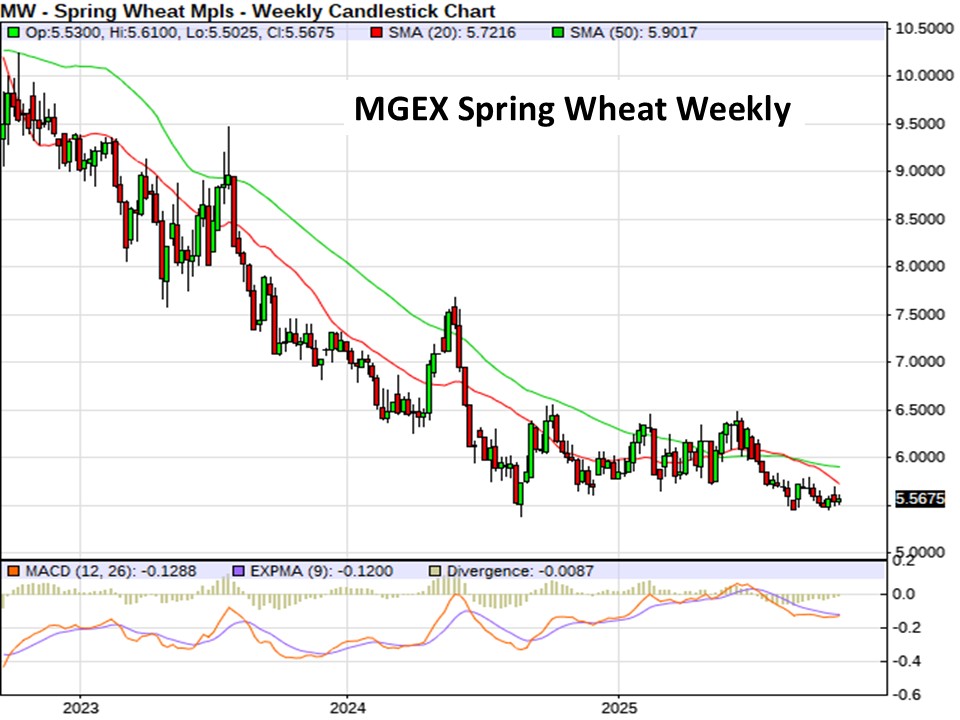
MGEX Dec spring wheat futures are down a half cent this morning at $5.57/bu after losing 2 cents yesterday. The slippage in spring wheat futures is not encouraging as it confirms the sideways trend in the market near contract low territory. The price spread between Minneapolis and Kansas City Dec contracts is around 23 cents/bu. The normal spread between the two contracts is normally in the 30 to 35 cent range. Spring wheat futures are becoming undervalued when compered with HRW contracts.
The overall wheat market continues to see some buying with reports of Chinese interest in US wheat, partially due to strengthening cash basis tracking in the Pacific Northwest, there s no confirmation business as of yet. The USDA s weekly US export sales numbers and daily sales announcements remain suspended by the now record-long partial shutdown of the US federal government.
US winter wheat development weather mostly looks good. The trade is also monitoring wheat at various stages of planting, development, and harvest in Argentina, Australia, Europe, Russia, and Ukraine.
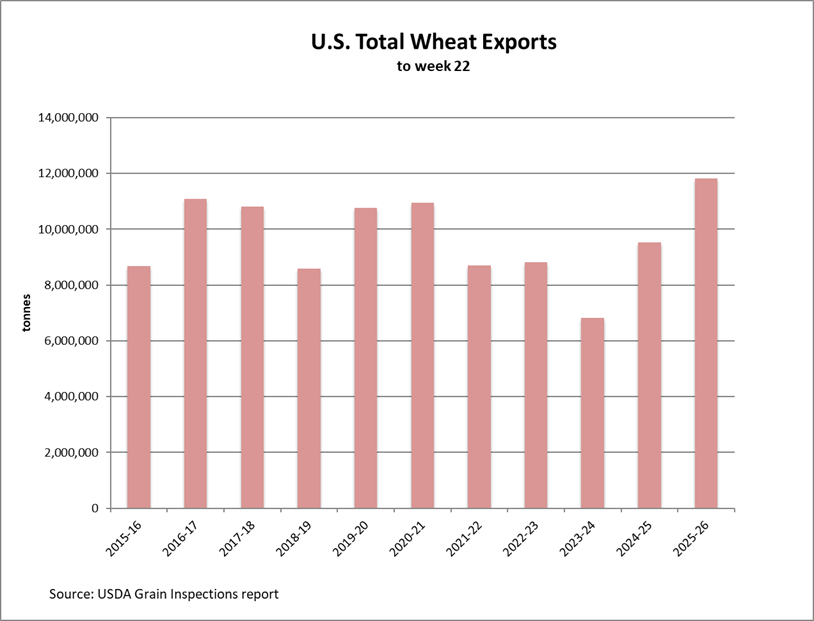
US wheat exports did improve last week as 350,293 tonnes were shipped during the week ending on October 30. That brought the total exports to date to 11.83 MMT. This is the fastest pace of wheat exports since the 2013-14 marketing year. The fast pace for wheat demand on the latest week was led by HRS and HRW wheat which accounted for 100,989 and 99,982 tonnes, respectively of the weekly exports. This indicates that wheat demand is still strong for bread wheat in Asia and Latin America.
At the same time, wheat exports from Canada are continuing at a record pace with a total of 5.12 MMT shipped by October 24. This is 12 weeks into the Canadian wheat crop marketing year, and exports are running 630,400 tonnes ahead of last year. The good news is that Canadian exports remain at a record pace. Wheat demand remains strong…not surprising I suppose with wheat being priced cheaply.
CANADIAN GRAIN MARKET
ICE canola futures were weaker on Tuesday, taking back most of Monday s gains as chart-based selling weighed on values. Losses in the Chicago soy complex accounted for some spillover weakness, although Malaysian palm oil and European rapeseed held closer to unchanged.
A lack of any significant movement on trade talks with China pressured canola values despite recent indications that relations could be thawing.
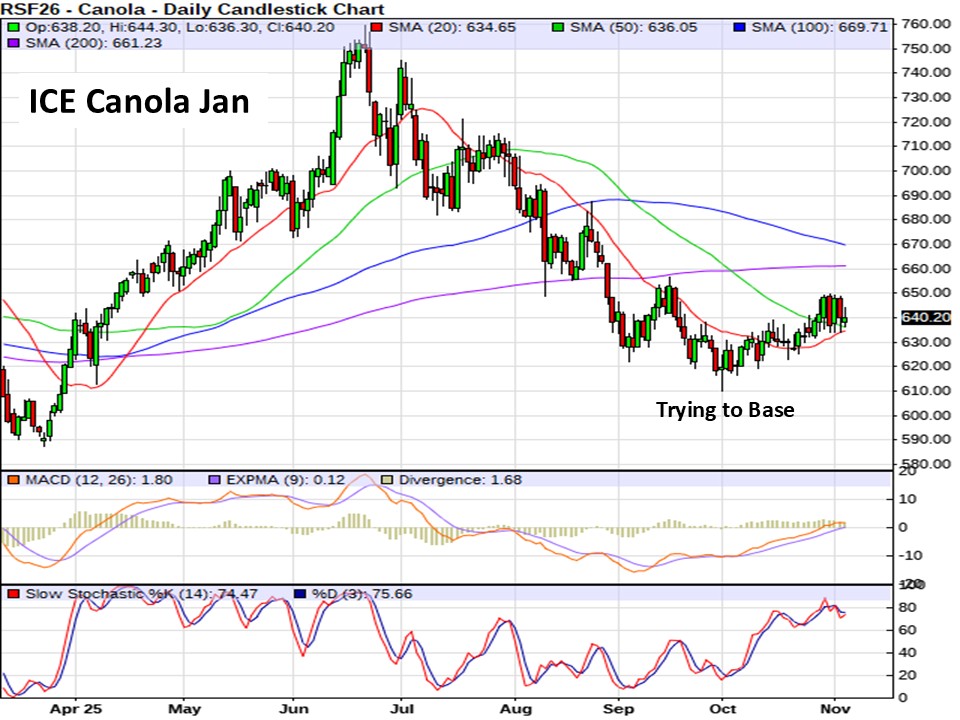
While the canola market was due for a correction from a chart standpoint, nearby technical support and values were well off their session lows at the close. The January contract briefly traded below its 50-day moving average and touched its 20-day average but settled above both chart points.
January canola futures fell $7.80 on Wednesday to close at $640.10/tonne, while Mar canola dropped $7.60 to $651.40.
For today… canola futures are starting the day narrowly mixed…less than $1/tonne either side of unchanged. Nearby Jan canola is a very modest $0.40 higher at $640.50/tonne, testing trendline chart support draw off its low posted in October, but losing bullish momentum in recent sessions in higher volatility daily trade. Both the 20- and 50-day moving averages are just below at $634 and $636, respectively. MACD and Stochastics indicators have been rising the past month, but hitting some near-term turbulence of late.
In related outside markets… CBOT soy complex futures are trading slightly higher. Malaysian palm oil is quietly lower on nagging concerns over seasonal production increases to come…down pretty hard on the month. European rapeseed is steady to quietly higher.
To access the latest futures prices, go to https://www.producer.com/markets-futures-prices/


Source: producer.com