
F&B industry meet to advance works standards in Canadian agrifood
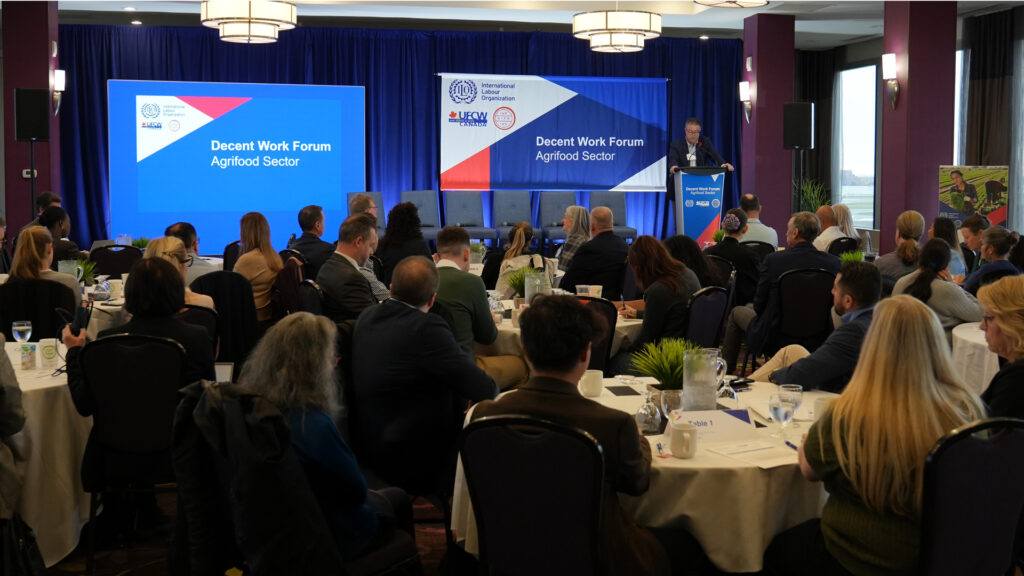
The Decent Work Forum brought together representatives from labour organizations, industry associations, F&B manufacturing companies and different levels of govt.
Representatives from labour, industry and government in the agrifood sector met in Toronto on Nov. 5 to discuss the future of decent work in the sector in Canada, building upon the model of social dialogue recommended in the International Labour Organization’s (ILO) Decent work guidelines for the agrifood sector.
Hosted in conjunction with the International Union of Food, Agricultural, Hotel, Restaurant, Catering, Tobacco and Allied Workers’ Associations (IUF), the event brought together representatives from Canada’s agrifood employers, the federal government, and the food workers’ union as social partners.
In 2023, the International Labour Organization (ILO) released the Decent work guidelines for the agrifood sector, calling for organizations to host events, foster dialogue, and advance the guidelines. The first-of-its-kind dialogue was held in May 2025 by UFCW Canada.
ILO defines Decent work as a summation of the aspirations of people in their working lives, including productive employment, fair income, security in the workplace, personal development, freedom and equality, and fundamental labour rights.
“This forum is an opportunity to bring together all major stakeholders across the food sector to advance an agenda for safe, healthy and sustainable food systems across the country,” said UFCW Canada national president Barry Sawyer. “How can a food system be safe and healthy if the workers across the system feel insecure, disadvantaged, or disempowered? A sustainable food system must be just for all. A sustainable system must account for food worker justice from field to table if it is to be truly sustainable.”
In additional to international representatives from IUF and the ILO, Canadian labour voices included the Canadian Labour Congress, the Bakery, Confectionary, Tobacco and Grain Millers Union (BCTGM), the United Steelworkers (USW), and UFCW local union leaders from across the country.
Industry representatives included Loblaws, Maple Leaf Foods, Clearwater Seafood, Food and Beverage Canada, and Highline Mushrooms.
Representatives from Employment and Social Development Canada, Agriculture and Agrifood Canada, the Ontario and B.C. labour ministries, the Future Skills Centre, and Food Processing Skills Canada were also present.
“It’s incredibly important when we’re talking about food and beverage manufacturing to make sure that we have a stable and secure food supply chain,” says Kristina Farrell, CEO, Food and Beverage Canada. “We need to make sure that all employers are making sure that we have decent work, that we’re following the principles from today, that we’re doing whatever we can to retain employees, but also to make sure that we continue to attract new workers to our industry, to make sure that we can continue to secure our food supply chain.”
Dr. Elvis Beytullayev of ILO led sessions on recent developments regarding decent work in the agrifood sector while Dr. Raluca Bejan from Dalhousie University presented findings on research examining the conditions of decent work within Canada’s agrifood sector. Other sessions focused on supply chain transparency, legislation, responsible business conduct, and human rights.
Panel discussions included challenges faced by migrant workers in the agrifood sector and the necessity of a permanent pathway to permanent residency for migrant agrifood workers.
Source: www.foodincanada.com