
Verticillium extends its reach across Prairies
WINNIPEG — A few years ago, verticillium stripe was mainly a Manitoba problem.
Those days are over.
The fungal disease has now spread across Western Canada, and most canola growers should be concerned, says Saskatchewan’s provincial plant pathologist.
Read Also
Canada needs strong global lentil demand in 2025-26
Turkey harvested the third smallest red lentil crop on record. Hopefully that boosts import demand because Canada is going to need it.
“This disease is no longer a Manitoba problem. It’s a Prairie-wide issue that needs to be tackled and managed,” said Alireza Akhavan.
In early November, Akhavan was in Winnipeg for the Western Forum on Pest Management, where he reported on the oilseed disease situation on the Prairies.
He shared data from the canola disease survey in Manitoba, where verticillium stripe was found in 73 per cent of canola fields and an average incidence (plants with symptoms) of 41 per cent.
Akhavan didn’t provide numbers for Saskatchewan, but it’s obvious verticillium is present throughout the province.
“Last growing season … we had one-third of the surveyed crops in Saskatchewan lab confirmed with verticillium stripe,” Akhavan said.
“They (detections) were right across the province, as far west as the RM of Maple Creek (on the border with Alberta).”
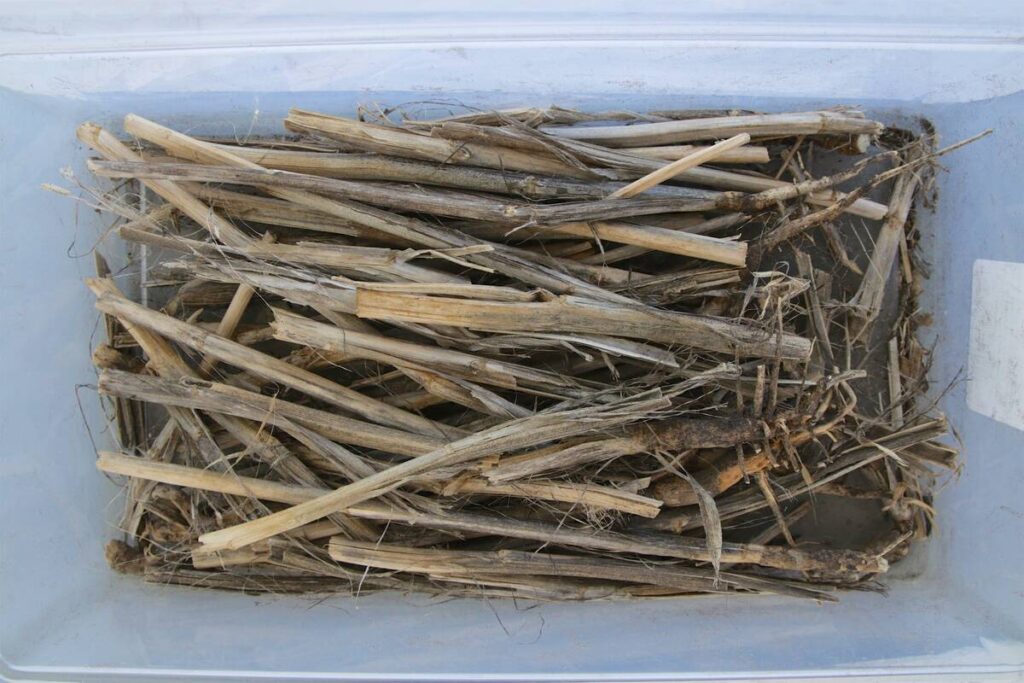
Verticillium stripe interferes with a plant’s uptake of water and nutrients. Symptoms include early ripening, plant stunting and leaf chlorosis and shredding or striping of the stem tissue. The symptoms usually appear later in the growing season.
In 2025, the canola disease survey looked at 201 fields in Saskatchewan.
Samples with suspected verticillium have been sent to a lab, and results will be available at a later date.
Early reports suggest verticillium symptoms are commonplace.
“Just looking at our data, I can say 25 per cent of our fields had some sort of suspect symptom,” Akhavan said.
“But we will wait for the lab to get back to us.”
Akhavan’s oilseed disease report also did not contain detailed data for verticillium levels in Alberta, but did include information from the Alberta Plant Health Lab:
From Sept. 1, 2024, to Aug. 31, 2025, the lab received 497 canola samples for disease testing.
Of those, verticillium stripe was detected in 52 samples, or 10.5 per cent.
Verticillium was first confirmed in Manitoba in 2014, and canola experts are still trying to understand its impact on yield.
What is known is that blackleg (another fungal disease) and verticillium seem to work together. When blackeg and verticillium are present in canola, the fungal diseases join forces and yield losses are higher.
Blackleg
The Saskatchewan canola disease survey found that blackleg was present in 83 per cent of fields in 2025. In terms of prevalence, 11 per cent of plants were infected in a field.
Those numbers are much lower than 2024, which was a horrific year for blackleg in Saskatchewan.
Last year, 93 per cent of canola fields had blackleg symptoms and 23 per cent of plants were infected, both all-time highs.
A lack of rainfall in Saskatchewan this spring likely kept the disease in check.
“With a dry June, our (blackleg) numbers got back to what we are used to,” Akhavan said.
In Alberta, blackleg levels were higher than Saskatchewan. Results from the canola disease survey, of 395 Alberta fields, found that:
Blackleg was present in 98.2 per cent of fields.
The disease incidence (percentage of infected plants) was 44.7.
“Prevalence of all measured canola diseases was slightly higher in 2025 compared to the previous year,” said Akhavan’s report presented in Winnipeg.
Despite the spread of verticillium and higher disease levels in Alberta, canola yields may have reached record levels in 2025.
The average canola yield in Saskatchewan was 42.4 bushels per acre, said the final provincial crop report for 2025.
The average yield in Alberta was 42.6 bu., said the Oct. 7 crop report, and Manitoba yields will likely top 45 bu. per acre.
If the numbers hold up, average yield will break the 42.3 bu. record from 2016.

Source: www.producer.com