

Dry June kept Prairie cereal diseases in check
WINNIPEG — The numbers aren’t finalized, but 2025 was likely a below average or normal year on the Prairies for fungal leaf diseases in wheat, barley and other cereal crops. Dry weather this spring in many growing regions of Western Canada was likely a factor.
“What really cycles the (disease) epidemics … is rainfall and relative humidity,” says Kelly Turkington, a plant pathologist with Agriculture Canada in Lacombe, Alta.
”Often, it’s all about timing.”
Read Also
Initiative offers ‘Yellow Pages’ for agricultural research
Collaborators behind a newly launched agriculture database project hope to make research more accessible, accurate and less isolated.
May and the first few weeks of June were especially dry in many regions of Western Canada, especially Saskatchewan’s northern grain belt.
For example, farmers and crop production advisers in western Saskatchewan were concerned in June about the lack of rain and how leaves were turning brown on some cereal crops.
The dry weather may have put a damper on cereal crop diseases in some geographies because early season infections tend to cause more damage, said Turkington, who reported on the cereal disease situation on the Prairies at the recent Western Forum on Pest Management in Winnipeg.“(The) leaf diseases, including the rust, if they become established prior to head emergence, or prior to flag leaf emergence, that’s when you’re going to see the 20 to 40 percent yield loss (from rust),” he said.
“But if that disease development is slow… and (happens) after head emergence … it doesn’t have enough time to work its way up onto the upper canopy leaves.”
Turkington’s cereal disease situation report didn’t contain any alarming language.

Some comments suggested that diseases were less of a problem in 2025.
“Overall barley fungal leaf disease levels in 2025 were lower than in previous years, while generally trace levels were observed for head and rust diseases,” said the report for Alberta.
“Bacterial leaf streak was observed in five of the 201 fields surveyed.”
However, Turkington is concerned about one disease in wheat and barley — powdery mildew.
“I’ve been in too many fields, in recent years, in central Alberta where powdery mildew (is a problem) in cereals.”
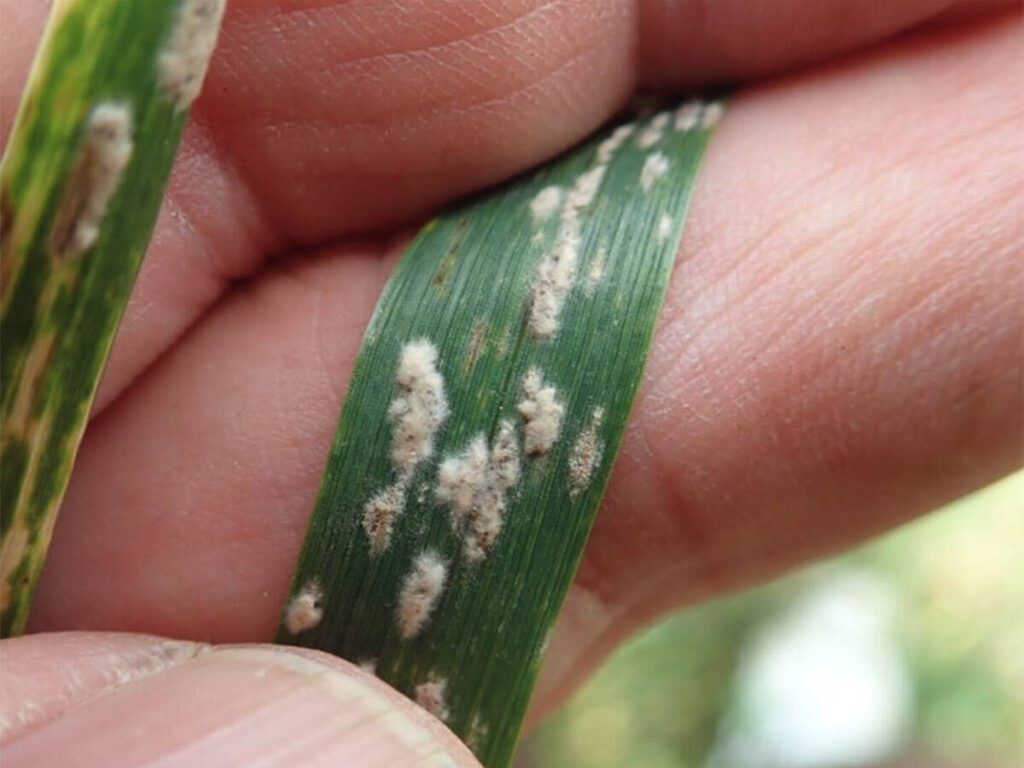
Powdery mildew of cereals is caused by a fungus called Blumeria graminis. It can produce yellowish spots on leaves with whitish/grey fuzzy masses of on the upper side of the affected leaf tissue.
In late June, the Prairie Disease Crop Monitoring Network received reports of powdery mildew in spring wheat crops around Lacombe and Ponoka, Alta.,
Historically, it’s been more a problem in winter wheat.
“We’re seeing more and more of it in spring wheat, in June and July. It’s obviously affecting the crop throughout the canopy,” Turkington said.
The fungus survives on crop stubble into the next growing season, in a form called a cleistothecia, a fruting body with spores inside.
Fungicides are effective against powdery mildew, but an untreated infection can affect photosynthesis and will drag down wheat yields.
“Maybe at moderate levels, we’re looking at the 20 to 40 percent (yield loss) range,” Turkington said.
In parts of Australia where powdery mildew is a chronic problem, estimates suggest an early-season infection can reduce wheat yields by 25 per cent, says a Government of Western Australia factsheet.
The fungal disease is on Turkington’s radar, but he’s unsure why it’s becoming more common in Alberta’s wheat fields.
“I don’t know if it’s weather related,” he said, noting it’s a disease that doesn’t require a lot of moisture.
“Sulfur deficiency might be one piece of the puzzle.”

Source: producer.com