
Organic yield data depends on the source
WINNIPEG — A farmer who grows organic field crops will achieve 118 per cent higher profits than a farmer who grows conventional crops.
That claim comes from a report published this fall by the Canadian Organic Growers called Cultivating the Organic Opportunity for Canadian Farmers and Consumers.
Related story in this issue: Is organic more profitable?
Read Also
Is organic more profitable?
An organic farmer’s observation is vastly different from a Canadian Organic Growers’ report that claims farmers can make large profits from organic field crops.
About 30 organic researchers, farmers and other experts were part of a task force that wrote the report, which argues that organic agriculture improves farm profitability and is good for Canada’s economy and the environment. As a result, the federal government should spend more money to encourage organic farming.
“The report recommends an annual investment of $68.5 million to triple and enhance organic agriculture in Canada.”
Why it matters: Organic agriculture could be more profitable, but a lot depends on realistic assumptions about yield.
To make its case for organic, the task force studied the financial returns from 10 organic and conventional field crops, including cereals, pulses and oilseeds.
They looked at the yields, production costs and price data for organic field crops and conventional crops.
After doing the math, they concluded that organic field crops generate 118 per cent higher profits.
The reason? Higher prices for organic crops and competitive yields.
The 118 per cent figure does come with a caveat.
Their analysis concluded that organic corn has 637 per cent higher profits than conventional, which inflates the overall returns.
“When corn is excluded, the average increase in net returns for organic field crops is 59 per cent,” says a footnote in a data table within the report.
Whether the returns are 59 or 118 per cent higher, the economic analysis is based on organic yields that could be higher than real world yields in Canada.
The task force got its yield data from a European report comparing organic and conventional cropping.
“Yield assumptions were based on Boschiero et al. (2023)’s global dataset since no comprehensive dataset exists for Canada by crop” says a footnote in the Canadian Organic Growers report.
“But these assumptions are in line with the sporadic Canadian data that does exist.”
With the global data as a guideline, the task force made the following estimates for Canadian organic yields:
- spring wheat – 75.9 per cent of conventional
- corn – 90.7 per cent
- flaxseed – 76
- oats – 71.4
- barley – 75
- rye – 76
- soybeans – 77
- peas, chickpeas and lentils – 57 per cent
The Western Producer asked the Saskatchewan Crop Insurance Corp. to collect its organic yield data for four crops: spring wheat, oats, flax and peas. The selected time period was 2020-24.
Saskatchewan was chosen because SCIC has a crop insurance program for organic producers and the province has the largest share of organic field crops.
In 2020, Saskatchewan had about half of the organic crop acreage in Canada.
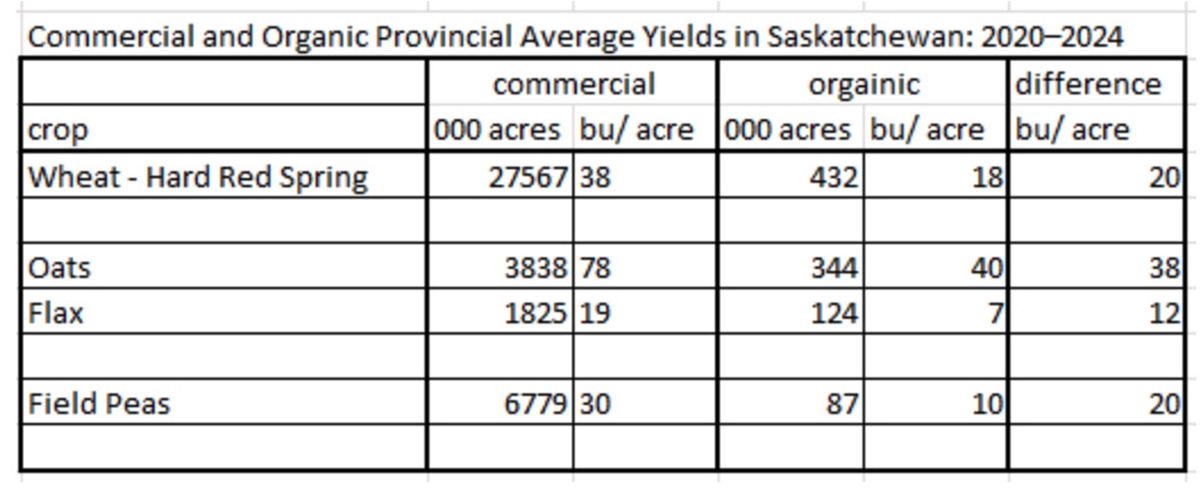
SCIC provided data that represents average yields across five years:
- Organic spring wheat — 18 bushels, 47.4 per cent of conventional yields of 38 bu.
- Organic oats — 40 bu., 51.2 per cent of conventional yields of 78 bu.
- Organic flax — 7.0 bu., 37.0 per cent of conventional yields of 19 bu.
- Organic peas — 10 bu., 33 per cent of conventional yields of 30 bu.
The yield numbers are skewed lower for both organic and conventional because of the severe drought of 2021 and extreme summer heat in 2024.
Nonetheless, SCIC said organic crop yields in Saskatchewan are half of conventional production or less.
“In general, organic cereal yields are 50 per cent to 60 per cent of commercial,” SCIC said in an email.
“Organic yields for oilseeds and pulse crops are 35 per cent to 40 per cent of commercial yield.”
Manitoba Agricultural Services Corp. publishes organic yield data on its website, and data from 2017-24 produced results that were comparable to Saskatchewan but on fewer acres.
Organic spring wheat was 23 bu. per acre, oats 37.5 bu., flax 10 bu. and peas 10.3 bu.
The difference in Manitoba’s data is that the yield gap between organic and conventional is larger than Saskatchewan. For spring wheat it was nearly 40 bu. per acre and for oats it was 70 bu.
Are crop insurance yields accurate?
For years, organic industry leaders have questioned crop insurance data, saying it doesn’t include yields from the top end of organic growers.
A paragraph in a 2024 report from the Organic Council of Ontario summarizes that thinking: “It is a widely held notion within the organic industry that yields from organic insurance programs are lower than total organic yields … though there is no published information to support this,” the report says.
“It is thought that less experienced organic farmers use organic insurance to manage risk on all eligible cropland, while more experienced organic producers enrol only higher risk fields…. They use lower cost conventional insurance coverage for less risky fields. This behaviour would effectively push down the yields in organic insurance programs.”
The crop insurance data from Saskatchewan suggests this argument is feasible. In five crop years, organic farmers insured 776,000 acres of spring wheat and oats.
It’s very likely that Saskatchewan had more acres of organic spring wheat and oats between 2020-24.
It’s difficult to say how many acres and what percentage was enrolled in crop insurance because organic data is often two or three years out of date.

Source: www.producer.com