

AM Market Report – November 25, 2025

ICE canola futures are trading $1 to $3/tonne lower to start this morning, weakening along with world vegoils and crude oil. Chicago soybean futures were tipping slightly weaker in overnight trade, but in the past hour have turned higher, now posting 1 to 4 cents/bu gains…pulled up by soymeal.
CBOT corn futures are up 1 to 2 cents.
US wheat markets are mixed…trying to stabilize prices…winter wheats slightly higher, but spring wheat steady to 2 cents lower. Bearish chart signals remain in the wind on strong global supplies and falling Russian wheat prices.
Monday’s trade quickly absorbed strong weekly USDA export inspection figures for US corn and wheat, although bookings were weak for soybeans. The market did receive positive news about China purchasing another load of US soybeans…but much more business needs to step up to meet seemingly over-optimistic Chinese purchasing targets set out by the Trump administration.
Record US harvests and favorable growing weather in South America keep a large supply overhang on trade sentiment.
In Other News
– Russian wheat export prices ease again… Russian wheat export prices slipped further last week amid high global supply, but analysts said they do not expect this trend to intensify significantly. The price for Russian wheat with 12.5% protein content for free-on-board (FOB) delivery in late Dec/early Jan was US $228/tonne at the end of last week, down $1 on the week, said the IKAR consultancy. However, the price is unlikely to fall far from these levels, IKAR says, noting that Russia is unlikely to be willing to sell substantial volumes at even lower prices.
The SovEcon consultancy estimated the price for Russian wheat with 12.5% protein content at $229 to $231/tonne FOB compared to $232 to $233/t FOB in the previous week.
– Saudi buys 300,000 tonnes of wheat… Arabia’s main state wheat buying agency, the General Food Security Authority (GFSA), said on Monday it had purchased 300,000 tonnes of wheat in a tender. The purchase involved hard wheat with 12.5% protein content for arrival in Saudi Arabia in February and April 2026. Origins offered were the European Union, Black Sea region, North America, South America and Australia with the sellers having the option of selecting the origin supplied. European traders expected the wheat to be sourced from the Black Sea region including Russia and Romania, although some cheap new crop wheat from Argentina could also be supplied.
“Prices awarded look aggressively low, around $7 to $8/tonne below replacement prices in the market, possibly showing anticipation prices could fall in the first quarter of the New Year because of large global wheat supplies,” one trader said.
– China soyoil exports surge… China s exports of soybean oil to India have risen sharply as weak domestic demand coincides with robust imports of soybeans from South America, and more recently the US, reports Bloomberg. China shipped a record 70,877 tonnes of the cooking oil in October, according to customs data, most of which went to India. Exports in the first 10 months of the year reached 329,000 tonnes, almost triple what they were for all of 2024.
China has long viewed its dependence on foreign soybeans as a vulnerability in a world where geopolitics and viruses can quickly disrupt commodity flows. However, robust imports from South America are hitting a tepid local economy, forcing Chinese soyoil processors to seek new markets.
The trade makes logistical sense for India, said Aashish Acharya, a vice president at Patanjali Foods Ltd., one of the country s top vegetable oil buyers. Chinese bean oil is trading at a discount of US $10 to $15/tonne to that from South America and can reach India s east coast in about 10 to 12 days, compared with the 50 to 60 day journey from Brazil and Argentina, Acharya said. China is the world s biggest producer of soybean oil, producing around 20 MMT a year.
– USDA expects deals on US farmer aid within weeks… The Trump administration expects to announce an aid package for US farmers within two weeks, says US Agriculture Secretary Brooke Rollins, without providing further details. Trump officials has said for months that it would issue subsidy aid for American farmers hit by low crop prices and trade disputes, but has not yet issued any plan or amount for the aid. US farmers lost billions in soybean sales this year as top buyer China turned to Brazil and Argentina amid tense trade talks with Washington. “We’ll have an announcement probably in the next week or two on what that’s going to look like,” Rollins told CNBC of the farmer aid. The American Farm Bureau Federation said on Monday that the aid is “urgently needed” as farmers face the compounding pressures of higher input costs and lower crop prices.
– Canada recession watch... Over the past few months, a single question has loomed over the economic landscape: Is Canada slipping into a recession? As the trade war bit deeper over the summer, the Canadian economy stalled. The unemployment rate climbed and economic growth repeatedly dipped into negative territory. The truth is, Canada has been on the precipice of a recession for months now.
A recession is usually defined as two back-to-back quarters of negative growth. Put another way, if the economy has contracted over a period of six months, we call it a recession. Over the second quarter (April, May and June), Canada’s economy contracted 1.6%. July posted 0.3% growth, which was better than expected. In August, those gains were reversed (which was much worse than expected).
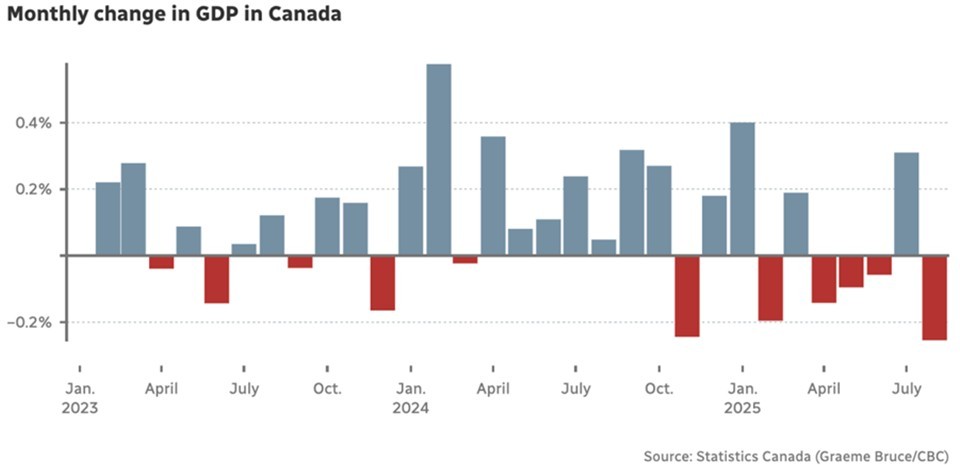
On Friday of this week, we will get GDP numbers for September. That’s the final month of the third quarter (July, August and September). If the September numbers show the economy contracted, we will officially be in recession territory. If the economy expanded, even a little, we will have probably avoided a recession.
Outside Markets
The Dow Jones Industrial Average finished 202.86 points higher on Monday to settle at 46,448.27, while the S&P 500 jumped 102.13 points to 6,705.12. Early Tuesday, the December Dow Jones Futures are up a modest 13 points.
US stock index futures are taking a bit of breather this morning…mixed…as investors turned cautious ahead of today s release of US economic data, even as expectations of Federal Reserve interest rate cuts rose. But Canada s TSX stock index futures are higher, as are European stock markets.
US markets await the release of a US producer inflation report and retail sales figures following the longest ever US government shutdown, which left markets and the Fed navigating a data gap.
The December US Dollar Index is down 0.217 at 99.855. The Canadian dollar weakened against its US counterpart…currently quoted at 70.93 US cents.
Jan crude oil futures are down $1.22 at US $57.62/barrel. Oil prices are weaker amid concerns supply will exceed demand next year, which outweighs worries that Russian shipments will remain under sanctions as talks to end the Ukraine war remain inconclusive.
Grain Markets
Chicago soybean futures are trading mostly 1 to 4 cents/bu higher this morning…nearbys leading…showing some comeback from slightly weaker trade through parts of the overnight session. Bean futures ended lower on Monday, with contracts down 1 to 2 cents in the nearbys, though some strength in some deferred 2026 contracts. Soymeal futures are up $3 to $5/ton this morning. Soyoil futures are down 43 to 45 points right now…steadily eroding to the fall season lows.
USDA reported a private export sale of 123,000 tonnes of US soybeans to China this morning. Last week…China bought 1.584 MMT of US soybeans.
Traders are still hoping for substantially more Chinese buying as US officials said China had agreed to buy 12 MMT by the end of this year after US President Donald Trump met with Chinese President Xi Jinping. The White House on Monday confirmed Trump and Xi had spoken by phone but gave no details about the call.
US Agriculture Secretary Brooke Rollins said on Monday that the Trump administration expects to announce a subsidy aid package for US farmers within two weeks and a deal on Chinese soybean purchases, but did not provide further details.
Meanwhile, Brazilian soybean pricing remains cheaper than US origin supply and the economically logical choice for most importers.
Chicago corn futures are up 1 to 2 cents this morning. The corn market ended Monday steady to 2 cents lower in the front months.
USDA tallied US corn export shipments at 1.63 MMT during the week ended Nov 20. That was 20.98% below the week prior, but up 61.78% from the same week last year. US marketing year exports for 2025/26 are now 17.483 MMT since Sept 1, which is now a staggering 72% above the same period last year. Corn inspections in 2025-26 are running well ahead of USDA’s estimated pace.
However, the big drop for US cattle placements into feedlots in the recent on feed update from the USDA is a bearish sign for livestock feed usage, as it implies a light supply of ready cattle mouths to feed through at least spring 2026.
Traders are monitoring the late US harvest and South American planting and crop development conditions during this US holiday shortened week.
US wheat markets are mixed this morning… Minnie spring wheat futures are steady to 2 cents lower, but the winter wheats HRW are gaining 1 to 2 cents. The US wheat complex posted mixed in Monday s price action, with the winter wheats leading the charge lower and spring wheat holding up (finishing steady to 3 cents in the green on the day).
USDA s US export inspections report showed a total of 474,530 tonnes of US wheat shipped in the week of Nov 20. That was 92.48% above the week prior and 29.68% larger than the same week last year. US marketing year wheat exports now total 12.84 MMT since June 1, up 19.65% over the same period last year.
Traders continue to watch harvest activity in Argentina and Australia, along with winter wheat crop development weather in Europe, Russia, and Ukraine. Wheat is also waiting to see what happens in negotiations to end Russia s war on Ukraine, which could shift export movement out of the Black Sea.
CANADIAN GRAIN MARKET
ICE canola futures closed with modest gains on Monday amid weakness in the Canadian dollar. Declines in Chicago soybeans and soyoil undermined canola, with European rapeseed and palm oil providing no clear direction. Crude oil was a bit higher on the day, but still trending lower longer term.
January canola finished Monday up $3.10 at $644.20/tonne, and March was $3.30 higher at $657.
For today… canola futures are trading $1 to $3/tonne lower so far this morning…following the bearish tone being set by weaker world vegoils and crude oil. Jan canola is off $1.70 at $642.50/tonne…holding just below its 20-day moving average ($645) but above its 50-day ($637). The uptrend line drawn off the early October low is maintaining chart support…but it is being tested.
Malaysian palm oil futures have tumbled overnight and pressing its lowest price levels in 5 months as slow exports during the first half of November add to the weight from declining soyoil and diesel prices. European rapeseed futures are leaking lower this morning.
To access the latest futures prices, go to https://www.producer.com/markets-futures-prices/
Source: producer.com