
Calgary company inks deal with United Arab Emirates
Glacier FarmMedia – Sultech Global Innovation Corp., a Canadian agricultural technology company, has signed a memorandum of understanding with ADNOC Sour Gas to bring commercially proven next generation micronized elemental sulphur to the United Arab Emirates.
The agreement was signed earlier this month at ADIPEC, an international oil, gas and energy conference held in Abu Dhabi every year.
Groups affiliated with the signing were members of Sultech Global, ADNOC Sour Gas and representatives from the Alberta government, the Embassy of Canada to the United Arab Emirates and Calgary Economic Development.
Read Also

European Union’s deforestation delay bad news for canola
The European Union’s deforestation regulation may be delayed by another year. The regulation has the potential to boost canola oil consumption.
Murray MacKinnon, chief executive officer of Sultech, said research on micronization started more than 14 years ago but was shelved.
“Fourteen years, there was a report that came as research out of Australia and with Imperial Oil,” said MacKinnon, who is based in Calgary.
After many years, the research was revived, and Sultech started using it to micronize elemental sulphur.
“If you can make elemental sulphur small enough, it can supply nutrients in a timely manner to crops,” he said.
The smaller the particle of sulphur, the more it can cover in an increased surface area. It can also dissipate quickly.
Sulphur is a byproduct of the sour oil and gas industry. Micronized sulphur can deliver faster oxidation, greater nutrient availability, and lower greenhouse gases compared to traditional fertilizers.
Micronized sulphur can be used to address sulphur deficiencies in soils and improve crop yields, protein content and fertilizer efficiency while reducing nutrient losses to waterways.
Under the MoU, Sultech and ADNOC will conduct a feasibility study and create a pilot production facility, which will handle the first 50,000 tonnes to be used in the region.
The production facility will be the United Arab Emirates’ first commercial micronized sulphur manufacturing facility. The project will integrate Sultech’s patented micronization process within ADNOC’s sulphur granulation at the Shah Gas Plant, the world’s largest ultra-sour gas operation.
“We’re doing it as a pilot, as a test to see uptake, effectiveness and all that. And if it’s going to continue to grow, then they’re going to support the growth of us,” he said.
Another part of the pilot involves seeing how the micronization process will work in the heat of the United Arab Emirates, while the third part involves Sultech collaborating with universities in the United Arab Emirates to see if the product delivers the same as it does in Alberta.
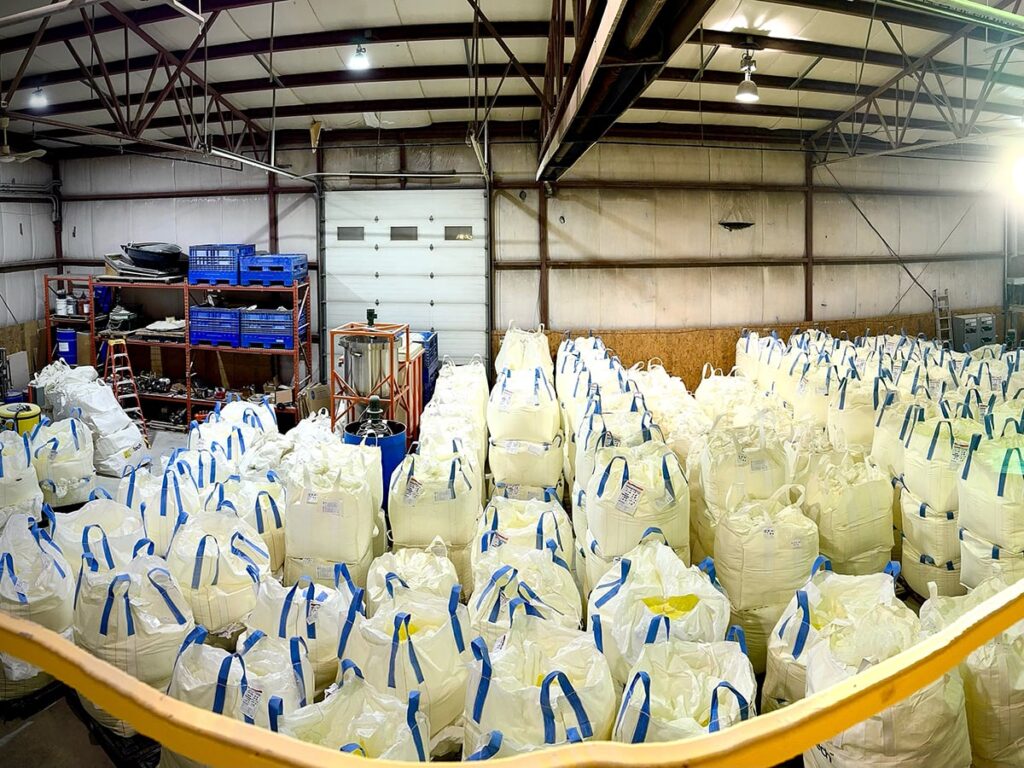
Sulphur can be explosive and dangerous, so Sultech conducts all its processes in water. When the product is complete, it has 10 per cent surface moisture, so it doesn’t dust and is safe to handle.
“Our biggest goal was a way to make micronized sulphur safely and be able to store it and move it safely and not have a problem with dusting,” said MacKinnon.
Sultech had one of the first elemental sulphur products that could match the performance of synthetic sulfate fertilizers in a normal year. It can perform well in dry and wet years.
Members of ADNOC toured Sultech’s plant in Crossfield, Alta, in September 2025 and were pleased with the facility and the product.
In July 2024, Emissions Reduction Alberta awarded $5 million to Sultech to help it build a bigger commercialized facility.
A group called Cleantech out of London wanted to find companies working with sulphur, using low greenhouse gas emissions. They invited Sultech to participate in what they called the sulphur challenge at ADIPEC last year, which Sultech won.
MacKinnon said ADNOC, the largest oil and gas company in the United Arab Emirates, was impressed. It wants to move away from shipping bulk sulphur piles from the port of Vancouver.
There are numerous bulk piles that people want to move around the world, but Sultech wants to do a value-add, which made it more appealing to ADNOC.
MacKinnon said the partnership with the United Arab Emirates is a good one because there is a huge market for Sultech’s products.
Some of Sultech’s product is used strictly as a plant nutrient in crops that need sulphur, including canola, pulses, legumes, yellow peas and potatoes.
The company has also done research in the United States to see how their micronized sulphur works with soybeans and corn. Some of Sultech’s products are used in forage crops, such as alfalfa. An equivalent amount of Sultech’s product goes into soil amendments.
MacKinnon said irrigation in some areas has started to raise soil PH because hard water contains a lot of calcium.
“We’re having similar problems down in St. Mary’s and the Bow River irrigation areas (in Alberta) because of all that good calcium that comes out of the Rocky Mountains,” he said.
The company has a product called SulGroTM65, which lowers soil PH, whether it is caused from calcium or sodium.

Elemental sulphurs help with soil remediation, and people in the United Arab Emirates have been working with it already.
“There’s a program that’s called MIITE, which stands for ‘Make it in the Emirates,’ ” said MacKinnon.
The country has companies and facilities and is working on value-add for products.
Sultech’s products could be beneficial in the Middle East because a lot of the region’s water is desalinated, but it still contains a lot of sodium, which builds up in the soil over time. Using Sultech could help restore the balance in the soil.
The company is currently working on building a new, bigger commercial facility in Alberta but hasn’t announced the location yet.
Funds from Emissions Reductions Alberta enabled Sultech to buy some of the equipment that’s going into the new Alberta facility. Some of the funds are invested in the cost of the facility so that Sultech can increase production and keep up with orders.
Countries in the Middle East are trying to stop selling raw resources and are following what is happening in Canada with value-added, said MacKinnon.

Source: producer.com