
AM Market Report – November 26, 2025

ICE canola futures are edging a modest $1/tonne higher to start this morning, posting a third straight day of grinding gains and pushing back above its 20-day moving average.
Chicago soybean futures are narrowly mixed this morning, though the nearby contracts are fractionally to 2 cents/bu higher. Bean futures ended higher on Tuesday in a day of range-bound trading after comments by US President Donald Trump s administration bolstered expectations of further Chinese purchases under a bilateral trade truce.
CBOT corn futures are fractionally to 2 cents higher. US wheat markets are higher as well… Minnie spring wheat futures rising 2 to 4 cents and winter wheats fractionally to 2 cents higher.
Wheat and corn markets ticked higher on Tuesday, recovering from losses since late last week, but still traded within relatively narrow ranges. But gains in wheat markets remain constrained by falling Russian prices, harvesting of big crops in Argentina and Australia, and results from a Saudi import tender on Monday that keeps attention on strong competition in a well-supplied wheat market.
Expect a quieter trading day in the grain futures markets, as many US traders will hit the exit doors early to get a jump on the American Thanksgiving Day holiday on Thursday. North American grain futures will trade normal hours today, but US markets are closed Thursday and will also close early on Friday. Canadian markets trade normal hours through the week.
In Other News
– China buys at least 10 US soybean cargoes in new deals after Trump-Xi call… China bought at least 10 cargoes (600,000 tonnes) of US soybeans so far this week, according to a Reuters report citing traders with knowledge of the deals, a day after the presidents of both countries spoke on the phone. The purchases of the unusually large volumes extend a surge in Chinese buying after the recent thaw in US-China trade relations.
Oddly lacking though…keeping me from believing this report just yet…USDA s daily export reporting system has yet to confirm this week s latest round of sales. Maybe the data comes out today?
The USDA last week announced China bought nearly 1.6 MMT of US beans, and reported a further 123,000 tonnes on Monday.
Also worth noting, these latest supposed purchases come despite the US soybeans being priced 40 to 50 cents/bu higher than Brazilian supplies…resulting in negative domestic margins for Chinese crushers.
US President Donald Trump touted relations with China as “extremely strong” after a phone call with his Chinese counterpart Xi Jinping on Monday. Trump said he had pressed Xi to accelerate and increase Beijing’s purchases of US goods during the call, and that the Chinese leader had “more or less agreed”.
The recent deals still remain well below the 12 MMT of purchases the White House says China will make before the end of the calendar.
– October canola crush up from Sept… The Canadian canola crush increased in October compared to the previous month, but fell below last year s pace. Statistics Canada s crush report on Tuesday pegged the October canola crush at 1.026 MMT, up 1.9% from September. However, this past month s crush was 6.7% below the 1.101 MMT of canola crushed in October 2024.
The cumulative 2025-26 canola crush now stands at 2.901 MMT, up just 0.5% from the same time last year. The three-month total amounts to 24.5% of Agriculture Canada s full-year forecast of 11.8 MMT. That compares to last year, when the Aug-October total of 2.884 MMT was 25.2% of the eventual total 2024-25 crush of 11.412 MMT.
Given the expansion in domestic processing in recent years, demand for Canadian canola is increasingly being domestically driven, Ag Canada said in its November supply-demand update, released on Monday. As such, the 2025-26 canola crush estimate remains forecast at a record high of 11.8 MMT, up modestly from last year s 11.4 MMT and notably higher than the five-year average of 10.3 MMT.
– Looking for India trade deal to benefit Canadian growers… MarketsFarm reporter Glen Hallick writes that as trade talks between Canada and India are soon to restart, Pulse Canada said it s looking for any deal arising out of those talks to be beneficial for Canadian pulse growers. Prime Minister Mark Carney met with his Indian counterpart, Narendra Modi, at the recent G20 summit in South Africa. The two leaders agreed to resume trade talks between their countries.
Those negotiations were suspended in 2023 by then Prime Minister Justin Trudeau following substantial allegations that Indian operatives connected to Modi s inner circle assassinated Sikh activist Hardeep Singh Nijjar in Surrey, B.C. Since then, Canadian-Indian relations have been frosty for the most part.
At last weekend s G20, Carney said India has one of the fastest growing economies and trade between the two countries could more than double to $70 billion per year.
Pulse Canada has long advocated for strengthening Canada s trading relationship with India through a comprehensive free-trade agreement, a Pulse Canada spokesperson said. We look forward to working closely with the Government of Canada throughout the negotiation process to help ensure the agreement delivers meaningful, mutual benefits for Canadian farmers and processors, as well as for India s pulse value chain.
Foreign imports of yellow peas, including those from Canada, were entering India duty-free for some time, but late last month the Modi government suddenly imposed a 30% tariff. Reports said the country s large farm sector pressured the government for the about-face.
– G20 resolve in absence of the US participation… Leaders at last weekend s G20 summit in South Africa sounded the alarm that the group s relevance and effectiveness were at grave risk in the face of escalating geopolitical conflicts and a world order that is dramatically shifting. Founded in the late 1990s in part by former prime minister Paul Martin, the Group of 20 has met every year since 2008 with a focus on international economic and financial stability. It s supposed to be the pinnacle of multilateralism: the idea that nations can co-operate, compromise and co-ordinate for the greater good. But a lot has changed in the past two decades.
We are struggling to resolve major crises together around this table, said French President Emmanuel Macron of the summit. At the heart of this rupture in the global world order, to borrow Prime Minister Mark Carney s description, is the United States and President Donald Trump. Trump s tariff war on most of the world, combined with his transactional approach to geopolitical conflicts like the war in Ukraine, had G20 members focusing more on how to find economic security than integration.
Even a massive economy like China, a country itself often accused of destabilizing the world s security, voiced its concerns over for the future. Unilateralism and protectionism are rampant, said Chinese Premier Li Qiang, who was at the G20 in place of President Xi Jinping. Many people are pondering what exactly is happening to global solidarity.
US self-isolation and dedication to its America First approach has countries, especially middle powers like Canada, seeking and finding like-minded nations to boost trade and investment and bolster security through new alliances. Prime Minister Mark Carney pointed out that the countries at the summit represented two-thirds of global GDP, and three-quarters of the world s trade. The US administration was foolish for missing out…but likely turned out to be a good thing for other players to gain audiences, including Canada, without the distracting bullhorn of Trump.
Outside Markets
The Dow Jones Industrial Average rallied 664.18 points higher on Tuesday to settle at 47,112.45, while the S&P 500 bumped 60.76 points higher to 6,765.88. Early Wednesday, the December Dow Jones Futures are up another 119 points.
North American and European stock markets are trending slightly higher this morning on expectations that the US Federal Reserve will cut interest rates next month, while hopes were growing for a Ukraine peace deal and British markets assessed a new budget. Markets rallied notably yesterday. TSX stock index futures continue to follow sentiment higher after Canada s main stock index hit at a fresh record high close yesterday.
The December US Dollar Index is up 0.231 at 99.820. The Canadian dollar weakened against its US counterpart…current quoted at 71.01 US cents. The loonie continues to lose ground vs the US greenback, pressured by a slowing Canadian economy and continuing concerns about US tariff threats.
Jan crude oil futures are down $0.08 at US $57.87/barrel. Oil prices are steady to slightly weaker this morning after sliding to a one-month low yesterday as investors assessed prospects of oversupply and talks over a Russia-Ukraine peace deal.
The (oil) market remains fundamentally skewed to the downside, with investors increasingly pricing in an oversupplied 2026 and no convincing demand catalyst to offset it, said Phillip Nova analyst Priyanka Sachdeva.
Grain Markets
Chicago soybean futures are trading narrowly mixed, but steady to 2 cents/bu higher on the front month contracts. Bean futures were higher yesterday with contracts up 1 to 3 cents on the day. Soymeal futures are steady to $1/ton lower this morning after rising $1 to $2/ton on Tuesday. Soyoil are 18 to 29 points higher this morning after finishing steady to 13 points higher yesterday.
Wire reports indicate that China had purchased another 10 cargoes of US soybeans for January shipment late on Tuesday…though so far unconfirmed by USDA s daily export reporting system.
USDA yesterday reported total US soybean export sales for the 2025-26 marketing year as of Oct 9 (started Sept 1) were down by 37%, compared to the same period last year. Until the USDA gets caught up with its weekly sales reports in late January, traders are taking them with a grain of salt. The bigger impact on prices will come from daily flash sales.
Traders will also keep a watchful eye on South America’s crop weather. So far, that weather pattern remains crop favourable (bearish).
Chicago corn futures are trading fractionally to 2 cents higher this morning. The corn market closed Tuesday with contracts seeing some spreading and adding carry back into the market as the Dec contract ticked up a modest quarte of a cent, while the deferreds finished 2 cents higher.
Traders, while facing a US Thanksgiving holiday break Thursday, digested strong demand numbers from Tuesday’s delayed weekly USDA export sales report. Though the impact of these delayed reports is questioned, they do provide reaffirmation for the strong weekly US corn export bookings. As of October 9, total US corn export commitments were 55% ahead of last year.
Overall demand for US corn is solid, but there are concerns about livestock feed usage due to tight US cattle supplies.
US wheat markets are slightly higher this morning… Minnie spring wheat futures are up 2 to 4 cents, HRW 1 to 2 cents higher and SRW wheat gaining fractionally to a penny. The US wheat complex posted strength Tuesday across the three markets…spring wheat futures charged up 12 cents in the expiring Dec contracts, with other months 4 to 5 cents higher. Friday is first notice day for Dec futures.
The wheat market generally, despite its hefty global supply pressure, is being supported by robust export demand for Canadian and US wheat. But still soft Russian export prices continue to be a drag on international wheat values. SovEcon says Russia has sped up grain sales to acquire cash.
South Korean millers bought 131,000 tonnes of milling wheat in their international tender this morning, including 91,000 tonnes from the US and 40,000 tonnes from Canada. A range of different types were purchased with more volumes still possible.
CANADIAN GRAIN MARKET
ICE canola futures posted gains Tuesday on the heels of strength in the Chicago soy complex. Chicago crop futures were broadly higher yesterday as traders began positioning ahead of the US Thanksgiving holiday on Thursday. Gains in European rapeseed were supportive for canola as well, although Malaysian palm oil was lower. Crude oil also lost ground yesterday.
A StatCan crush report on Tuesday pegged the October canola crush at 1.026 MMT, up 1.9% from September and the highest so far in the 2025-26 crop year. But lagging export demand remains a bearish influence for canola.
January canola finished Tuesday up $3.90 at $648.10/tonne, and March was $4.30 higher at $661.30.
For today… canola futures are pushing less than $1/tonne higher this morning, with price action bit sluggish in all grain markets given US markets will be closed Thursday for American Thanksgiving, and many traders will likely remain absent for an extended US long weekend despite markets reopening on Friday.
Jan canola futures are currently trading $0.50 higher at $648.60/tonne…near the high of the overnight session…maintain support above the upward trendline drawn off the early October low and now trading just above its 20-day moving average ($646).
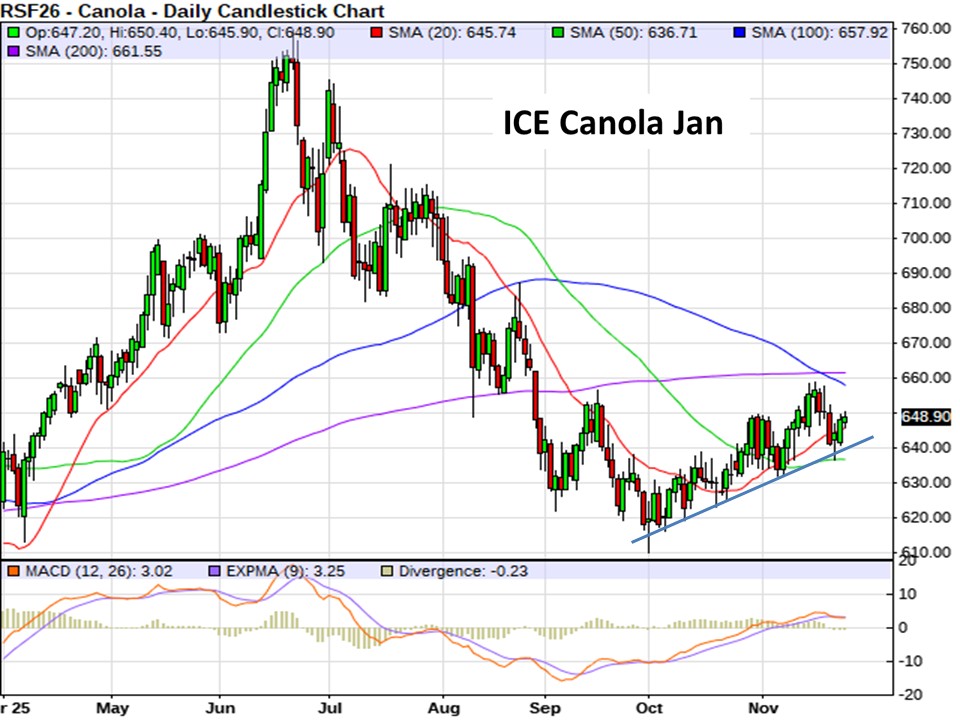
A weaken Canadian dollar and a modest recovery in CBOT soyoil is helping canola futures edge higher. Jan canola is again flirting with near-term overhead chart resistance in this $650-$660/t zone around where the 100- and 200-day average have converged. Technically, a push up through here would suggest a test up to near $680.
Malaysian palm oil is showing modest gains this morning after the recent collapse to near 5 month lows. European rapeseed is quietly lower, trading well within a relatively tight range established over the past month.
Soyoil futures are trying to hold above 50 US cents/lbs, but the market remains wary with the uncertainty surrounding US biofuel policy. Plus, crude oil remains in a bearish struggle on large global supply prospects. Vegoil price trends have a notable influence canola prices. But Prairie canola cash pricing has been ticking higher slightly, with the recent rise in futures complemented by a narrowing of cash basis.
Demand from the domestic crushing sector has been solid, but the currently marketing year export pace remains slow with the absence of China buying and no where enough gain from other buyers to pick up the slack. As China s 76% tariff on Canadian canola seed blocks sales to that key export buyer.
As for repairing Canada s trading relationship with China…federal agriculture minister Heath MacDonald says the canola tariff issue with China should be resolved before the 2026 canola harvest. MacDonald feels the relationship is thawing but that s not a near-term fix. I suspect Canada will have to shift its position on importing Chinese electric vehicles before China welcomes back Canadian canola.
In the meantime, canola s price direction will depend on improving exports to other buyers and more clarity on American biofuel policy.
To access the latest futures prices, go to https://www.producer.com/markets-futures-prices/
Source: producer.com