
AM Market Report – February 26, 2026
GOOD MORNING…HERE IS YOUR MORNING MARKET NEWS
OVERNIGHT GRAIN TRADE
ICE canola futures are trading around $1/tonne higher to start this morning, erasing losses seen during the overnight session…and are in fact now trading at the overnight highs.
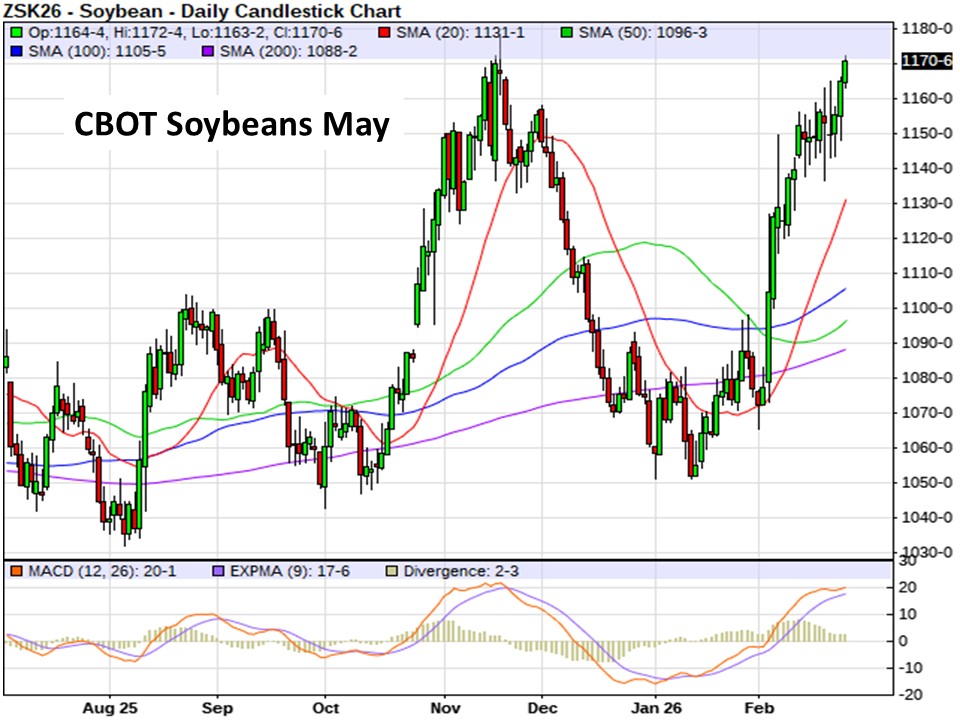
Chicago soybean futures were also lower overnight but have now turned higher in the early morning hours…posting gains of 3 to 6 cents/bu (nearbys leading)…also trading at the higher of the overnight session and 3-month highs. A bounce up in both soymeal and soyoil futures is helping the bean market. The soy complex has been supported recently on ideas of better US biodiesel blending volumes soon coming to market.
Read Also
Overnight Trade
Crude oil continues to rally this morning on the Iranian conflict concerns with the nearby contract trading at US$65.89 per barrel….
CBOT corn futures are up 1 to 2 cents.
US wheat markets are narrowly mixed… Minnie spring wheat futures are a penny or two either side of unchanged, HRW down a penny, while SRW wheat is a penny higher.
In Other News
– Update to Trump s trade war with the world… The big takeaway from US President Donald Trump s reaction to the Supreme Court s decision to strike down his tariffs enacted under the International Emergency Economic Powers Act (IEEPA) is that trade uncertainty is back on the rise.
Just when we thought we d have more clarity on tariffs after the Supreme Court ruling, we of course do not, said Peter Boockvar, chief investment officer at One Point BFG Wealth Partners, in his widely followed Boock Report newsletter. Still cloudy for small and medium sized businesses in particular (who make up most of US business in terms of number of companies, about half of the private sector workforce and import about 1/3 of their needed things) and certainly not for those countries we have new trade deals with where the new 15% blanket tariff is above what was agreed upon for some like the UK and for others it is below.
Trump over the weekend said he would impose a 15% global tariff on imports using the so-called Section 122 authority under the Trade Act of 1974. That can remain in place only for 150 days, and would require Congress to approve any extension. At the same time, the Trump regime is pursuing numerous investigations under other nefarious mechanisms.
Trump s recent trade deal shake-downs that seemed settled now seem to be on shakier ground. And that means those clouds Boockvar pointed out hang over the farm sector, too.
China s commerce ministry criticized Trump s decision to implement a 15% levy, saying that unilateral tariffs violate international trade rules and US domestic law, and are not in the interests of any party. The ministry said cooperation between the US and China is beneficial to both sides, but fighting is harmful.
Implications for China s outstanding purchases of US soybean purchases remain unclear. Beijing may want to keep buying as a goodwill gesture ahead of a meeting between Trump and Chinese leader Xi Jinping in April. At the same time, the move has been characterized widely as a blow to US bargaining power with Beijing. Meanwhile, strong US crush demand, spec fund buying and a slow start to Brazil s harvest have underpinned the market.
Thierry Wizman, global FX and rates strategist at Macquarie believes US import tariffs are a reflection of US ‘disengagement’ from the US-based rule-based order that upheld concepts of free and fair trade. Moreover, the tariff war itself is a source of uncertainty that emanates from the US specifically. The US Supreme Court may have improved institutional effectiveness, yet increased uncertainty, since Trump will resume the tariff war under different guises which are yet to be fully revealed.
– Canada, US trade teams may meet soon… US and Canadian trade officials spoke on Wednesday and plan to meet in coming weeks, US Trade Representative Jamieson Greer said, adding that the Trump administration was open to their ideas on how to reach an agreement. A spokesperson for Ottawa’s Canada-US Trade Minister Dominic LeBlanc told Reuters that the two officials have “had a number of brief, informal exchanges in recent days about a potential in-person meeting in Washington, D.C., in the near future.”
US-Canada tensions have grown in recent months over trade and other issues as Trump has turned his ire on Washington’s northern neighbor. The Trump administration is reviewing the Canada-US-Mexico trade pact (CUSMA) enacted during Trump’s first term in the White House and faces a July 1 deadline to notify Congress whether it plans to change the agreement.
– Canada and India to begin free trade talks during Carney s visit… India hopes to start talks on a free trade agreement with Canada during Prime Minister Mark Carney s visit to India later this week, India s trade minister said on Tuesday. We will finalize the terms of reference and are hoping to launch talks for a free trade agreement later this week, Piyush Goyal told reporters.
The trip comes at a key time when Prairie farmers have been dealing with a 30% India import tariff on yellow peas and a 10% tariff on lentils.
Carney leaves this week on a multi-nation Indo-Pacific trade mission aimed at expanding market access for key export sectors and deepening ties with three of Canada s most important regional partners: India, Australia, and Japan. The Prime Minister s mission runs from February 26 to March 7.
– Canola crush eases in January… The monthly Canadian canola crush eased slightly in January after hitting its highest of the 2025-26 crop year the previous month. Statistics Canada reported that 1.053 MMT of canola were crushed in January, down 2.2% from December, but still the fifth straight month the crush has the exceeded the 1 MMT benchmark.
The cumulative year-to-date 2025-26 canola crush (August to January) now stands at 6.115 MMT, compared to 5.929 MMT for the same period last year, up nearly 3.1% and representing almost 51% of the full-year Agriculture Canada forecast of 12 MMT.
According to the Canadian Oilseed Processors Association, crush capacity is expected to reach 15 MMT in 2026. Cargill s new canola crush plant at Regina is expected to process about 1 MMT of canola seed annually when it opens in the spring.
– IGC February report adjusts world data… There were several revisions made to the International Grains Council monthly supply and demand report, most notably in soybeans.
Soybeans…The IGC raised its global soybean production call for 2025/26 by 1.30 MMT from January, now at 428.20 MMT. Total supply was bumped up 1.40 MMT to 510 MMT. There was an increase to Brazilian production with 2 MMT added to its crop at a record large 179 MMT. That was partly offset by an 800,000 tonne reduction to Argentina s harvest at 47 MMT.
A 900,000 tonne cut to total use brought it to 430.80 MMT. The projected world soybean carryover was raised 2.30 MMT at 79.20 MMT.
Wheat… 300,000 tonnes were shaved off world wheat output at 841.70 MMT for 2025/26, as the IGC took that amount off from its call on the European Union harvest at 143.40 MMT. Total global supplies were lowered by 1.10 MMT to almost 1.11 billion.
Total use was trimmed 300,000 tonnes to 822.80 MMT. Ending stocks came down 900,000 tonnes at 282.40 MMT.
Corn… For global corn production, the IGC upped tacked on 500,000 tonnes at 1.31 billion. Total supplies were raised by 700,000 tonnes at 1.60 billion. Total use was increased by 800,000 tonnes at nearly 1.30 billion. The world carryover remained at 304.80 MMT.
– Ukrainian port damage… Strikes by Russia on Ukraine s Odessa ports in recent months have reduced their export capacity by up to 30% from their pre-war level, Reuters reported, citing a source in the transport industry. The report said the decline in capacity hasn t affected overall export volumes because shipments are significantly lower than pre-war levels due to the impact of the conflict on production.
The attacks on port infrastructure, however, has triggered a jump in logistics and freight costs, hurting local businesses and forcing them to lower prices to remain competitive on the global market.
Agricultural products account for over 50% of Ukraine’s total export revenues, Deputy Economy Minister Taras Vysotskiy said, according to the report, amounting to nearly US $23 billion last year.
Officials said the overall volume of farm exports dropped last year mostly due to a smaller grain harvest and delays in corn harvesting caused by unfavourable weather, but attacks on infrastructure disrupted the timing of exports.
– Limited shipments support Russian wheat export prices...Limited shipments and a strong rouble supported Russian wheat export prices last week, which approached those of Black Sea competitors. The price of Russian wheat with 12.5% protein content for free-on-board delivery at the end of March was US $233/tonne at the end of last week, unchanged from a week earlier, the IKAR consultancy said. Weather problems that have affected the new harvest in France and the US may provide further support for prices, IKAR said.
The situation with shipments from Russian ports remains difficult, as stormy weather continues in the Black Sea, and ice prevents ships from passing through the Caspian and Baltic seas. In the Sea of Azov, however, convoys of ships have begun to pass through even though it is covered with ice. High Russian prices mean some importers have been buying grain shipped from Constanta, in Romania, and Varna and Burgas in Bulgaria, rather than from Russian ports, due to a freight advantage.
– Indonesia opens market to Canadian pork, expands beef access… Indonesia has opened its market to Canadian pork and expanded access for beef imports, the Canadian government announced this week. A market of almost 300 million people is obviously an important one for Canadian producers. That s why this step in diversifying Canada s pork export markets is so crucial, said Canadian Pork Council chair Ren Roy in a federal news release.
Indonesia has opened its market to Canadian pork and pork products. It will also now accept over-30-month bone-in beef and beef offal. Previously, Canadian producers could only export boneless beef. Indonesian authorities also audited and approved more Canadian meat and livestock facilities.
Canada and Indonesia signed the Canada-Indonesia Comprehensive Economic Partnership Agreement (CEPA) in September. The agreement will eliminate nearly all tariffs on Canadian beef and pork, the Feb. 23 news release said. Indonesia is Canada s sixth-largest agri-food and seafood export market, the federal government said.
– India braces for unusually hot March… India is likely to record one of its warmest Marches on record, with above-average temperatures forecast in key wheat, pulse and rapeseed-growing states, potentially cutting yields, two weather bureau sources said on Thursday. India is the world’s second-largest wheat producer and biggest consumer of pulse crops and importer of edible oils. However, higher temperatures during the crucial grain-filling and maturity stages could cut yields, trimming overall production that was expected to reach a record high.
“Maximum and minimum temperatures in northern and northwestern states are likely to be significantly above average in March,” said a senior official at the India Meteorological Department (IMD), who did not wish to be identified ahead of the official announcement from the weather office. The IMD is expected to release its forecast for March temperatures later this week.
Maximum temperatures in March are expected to stay up to 7 degrees Celsius above normal in Punjab, Haryana, Rajasthan, Uttar Pradesh, and parts of Madhya Pradesh, the official said. These states account for over 80% of India’s total wheat, pulse and rapeseed production. Winter crops, such as wheat, rapeseed, and chickpeas, are planted from October to December and require cooler weather conditions throughout their growth cycle for optimal yields. Day temperatures are expected to start rising in the next few days and by the end of March maximum temperatures could exceed 40 degrees Celsius in many states.
– Boston Fed President: US rates on hold for some time. … US Federal Reserve Bank of Boston President Susan Collins says US interest rates are likely to stay unchanged for some time as recent economic data shows an improvement in the labor market, while risks to inflation remain. The US labor market is showing at least some more signs of an unusual kind of stability, Collins said during a panel discussion hosted by the Boston Fed and as reported by Bloomberg. She also pointed to the need for more evidence that US inflation is coming down toward 2%. I think that it s quite likely that it will be appropriate to hold the current range for some time, she said. After 175 basis points of easing over the past year and a half, we are at mildly restrictive, perhaps quite close to neutral already, Collins said, referencing the level at which interest rates neither stimulate nor restrain the American economy.
Outside Markets
The Dow Jones Industrial Average rallied up 307.65 points on Wednesday to settle at 49,482.15, while the S&P 500 ended 56.06 points higher at 6,946.13. Early Thursday, the March Dow Jones Futures are up another 141 points.
World stock markets are trading at all-time highs as immediate nerves around AI disruption continued to fade. Traders were still digesting Nvidia s numbers, after the world s most valuable company delivered first-quarter revenue guidance of a whopping US $78 billion, betting on Big Tech s unabated spending on its AI processors.
Wall Street futures are mixed to slightly higher this morning after US markets ended higher on Wednesday. TSX stock index futures are steady a day after Canada s main stock index rose to a new record ?high.
The March US Dollar Index is up 0.035 at 97.660. The Canadian dollar weakened against its US counterpart…currently quoted at 73.10 US cents.
April crude oil futures are down $1.23 at US $64.19/barrel. Oil prices are weaker this morning as US crude inventories rose by the most in three years and signs of weakness in the physical oil market weighed on prices, while traders assess whether US-Iran talks could avert a supply-threatening military conflict.
OPEC+ is likely to consider raising its oil output by 137,000 barrels per day for April, according to sources as the group prepares for peak summer demand and a price boost from tensions between the US and OPEC member Iran. The resumption of output increases after a three-month pause would allow OPEC leader Saudi Arabia and members such as the UAE to regain market share at a time when other OPEC+ members, such as Russia and Iran, contend with Western sanctions, and while Kazakhstan recovers from a series of oil production setbacks. ?
Meanwhile… Russian and Iranian oil producers are offering deepening discounts as they compete for the same limited group of Chinese buyers after India retreated from purchases, Bloomberg said in a report. India s imports from Russia could drop by 40% from January levels to around 600,000 barrels a day, according to a scenario from Rystad Energy. Much of the displaced cargoes are now heading east, spurring a price war with Iranian suppliers that have long been favored by China s private refiners. Russia s Urals grade is selling at around $12/barrel below ICE Brent, compared with a $10 discount last month. Iranian Light is going for as much as $11 less than the global benchmark, said Bloomberg. That s widened from $8 to $9 in December.
The independent Chinese refiners, known as teapots, have historically acted as the oil market s pressure valve, absorbing barrels shunned by others. But their capacity is finite, given they only account for around a quarter of the country s processing capacity and are also subject to government-set import quotas, said the report. With China unable to fully soak up the displaced crude, unsold oil is piling up in Asian waters and Russia and Iran are running out of options.
In other news… South Bow Corp. is considering an expansion of its US oil pipeline system that may revive a version of the canceled Keystone XL project, said a Bloomberg report. Bridger Pipeline LLC filed an application last month with the Montana Department of Environmental Quality to build and operate a 550,000-barrel-a-day line that would move Canadian crude through Montana to Wyoming. The route would originate near Keystone XL s planned border crossing, raising the prospect that parts of the long-stalled project could be repurposed. Keystone XL was meant to be an expansion of the existing Keystone system, which crosses the US border in North Dakota, and instead has become a political flashpoint since it was originally proposed in 2008. Former US President Biden withdrew a key permit for the project in 2021 after portions had already been built in Canada.
And finally in energy news… The European Commission will submit a legal proposal to permanently ban Russian oil imports on April 15, three days after Hungary’s parliamentary election, according to EU officials and a document seen by Reuters. Two EU officials told Reuters the timing was designed to prevent the oil ban becoming a major factor in Hungary’s election campaign.
Grain Markets
Chicago soybean futures are advancing 3 to 6 cents/bu higher this morning…a nice lift off overnight session lows, and a move up to the fall season highs posted 3 months ago. Bean futures rallied 8 to 10 cents on Wednesday, supported by strength in soymeal. Meal futures are up another $1 to $2/ton this morning after gaining $4 to $7/ton yesterday.
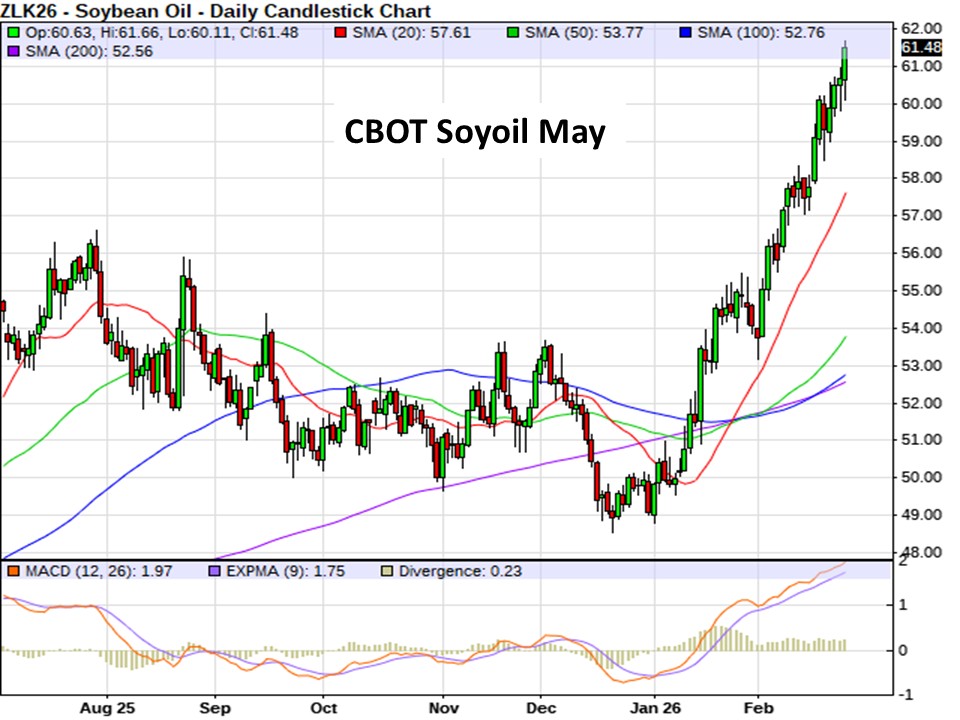
Soyoil futures are jumping an impressive 63 to 84 points higher this morning, up from a weaker start during the overnight session as the rocket-ship to fresh contract and 3-year highs during the past 2 months continues. Bean oil rose a modest 7 to 23 points in the nearbys on Wednesday. Soyoil, and the soy complex generally, is getting a lift from reports the EPA sent its 2026 US biofuel production volume mandates to the White House late on Wednesday for review.
USDA this morning reported US soybean export sales for the week ended Feb 19 at 407,100 tonnes, which came in at the bottom of trade expectations, and down compared with 864,000 tonnes the previous week. Sales were likely slowed because of the Lunar New Year celebrations that week in China and across Asia.
The bigger question is how China s buying of US bean will be affected by the new global US tariffs ahead of the face-to-face meeting between President Trump and President Xi in about a month.
Brazil has harvested about 2 billion bu of beans so far, while rain in Argentina is mostly benefitting later planted crops.
Chicago corn futures are up 1 to 2 cents this morning…continuing to mosey gradually higher over the past month. The corn market posted 2 to 3 cent gains across most contracts on Wednesday.
EIA data from Wednesday showed a total of 1.113 million barrels per day of US ethanol produced in the week ended Feb 20, down just 5,000 bpd from the week prior. Ethanol stocks were up 58,000 barrels to 25.646 million barrels.
USDA this morning reported US corn export sales for the week ended Feb 19 at a disappointing 685,800 tonnes, which came in below the bottom end of trade expectations which ranged between 0.9-1.8 MMT of old crop corn.
Traders are monitoring scattered near-term rain chances for Argentina, along with second crop planting activity in Brazil.
US wheat markets are narrowly mixed this morning… Minnie spring wheat future are mixed (a penny either side of unchanged), HRW is down a penny, while SRW wheat is a mostly a penny higher. Pretty dulls-ville stuff in wheat today so far.
On Wednesday, the US wheat complex posted weakness in the winter wheats, while spring wheat turned 1 to 4 cents higher at the close.
USDA this morning reported old crop US wheat export sales for the week ended Feb 19 at 243,800 tonnes, which came in below the bottom end of trade expectations which ranged between 250,000 and 500,000 tonnes.
Algeria purchased an estimated 600,000 tonnes of option origin wheat in a tender on Tuesday…probably be Black Sea sourced business. Saudi Arabia issued a tender for 655,000 of wheat overnight, with a Friday deadline for offers.
Rain and snow events are expected to move through the US Plains states for the rest of the week and into next week, giving a boost to the snow drought-stricken winter wheat crop that s about to soon break winter dormancy.
Traders are also keeping an eye on overwintering conditions in Europe, Russia, and Ukraine. Shipments out of the Black Sea have been complicated recently by weather, in addition to the ongoing issues created by Russia s war on Ukraine.
CANADIAN GRAIN MARKET
ICE canola futures managed just a mixed close on Wednesday, despite strength in the Chicago soy complex. The gains in the soy complex were driven by reports the US Environmental Protection Agency is sending its proposal for new US biofuel blending volume mandates to the White House, with an expected rule to be finalized by the end of March. The new volume mandate could lead to additional vegetable oil demand as a biofuel feedstock.
On the other hand, both European rapeseed and Malaysian palm oil were lower yesterday, while gains in the Canadian dollar were negative for canola as well.
Statistics Canada reported that 1.053 MMT of canola were crushed in January, down 2.2% from December…but still the fifth straight month the crush has the exceeded the 1 MMT benchmark.
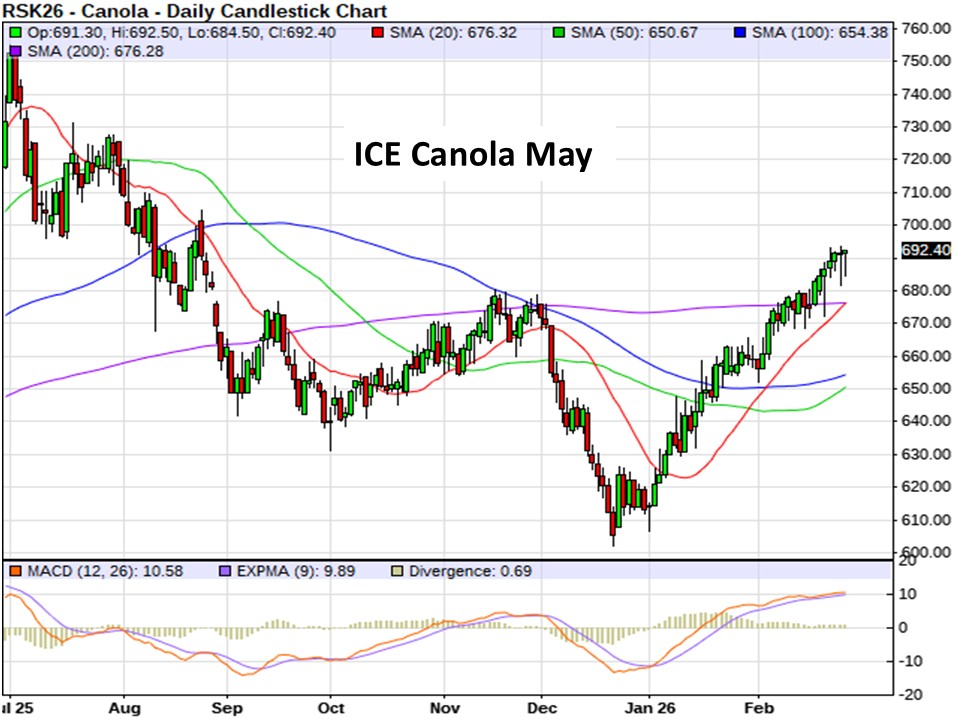
May canola slipped 20 cents on Wednesday to close at $691.40, while new crop November was $1 higher at $696.10.
For today… canola futures were trending weaker during the overnight session, but are making a comeback into early morning price action…futures now around $1/tonne higher and trading at the highs of the overnight session. The 2-month run higher in canola has been impressive…encouraged by the US soy complex rally, especially in soyoil.
It was confirmed yesterday that the EPA had submitted its final rule for US renewable fuel standard (RFS) volumes to the White House. There is normally a quick turnaround, so details should be released soon…but still might be delayed to the end of March.
Meanwhile, the spec funds recently flipped their net position holding in canola futures short to long amidst speculation of a canola-friendly US biofuel mandate for 2026.
March 1 also marks the point where China lowers its import tariff on Canadian canola shipments from 76% down to 15%. There was a run of export sales to China schedule for late winter/early spring shipping when the news broke a couple of weeks ago, but business seems quiet of late. Hopefully, we can soon crank up the sales to China again shortly.
Stay informed with our daily market videos. Each video quickly covers key futures moves, price trends, and market signals that matter to Canadian farmers. Get clear, timely insights in just a few minutes. Bookmark https://www.producer.com/markets-futures-prices/videos
To access the latest futures prices, go to https://www.producer.com/markets-futures-prices/

Source: producer.com