
Canadian drone spraying regulation changes expected in late spring
The drone market in Canada is evolving rapidly, with a significant push to implement regulations that would equate drone spraying with aerial application for this growing season.
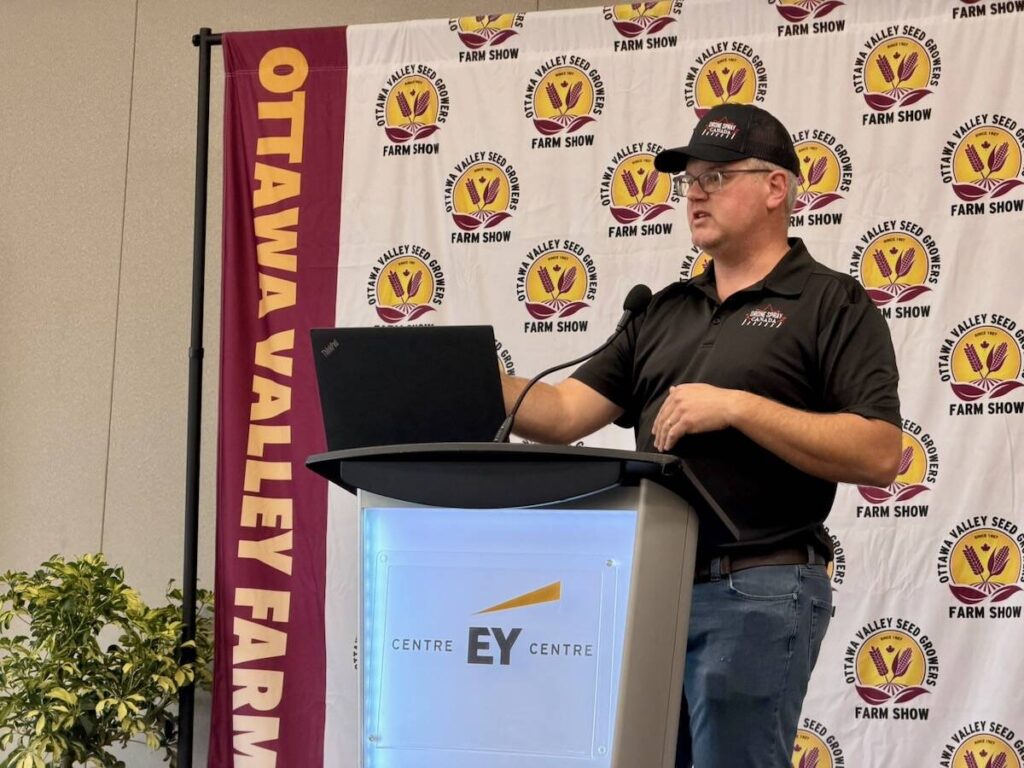
Mike Verhoog, one of the owners of Drone Spray Canada, a DJI dealer in Ontario, said during a session at the Ottawa Valley Farm Show that he expects approved labels for drone spraying of Delaro Complete and Prosaro Pro by the spring.
“Delaro Complete will be a big deal for us for tar spot,” he said, referring to the corn leaf disease.
Read Also
Kathy Hardy receives OVSGA Award of Excellence
The 2026 Ottawa Valley Championship Seed, Feed and Forage Show awards were a big draw at the Ottawa Valley Farm Show.
Why it matters: Drones offer a complementary option to ground sprayers to spray fields when crops are taller, and the ground is wetter.
Verhoog says that the Pest Management Regulatory Agency, the government’s regulatory agency for pesticides, is moving much more quickly than usual, with the goal of having it ready for this growing season. He warns, however, that if there’s a box that’s not checked, approval of the use of aerial application rules for drones could be pushed back until the 2027 growing season.
Meanwhile, American and Brazilian farmers are moving ahead quickly to use drones as they are regulated under aerial application rules.
Drone Spray Canada has been part of research projects around the world testing drone spraying for companies and governments.
Verhoog says a third of the acres in China being sprayed, are now sprayed by a drone.
One of the major reasons for excitement around drones is the cost of operation. The largest drone available in Canada, the T100 from DJI, costs $45,000 to $55,000 depending on how it’s outfitted.
Many drone operators fly the drone over about 15,000 acres in a year. Drones are usually shelved at about 25,000 acres, says Verhoog. That means depreciation is about $2 per acre. Operating costs for parts are about 10 cents per acre, with fuel for a generator at 30 cents per acre, which he says makes the drones competitive with other application methods. He estimates about a $2.50 cost of operation per acre.
There’s research, shown by OMAFA’s spray expert Jason Deveau at the South West Ag Conference in January, that show deposition and spray pattern challenges with drones, but Verhoog says there’s efficacy data that shows equivalence with other spraying methods. There’s work being done to figure out that discrepancy, but the rapid adoption of drones in Canada and especially elsewhere shows that farmers are seeing value in coverage.
Verhoog says the downwash from the drone helps to change how the materials get into the crop. He likens it to a “giant air blast sprayer from above”.
Efficiency is important with a goal of having the sprayer on the ground for a minute to a minute and a half for refilling. Dry material, like fertilizer, can take longer, but some operators are using conveyors and bulk bins to make loading faster compared to bags and pails.
Verhoog emphasized the importance of proper training.
“Every piece of equipment can be run wrong,” he says.
The drone market is busy, and Verhoog is not going to be doing custom applications in the coming season to focus more time on sales.
“It’s exciting for the industry. It will get us to a place with the rest of the world where drone application is allowed with the right regulation,” said Verhoog.

Source: Farmtario.com