
Barcodes a Thing of the Past?
Barcodes have begun disappearing from supermarket shelves as retailers trial technology set to replace them.
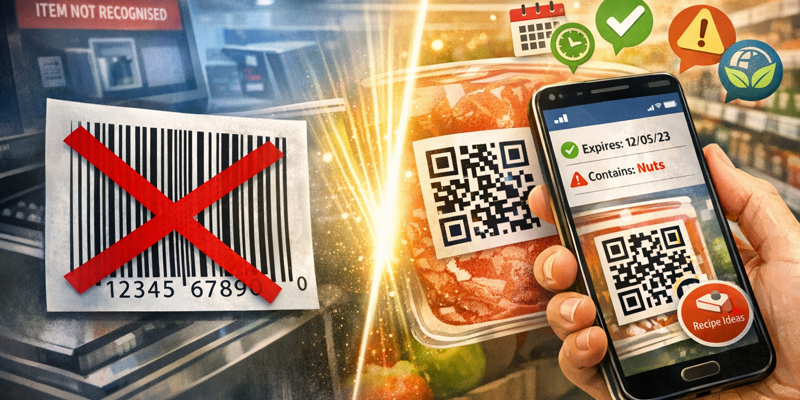
The zebra-striped labels are in the process of being phased out in favour of new, square-shaped QR codes in a move that could put an end to squinting at tiny product labels and accidentally buying food past its sell-by date.
As well as scanning the “2D barcodes” to pay, shoppers could soon scan the codes on their smartphones to pull up information about items in their basket, including dietary guidance, allergen details and expiry dates.
The new QR codes are currently being trialled at Tesco stores across the country on packets of lemons and limes, steaks and sausages, where scanning the black square gives customers access to recipe inspiration and storage instructions. Other major brands adopting the 2D barcodes include Unilever, Procter & Gamble and L’Oréal.
In the Tesco trial, some products have already had their traditional barcodes replaced entirely by QR codes, offering an early glimpse of how the technology could eventually replace the old system.
GS1, the non-profit organisation that oversees the world’s barcodes, is encouraging all UK retailers to adopt the new system by 2027, while experts believe the technology could transform the way we shop.
“I think it will end up being as significant as the original introduction of the barcode,” said Lee Metters, business development director at Domino Printing Sciences, a global printing manufacturer that provides equipment to produce the new labels.
Regular shoppers are well acquainted with the frustrations of traditional barcodes: the dreaded “item not recognised” message at self-checkouts, trying to flatten a crumpled voucher so it scans, or waiting for a cashier to help.
The next-generation QR codes not only scan more easily, reducing self-checkout frustrations, but can also provide shoppers with a wealth of information about their food at the touch of a button.
While navigating supermarket aisles, customers will be able to scan items with their smartphones to see where products were grown, their carbon footprint and customer reviews, without having to peer at the fine print on the label.
Currently, the main beneficiaries are supermarkets themselves, which can input use-by dates and batch numbers into QR codes. This allows them to stop the sale of out-of-date products and better predict when food will expire, helping reduce waste.
However, according to Camilla Young, programme lead for the next generation of barcodes at GS1 UK, “the potential for consumers is huge”.
With 51 per cent of shoppers having bought out-of-date food at some point – costing UK consumers £11.8bn a year – the new barcodes could eliminate the risk by flashing up warning alerts, she said.
In the future, they could even be used to track all the items in a fridge, notifying families when supplies are running low, suggesting recipes and flagging when products are close to expiring.
For people with allergies, the ability to scan food with an app rather than searching supermarket shelves for products that will not trigger a reaction would be a “game changer”, said Mr Metters.
Unilever has also been trialling accessible QR codes that allow visually impaired shoppers to scan products from a distance and receive increasingly detailed information through headphones as they move closer to the item.
“It’s all about making shopping more convenient,” said Mr Metters.
Barcodes were first introduced in Britain in 1979, when a box of Melrose tea bags was scanned at a Keymarkets supermarket in Spalding, Lincolnshire.
Invented in the late 1940s by US science graduates Norman Joseph Woodland and Bernard Silver, traditional barcodes contain 13 digits and hold only seven pieces of basic information – a product’s name, manufacturer, type, size, weight, colour and price.
When scanned at the till, the barcode number is matched with a vast product database to ensure customers are charged the correct amount.
Though rudimentary by today’s standards, barcode lines can be arranged to register up to ten trillion different products and are scanned worldwide around 10 billion times a day.
In contrast, QR codes, invented by Japanese scientists in the 1990s, can contain up to 4,000 characters, allowing retailers to embed far more information.
Source: westerngrocer.com