
Drone spraying proposal comes with opportunities, risks
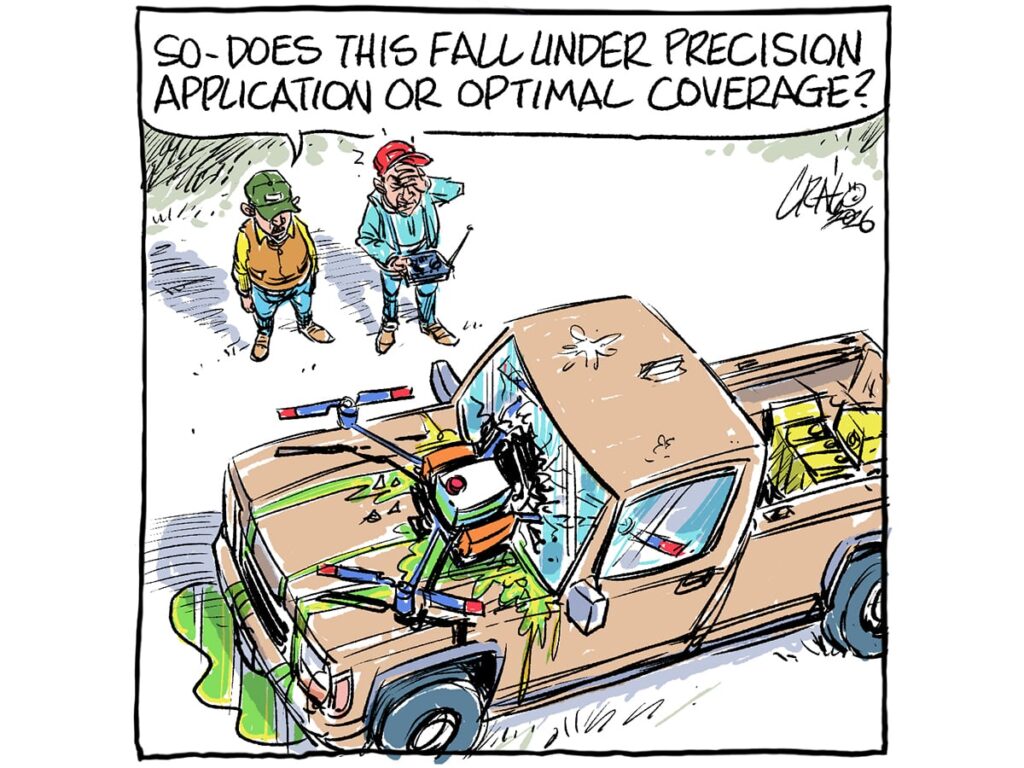
Farmers interested in using spray drones on their farms were given positive news with a recent announcement from Health Canada.
It’s seeking public opinion on proposed rules that would allow pesticides to be applied by drones if they’re already registered for aerial application.
The United States uses this approach, and Health Canada has been under pressure for years to synchronize regulations.
Read Also
Agriculture trade with U.S. still solid despite recent tariff threats
U.S. president Donald Trump’s incessant on-again, off-again tariff announcements had Canada’s agriculture sector on edge for much of 2025.
For instance, last December the House of Commons agriculture committee called for this approach.
The Alberta Federation of Agriculture also asked for a national strategy to fast-track the approval of application of crop protection products with drones.
Canadian spray experts estimate there are already more than one million acres sprayed annually in the country with drones, which regulators have so far ignored.
The growth in popularity of spray drones in Canada is easy to see at farm shows, including Ag In Motion, where this is a significant growth area at the show.
Health Canada is at a point where it must either start enforcing its own rules or change them to allow what is already happening.
Transport Canada has done its part to enable the use of this emerging technology, by creating rules and a certification process for the safe operations of drones.
Achieving approval from Health Canada for a new kind of application is a much more arduous affair, largely because of the broad scope and complexity of this process.
Having such a comprehensive approval process can be a good thing for both public safety and the industry because it helps maintain public trust in the food system.
Before a crop protection product is approved in Canada, its safety must be established, as does the effectiveness of all application instructions on its label.
Spraying with a drone creates a different deposition pattern of applied products compared to a plane or helicopter, meaning these approaches do not have the same result.
There are also multiple kinds of drones, and they can cause different deposition patterns.
Even if a specific drone platform is studied and understood, it doesn’t mean the utility of other drone types would be known.
Considering this variability, it’s not surprising Health Canada’s Pest Management Regulatory Agency has been slow to publish guidelines on the application of crop protection products with drones, even though it has been studying this approach since 2019.
Health Canada’s pivot, of asking for public opinion on these proposed rules, indicates a recognition that its typical approval approach is unlikely to yield clear and definitive evidence for drone application platforms within the means available to the agency.
The proposed rules also indicate a significant shift within Health Canada, where it seems to be offloading some of the onus of validating the effectiveness of crop protection products when applied with a drone.
This user-beware approach is not without risks.
There are many images available online that indicate the applications of fungicides with a drone can be anything but uniform. In these images, patterns where fungicide have and have not been applied clearly show the drone’s path.
Non-uniform applications of crop protection products with drones will be very costly in some instances, and it will be interesting to see how companies that sell these products respond to product claims.
There are also instances where drones are by far the most cost-effective approach to apply products.
For instance, DJI recently released its T100 agricultural drone that has a 100-kilogram payload. On smaller farms, it’s conceivable one or two of these units could handle all their in-crop application needs.
Patch management, especially in wet conditions, is another area where spray drones have a clear advantage over ground sprayers.
When it comes to the environment, international studies have demonstrated that drone applications have less spray drift compared to using a spray plane.
It’s likely groups that are in opposition to the use of crop protection products, regardless of how they are applied, will participate in Health Canada’s consultation process.
If you’re uncomfortable with their agenda to shape the spray-drone rules in Canada, there is still time to add your voice to the fray.
Health Canada’s consultations close March 25.
Karen Briere, Bruce Dyck, Robin Booker, Paul Yanko and Laura Rance collaborate in the writing of Western Producer editorials.

Source: producer.com