
AM Market Report – March 23, 2026
GOOD MORNING…HERE IS YOUR MORNING MARKET NEWS
OVERNIGHT GRAIN TRADE
Financial and commodity markets were awash in price volatility overnight and going into this morning.
US President Donald Trump on Saturday threatened to “obliterate” Iran’s power plants if the Strait of Hormuz was not reopened in 48 hours which would be tonight. In return, Iran threatened to target strike power plants across the Gulf region, including Israel, if Trump followed through on his ultimatum. Trump’s weekend warning to strike Iran’s power network came less than a day after he signalled the United States might be considering winding down the conflict, even as US Marines and heavy landing craft were heading to the region. Oil markets surged higher on the weekend tit-for-tat-threats and stock market futures plunged.
Read Also
Prairie Weather
There is a system pushing through the eastern Prairies this morning with most of the snow/freezing rain falling near the Saskatchewan…
Now…just in the past 2 hours as I m writing this commentary this morning…Trump issued yet another of his confused social media posts…now appearing to back down on targeting Iran s power network, saying the US and Iran have suddenly held constructive talks and that he would postpone any strikes on power plants and energy infrastructure.
The United States and Iran have had, over the last two days, very good and productive conversations regarding a complete and total resolution of our hostilities in the Middle East, Trump wrote in a post on Truth Social. I have instructed the Department of War to postpone any and all military strikes against Iranian power plants and energy infrastructure for a five-day period, subject to the success of the ongoing meetings and discussions.
However, Iranian media says there has been no direct or indirect contact with the Trump regime. Trying to find the source of this report, but came from a broker contact, so treating it with some caution.
But just goes to show chaotic this geopolitical situation is. What direction the Trump regime goes changes by the day, or even hour…some of it truth, other times just seems made up on the fly. So good luck try to guess what comes next from this White House.
But in the markets…after sharply higher crude oil and lower stock market index trade overnight…this latest Trump rant has turned crude oil down hard and US stock indices are now higher. It s Crazy-town inconsistency in Washington.
OK…this morning…ICE canola futures had ben swinging between small gains and small losses overnight, depending on the minute you look. But canola futures are now down a notable $6 to $7/tonne this morning, making new overnight lows following the latest Trump tweet, and after falling $13.80/tonne for the week ended Friday.
Chicago soybean futures are right now down 1 to 2 cents/bu on the nearby contracts…trading up/down though the overnight session.
CBOT corn futures are losing 3 to 4 cents…also up/down all last night…not sure where to go next.
US wheat markets were narrowly mixed overnight, but are now lower. Spring wheat is mostly 1 to 3 cents lower, but some deferreds contracts are flat. HRW wheat is down 7 to 8 cents, while SRW wheat is losing 7 to 9 cents.
Traders sold off ag markets last week ahead of the weekend as they squared positions. The war in Iran adds unparalleled uncertainty to all financial and commodity markets as we start a new week.
The soybean market dropped 64 cents/bu last week. Concerns over China trade spurred soybean and soyoil prices down the daily limit last Monday (Mar 16). The Trump regime now says it will wait to reschedule talks with China to some indeterminate date…sometime after America s war with Iran is concluded.
Corn and wheat fell in tandem with soybeans last week. While soybeans ended the week lower, corn and wheat made up for early week losses. Fertilizer supply concerns supported the corn market…suggesting a decline in US corn acres vs 2025.
Increased rain chances in the US Plains has helped push wheat pricing lower.
Spec funds remain active across ag futures markets, which has led to increased volatility across commodities.
In Other News
– Mexico says technical talks on CUSMA going well so far… Mexican Economy Secretary Marcelo Ebrard said over the weekend the start of technical talks with the US to review the North American free trade agreement is “good news.” The talks have focused exclusively on the US-Mexico trade, with US Trade Representative Jamieson Greer’s office saying the two sides will review options for increasing US and Mexican production and manufacturing employment.
Ebrard expects Ottawa to join the talks soon and defended the Canada-US-Mexico Agreement, saying it has delivered significant results, including economic growth and employment. The talks began even as US President Trump has suggested abandoning the three-nation framework for bilateral deals. A key deadline looms in July 2026, when all three governments must confirm in writing whether to extend the CUSMA for a new 16-year term.
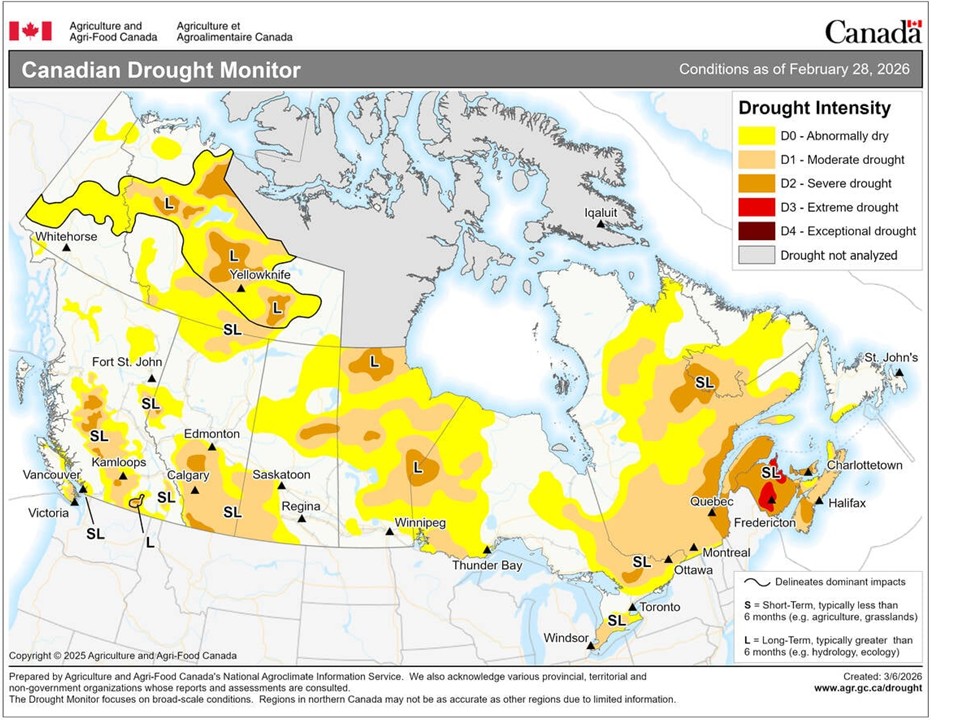
– Not much relief in sight for Prairie drought… There is not much relief on the horizon for the drought-stricken region of the Canadian Prairies, says Drew Lerner, president of World Weather Inc. The latest Canadian Drought Monitor map shows that a large portion of western Saskatchewan and central and southern Alberta is experiencing moderate to severe drought. That drought in the southwest is a concern, a very big concern, said Lerner. I certainly don t see anything at the moment coming around that s going to put a serious dent in this. There could be some rain events in early- to mid-April but not enough to make a big difference, which is worrisome. That s never a good thing when you re coming into the warm season and you haven t eliminated the dryness, said Lerner.
A ridge of high pressure could settle over the dry areas, which would perpetuate the dryness. Much of the US Plains region is also parched and has been experiencing a heat wave, which will likely lead to an expansion of drought in that country.
Lerner does anticipate better precipitation potential in the Canadian Prairies in the June through August period as a northwest summer jet stream pulls in some moisture from the US Midwest. However, that will likely only deliver moisture to the eastern portion of the region. I am nervous about the southwest Prairies, he said.
– Canada offers financial aid to farmers and companies affected by Iran war price spikes… Farm Credit Canada is offering financial aid ?to farmers, agricultural businesses and food ?companies hit by the spike in fertilizer and energy prices. FCC borrowers will be ?able to receive a new or additional ?credit line of up to $500,000 ?to modify terms and to defer principal ?payments on existing loans. The money will come from an expansion of the Trade Disruption Customer Support Program, ?which was introduced in March 2025 to ?help agriculture and food borrowers hit by US tariffs. It will ?now ?also provide support to help producers and agribusinesses “manage financial pressures caused by unexpected market shocks,” Friday’s statement said.
Fertilizer prices have soared ?since the Iran ?war began ?at the end of February and led to the closure ?of the Strait of Hormuz to ?most ?shipping, disrupting urea and sulphur supplies from the Gulf. As a result, farmers around the world are ?struggling ?with fertilizer costs as ?the northern hemisphere spring planting season approaches.
– China’s Jan-Feb soybean imports from US slump; Brazilian shipments surge… China’s soybean imports from the US plunged in the first two months of 2026 from a year earlier as most shipments, following a late October trade truce, have yet to arrive. The world’s largest soybean importer brought in 1.49 MMT of the oilseed from the US in January and February, down 83.7% from 9.13 MMT a year earlier, according to customs data published on Friday.
Trade tensions had delayed Chinese purchases of the US autumn soybean harvest until late October; state buyers have around 12 MMT of US soybean purchases since then…though much of that has yet to ship.
Traders are looking ahead to an upcoming meeting between US President Donald Trump and Chinese President Xi Jinping to provide more clarity on China’s future demand for American soybeans. On Thursday, Trump said his trip to Beijing had been delayed by about a month and a half.
Soybean imports from Brazil rose 82.7% from a year earlier to 6.56 MMT in January and February, as private buyers, who avoided US soybeans due to high tariffs, increased purchases of Brazilian supplies. However, traders are concerned that Brazil’s tighter phytosanitary checks and China’s prolonged customs clearance could slow the pace of arrivals in the coming months.
Imports from Argentina in January and February shot up to 3.27 MMT from 111,603 tonnes a year earlier. The surge was partly driven by a buying frenzy in September after Buenos Aires scrapped export taxes.
– Argentina grain exports jump as strong harvest meets global turmoil...Argentina is shipping out grains at a strong pace this season as record sunflower exports and booming corn sales help absorb one of the country’s biggest harvests in years, the Rosario grains exchange said on Friday, though the conflict in the Middle East is adding volatility to global prices and raising freight costs.
Argentina is benefiting from record wheat and corn production and its best sunflower harvest of the century, the exchange said in a report, with exports providing an outlet for abundant supplies. But the wider global backdrop is becoming more unstable, as war-related disruptions to shipping routes and heavy speculative trading in futures markets cause sharper swings in grain prices.
With the harvest advancing and heavy arrivals at the Rosario export hub, the first month of Argentina’s new corn export season is expected to break records, topping 4 MMT, the report said. Argentina’s corn remains competitively priced on world markets despite rising shipping costs, helping exporters maintain strong sales. That edge could weaken later in the year, however, when Brazil’s second-season corn crop begins reaching global buyers.
– IGC forecasts drop in wheat and corn production in 2026/27... The International Grains Council forecast that world grains production would fall in the 2026/27 marketing year, driven partly by an expected decline in output in the United States. “Total supply is expected to contract for the first time in four seasons,” the IGC said in a monthly update.
The intergovernmental body put total grains production at 2.417 billion tonnes, down from 2.470 billion in 2025/26 and below projected consumption of 2.440 billion.
US corn production is projected to fall to 400.2 MMT, down from 432.3 MMT in 2025, and the US wheat crop is seen at 50.7 MMT, down from 54.0 MMT.
The IGC forecast that world corn production would decline to 1.303 billion tonnes, down from 1.320 billion in 2025/26, while global wheat production was projected to fall to 822 MMT from 845 MMT in the previous season.
The report also highlighted concerns about risks to agricultural supply chains sparked by the Middle East conflict. “Although most northern hemisphere grains and oilseed producers are assumed to be sufficiently well covered heading into the spring fieldwork period, an extended crisis might affect planting decisions elsewhere later in the year,” the IGC said, noting parts of Asia and Africa were especially dependent on Gulf fertilizer supplies. “More broadly, a prolonged disruption could lead to a revaluation of fertiliser application rates, with possible implications for yields and crop quality,” the report added.
Outside Markets
The Dow Jones Industrial Average tumbled 443.96 points lower on Friday to settle at 45,577.47, while the S&P 500 was down 100.01 points to 6,506.48. After lower trade overnight Sunday, June Dow Jones futures have suddenly and dramatically surged 837 points higher in highly volatile action to start Monday morning.
The June US Dollar Index is down 0.324 at 99.135. The Canadian dollar strengthened against its US counterpart…currently quoted at 73.00 US cents.
May crude oil futures were up slightly just 2 hours ago…now plunging $7.36 lower to US $90.87/barrel. Oil prices rallied initially overnight after Iran s Revolutionary Guards said they would target Israel s power plants and those supplying US bases in the Middle East in retaliation against threatened US-Israeli any attack on its electricity sector. Now…this morning s latest Trump tweet backing off from his weekend threats has turned energy markets sharply lower.
Here s how Goldman sees crude oil prices playing out this year… Goldman Sachs has raised its crude oil price forecasts for 2026 due to the prolonged disruption of flows through the Strait of Hormuz, which it described as the largest-ever supply shock for the global crude market. The firm expects Brent crude oil prices to average $85/barrel in 2026 and West Texas Intermediate to average $79/barrel, up from earlier forecasts of $77 and $72, respectively. Goldman said the revisions are based on an assumption that oil flows through Hormuz would remain at only 5% of normal levels for six weeks, followed by a one-month recovery, resulting in cumulative losses of just over 800 million barrels.
Grain Markets
Chicago soybean futures are trading 1 to 2 cents/bu lower in what has been higher/lower trade through the confused overnight session. Bean futures were under pressure on Friday, with contracts down 5 to 11 cents across the board. May soybeans ended down 64 cents/bu on the week ended Friday.
Soymeal futures mixed this morning…$1/ton either side of unchanged. Meal futures ended down $2 to $4/ton on Friday, as the May contract still finished up $5/ton for the week. Soyoil futures are down 54 to 66 points this morning on the sudden turn down in crude oil. Bean oil ended Friday mixed with front months steady to 10 points higher and deferreds weaker, as May fell 193 points last week.
US/Israeli vs Iran war news is mixed up…confusing all financial/commodity markets this morning. The latest…US President Trump this morning put out a Truth Social post ordering the military to postpone strikes against Iranian power plants and energy infrastructure for 5 days after weekend tales were good and productive. Iran state media responded stating there was no direct or indirect contact with the White House.
Commitment of Traders data showed spec funds trimming back their soybean net long position in the week ended Mar 17 by 20,110 contracts. That took their net long to 201,997 contracts as some longs were liquidating. In bean oil futures, managed money closed in on their previous record net long position, adding 13,518 contracts to a net long of 122,356 contracts.
Brazil s soybean harvest is estimated at 68% harvested as of Thursday, which still lags the 80% paced from last year according to AgRural. A looming Brazilian port strike next week has supported world soymeal spreads and values.
New Brazilian soybean trade has been restricted at the moment to China, awaiting updated phytosanitary measures. Another Brazilian soybean crop shipment was rejected by China last week with pests. China is awash in soybeans and is likely using phytosanitary restrictions to slow its imports.
Meanwhile, the trade awaits more detail on an upcoming US-China trade meeting. The face-to-face meeting between President Trump and President Xi has been delayed by the military action in Iran and the Middle East, and is now expected to happen later in April…maybe?
Chicago corn futures are down 3 to 4 cents/bu this morning. The corn market has been up and down overnight…currently pressing towards overnight session lows now. Futures also sputtered late on Friday, with nearby contracts down 3 to 4 cents on the day, as some deferreds were fractionally lower. May corn was down 1.75 cents last week.
Trump s conflicting social media posts have confused markets…wildly threatening of Iran on Saturday, then more accommodating this morning in his order to postpone military strikes against Iranian power plants and energy infrastructure for 5 days after suggesting weekend talks were good and productive. Iran state media responded stating there was no direct or indirect contact with the President.
The Friday update to the CFTC Commitment of Traders report showed a total of 35,533 CBOT corn contracts added to the managed money net long position in corn futures as of last Tuesday. That took the net long to 228,804 contracts, as shorts dropped to their lowest level since last March.
Brazil s AgRural estimates the Brazilian second corn crop at 97% planted as of last Thursday, as last year was already completed by this point.
The trade is also looking at input costs ahead of widespread US corn planting. We ll get more information about all of those factors, plus demand, over the next few weeks, with the USDA s Prospective Planting and Quarterly Grain Stocks reports out March 31st, the USDA s updated supply/demand numbers April 9, and CONAB s new outlook for Brazil s crops on April 13.
US wheat markets are trending lower right now, but have bounced around overnight. Minnie spring wheat futures are currently trading steady to 3 cents lower, while the winter wheats are down 7 to 9 cents. Wheat futures were higher until this morning s latest Trump tweet came out.
The US wheat complex faced pressure across all three markets on Friday…with spring wheat finishing down 10 to 15 cents in the front months, as the May contract slipped back 17.5 cents on the week ended Friday.
55% of US winter wheat growing areas are in some stage of drought, a lot of that is hard red winter, with little relief in the extended forecast for that region. Winter wheat is emerging across the Northern Hemisphere, including the US, Europe, and the Black Sea region.
The trade s also monitoring trade impacts from Russia s ongoing war on Ukraine and the military action in the Middle East.
Export demand for wheat remains good, but global supplies are ample.
CANADIAN GRAIN MARKET
ICE canola futures closed with small losses on Friday. US soy futures were mixed with soybeans lower, but soyoil higher. European rapeseed and Malaysian palm oil were higher as well, while US crude was trading moderately higher this afternoon.
May fell $1.80 on Friday to close at $726.50/tonne, and November lost $2 to $731.80.
For today… canola futures have bounced between gains and losses overnight price action, but now turned notably lower…down $6 to $7/tonne and into its lowest levels of the overnight session. Downside pressure in canola is similar to what we are seeing across many commodity markets this morning following the latest Trump tweet on Iran issued just two or so hours ago…talked about extensively in comments above in this report.
Nevertheless, canola futures are weaker this morning with the turn lower across world vegoil and energy markets. May canola futures are down $6.50 right now at $720.00/tonne…and appearing to be establishing a topping formation for now, with the 20-day moving average approaching from below ($716).
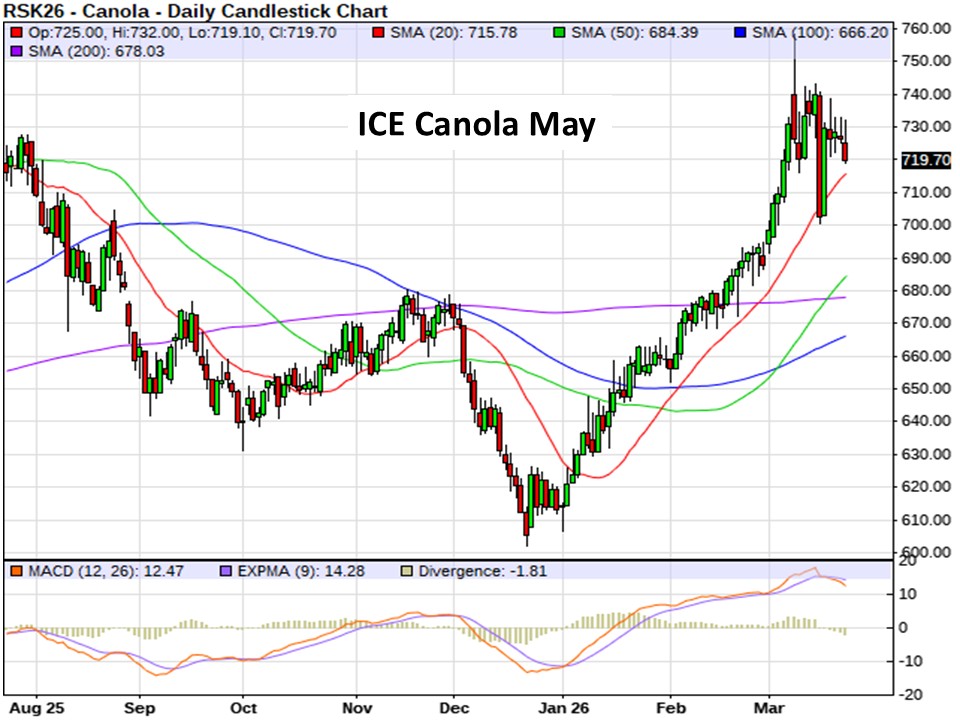
Markets were pricing in a hopeful announcement from Trump s Celebration of Ag event scheduled for Friday (Mar 27). There is speculation new US Renewable Volume Obligations for US biofuel production will be revealed, but we don t yet know for certain.
But right now, the news and influence from the war in Iran and energy markets remains the key driver of near-term oilseed markets.
On the feed grains… Feed grain bids in Western Canada were showing strength in mid-March, as gains in crude oil spill into the agricultural markets, writes our MarketsFarm reporter Phil Franz-Warkentin.
Chicago corn futures climbed to their highest levels in 10 months last week, though admittedly have backed off Friday and into this morning s price action. Rising energy and fertilizer prices amid the escalating conflict in the Middle East added to expectations that farmers in the United States will shift more intended 2026 corn acres into soybeans this spring.
Feed barley into the Lethbridge-area feedlots was priced at about $285 to $295/tonne in mid-March, having risen by $20 to $30/tonne over the past month. Seasonal price trends contributed to the gains, as feed supplies tighten ahead of cattle going out to pasture and the new crop.
My view…this is a selling opportunity to push old crop feed barley cash sales forward.
Solid export demand continues to underpin the domestic feed market, with more grain moving offshore this year. Canadian Grain Commission data shows 2.164 MMT of barley exported through 32 weeks of the marketing year, up from 1.267 MMT at the same point a year ago. Country-specific data through January shows China remains the largest single destination for Canadian barley in 2025-26, accounting for about 57% of the movement to date. Japan and Saudi Arabia were also major buyers.
Stay informed with our daily market videos. Each video quickly covers key futures moves, price trends, and market signals that matter to Canadian farmers. Get clear, timely insights in just a few minutes. Bookmark https://www.producer.com/markets-futures-prices/videos
To access the latest futures prices, go to https://www.producer.com/markets-futures-prices/

Source: producer.com