
AM Market Report – May 6, 2026
GOOD MORNING…HERE IS YOUR MORNING MARKET NEWS
OVERNIGHT GRAIN TRADE
Grain and oilseed markets lower this morning. The grain market bulls have turned shaky at midweek.
ICE canola futures are down $8 to $13/tonne right now, with plunging crude oil and vegetable oil markets. Chicago soybean futures are losing 5 to 7 cents/bu…pulled down with a soyoil sell-off.
CBOT corn futures are also down this morning…losing 6 to 7 cents. With a tip lower, corn traders are staring at a possible bearish double-top reversal pattern on the daily bar chart for July futures.
US wheat markets are also tumbling…having their price uptrends on the daily charts negated. Minnie spring wheat futures are currently off 10 to 11 cents, HRW also 10 to 11 cents lower and SRW wheat 12 to 14 cents down.
Profit-taking and a wave of long liquidation is featured in grain markets this morning amid the steep downdraft in crude oil prices on new hopes for a peace deal between the US and Iran.
However note…all ag markets are now up from their overnight lows.
Latest on US-Iran war
– Axios reports US and Iran close to agreeing on one-page memo to end the war
– Global stock markets rally, crude oil plunges on Axios report
– China urges reopening of Hormuz in talks with top Iran diplomat
– Gold gains over $154 on peace hopes
– US retail gasoline prices average $4.50 a gallon, near all-time high
US, Iran nearing agreement to end war… The White House believes it’s getting close to an agreement with Iran on a one-page memorandum of understanding to end the war and set a framework for more detailed nuclear negotiations, according to US officials and other sources briefed on the issue, in an exclusive Axios report. The US expects Iranian responses on several key points in the next 48 hours. Nothing has been agreed yet, but the sources said this was the closest the parties had been to an agreement since the war began.
Among other provisions, the deal would involve Iran committing to a moratorium on nuclear enrichment, the US agreeing to lift its sanctions and release billions in frozen Iranian funds, and both sides lifting restrictions around transit through the Strait of Hormuz. Many of the terms laid out in the memo would be contingent on a final agreement being reached, leaving the possibility of renewed war or an extended limbo in which the hot war has stopped but nothing is truly resolved, said the report.
In Other News
– US crop tour projects small Oklahoma winter wheat crop… A group of Oklahoma crop experts on Tuesday projected Oklahoma’s 2026 winter wheat harvest at only 47.799 million bu, with an average yield of a paltry 23.11 bu/acre, following an annual tour of the state, said Mike Schulte, executive director of the Oklahoma Wheat Commission. The estimates were based on field assessments conducted by Oklahoma State University Extension educators, as well as private crop consultants and area agronomists. The estimates were sharply lower than the 10-year yield average of 94.499 million bu in Oklahoma, among the top US wheat-producing states. The state’s harvest is projected to be far less than the 106.4 million bu that the USDA says were harvested in 2025. Farmers in Oklahoma planted 6% more acres of winter wheat in 2026 than they did a year earlier, the USDA reported in March. The USDA is scheduled to release its first production forecasts of the US 2026 winter wheat harvest on Tuesday, May 12.
“Due to severe drought, crop predictions are planned for an extremely poor crop,” Schulte said. The southern US Plains has been hit with the worst weather conditions since a 2023 drought forced widespread abandonment of wheat fields ahead of the harvest that year. This week, the US Drought Monitor said that western Oklahoma and western Texas “remained critically dry, leading to poor rangeland, pasture, and winter wheat conditions.”
Statewide, winter wheat in Texas was rated 56% very poor to poor on April 26, along with 45% in Oklahoma. Wheat plants were developing faster than usual in warmer-than-average temperatures, threatening yields.
The Oklahoma Wheat Commission’s forecast precedes an annual industry tour of fields in top producer Kansas, set for next week.
– US winter wheat freeze threat… Suffering winter wheat crops in western Kansas and Colorado will benefit from rain and snow through Wednesday, but any benefit may be more than offset by a sharp drop in temperatures. Morning lows are seen in the middle and upper 20s F in that area Thursday, said meteorologist Drew Lerner of World Weather Inc., in a note. Could this be the last straw for a crop that is already rated poorly? Lerner wrote. World Weather, Inc. believes some damage is possible and the impact when added to all of the other problems will maintain a lower production year for the crop, but a true disaster is not likely.
– US tariff worries redux… Iowa soybean farmer Dave Walton, vice president of the American Soybean Association, urged the US Trade Representative to avoid taking actions in its Section 301 investigation that could put further strain on already hard-hit producers. We are concerned this investigation could lead to remedies that will set back ongoing negotiations and lead the reimposition of even higher tariffs against US soybeans by China, Walton said in testimony before the Office of the USTR.
The US launched Section 301 investigations into the manufacturing policies of 16 major trading partners, including the EU, China and India, to address unfair trade practices, the Office of the US Trade Representative said in a March 11 statement. The move comes after the US Supreme Court earlier this year struck down President Donald Trump s so-called reciprocal tariffs. The court found Trump had exceeded his constitutional authority under the International Emergency Economic Powers Act.
Walton urged USTR to pursue targeted remedies, including exemptions for critical agricultural inputs, and to avoid actions that could disrupt key trading relationships by exempting Mexico and Canada from any future Section 301 remedies.
– Slow start for Manitoba planting… Planting of the 2026 crop is off to a slow start in Manitoba. Amid wet and chilly conditions, just 2% of the province-wide crop was planted as of Tuesday, said the first weekly provincial crop report of the season. That is 6 points behind last year and 4 points behind the five-year average.
Trace precipitation was reported in parts of southern and eastern Manitoba, with weekly accumulations ranging from 0 to 6.7 mm. The highest total was recorded at Sprague in the Eastern region.
Winter wheat and fall rye began to green up during the week and appear to have come through winter in good condition, while fertilization of winter cereal crops continues, the report said. Corn and spring wheat planting has started in the Central and Eastern regions, but no oilseeds have been planted yet. Producers are expecting fewer sunflower acres and more canola acres this spring as margins tighten.
Field pea planting has also started in the Southwest and Central regions, while soybean seeding remains on hold as producers wait for warmer soil conditions.
– US threatens European Union with tariffs on autos… US Ambassador to the EU Andrew Puzder said Washington will implement 25% tariffs on cars and trucks from the European Union relatively soon if the bloc doesn t swiftly ratify a long-delayed trade deal, Bloomberg reported. Unless we see some substantial progress, I think you probably should expect those relatively soon, Puzder told Bloomberg Television. President Trump recently vowed to slap 25% tariffs on European vehicles, accusing the bloc taking too long to ratify the agreement, which was initially reached last July. The EU, meanwhile, is frustrated over several Trump moves it argues undermine Washington s commitments under the pact.
Outside Markets
The Dow Jones Industrial Average rose 356.35 points on Tuesday to settle at 49,298.25, whiled the S&P 500 picked up 58.47 points to close at 7,259.22. Canada s S&P/TSX stock index gained 72 points to 33,567.
Early Wednesday, the June Dow Jones Futures are up 402 points after the S&P 500 and Nasdaq indexes closed at record highs yesterday. TSX futures are following sentiment higher this morning, with stock markets in Asia and Europe also rallying higher.
Global stock markets have jumped this morning amid reports the US and Iran are closing in on a one-page memo to end their war, while momentum in AI-driven trades accelerated.
It seems equity investors are still looking to put money to work and are jumping on positive-sounding news from the Gulf, said Chris Turner, head of global markets at ING. The prospect of a permanent peace deal remains highly uncertain, however, and oil ?looks set to remain very volatile.
The June US Dollar Index is down 0.520 at 97.790. The Canadian dollar strengthened against its US counterpart…currently quoted at 73.48 US cents.
June crude oil futures are down $6.25 at US $96.02/barrel. Oil prices are falling this morning after Trump said he would briefly pause an operation to help escort ships through the Strait ?of Hormuz, citing progress toward a possible comprehensive agreement with Iran. This signals potential de-escalation and raises hopes for the release of stranded vessels inside the (Persian) Gulf, which could gradually bring supply back to the ?market, said Anh Pham, senior research ?specialist for oil at LSEG.
Meanwhile, US gasoline supplies are still expected to drop to historical seasonal lows by late summer, further straining a tight fuel market upended by the war in Iran, according to a Bloomberg report. Stockpiles are expected to fall below 200 million barrels by the end of August, Morgan Stanley analysts wrote in a Monday note. The projections for record seasonal low fuel inventories are the latest indication that the global energy supply crunch appears set to continue for months to come.
Total US gasoline inventories stood at 222 million barrels as of late April…the lowest for that time of year since 2014, according to the US Energy Information Administration. Meanwhile, high margins for diesel and jet fuel…supplies of which are running shorter as a result of the effective closure of the Strait of Hormuz…are incentivizing refiners to produce more of those fuels instead of gasoline. US gasoline exports have also remained elevated as foreign buyers snap up barrels that might otherwise be delivered to US domestic markets.?
Grain Markets
Chicago soybean futures are falling 5 to 7 cents/bu lower this morning, though now well up from their overnight lows as traders try to maintain the bean market s fledgling price uptrend. Bean futures ended 2 to 11 cents in the red on Tuesday, with the nearbys leading the charge. Soymeal futures are around $1/ton higher this morning after finishing down 50 cents to $1.30/ton yesterday. Soyoil futures are down a stiff 133 to 151 points this morning, but steadily improving from the 200+ losses in the overnight session.
Crude oil is down $6/barrel this morning following the US and Iran reportedly closing in on reaching a memorandum of understanding that would, among other things, allow for safe vessel passage through the Strait of Hormuz, as well as a path to ending to conflict. Bean oil fell hard on the news.
Traders will watch closely for signs that outside investors are unwinding near-record-large bullish positions in the soy complex. As of last Tuesday, non-commercial traders in the soybean complex (soybeans, meal, oil) were carrying a net-long position in futures of over 500,000 contracts, which is just below the all-time record set in late 2020.
US soybean planting and emergence remain ahead of average. That s not to say there are not some areas of concern, but on the whole, for now, that US planting pace is a little price-bearish.
Trader are also waiting for details on the mid-month US trade meeting with China (May 14-15).
Chicago corn futures are trading 7 cents lower this morning, with possible double top implications on the price charts. The corn market closed Tuesday s session with deferred contracts fractionally lower to down 5 cents in the nearbys.
Crude oil is under notable price pressure following reports the US and Iran may be close to reaching a memorandum of understanding that would, among other things, reopen the Strait of Hormuz, as well as open a path to ending to conflict.
US corn planting and emergence are happening faster than normal, but some delays are likely this week. There are also the continued questions about just how many US acres will be planted to corn this year. While export demand is solid, there s looming competition from cheaper Argentine corn, as their record expected harvest moves forward. Traders are also monitoring second crop development weather in Brazil as well.
US wheat markets are continuing to sell down this morning… Minnie spring wheat futures are losing mostly 10 to 11 cents, HRW also down 10 to 11 cents, while SRTW wheat is 12 to 14 cents weaker. The US wheat complex posted losses across its three markets on Tuesday, with spring wheat 3 to 4 cents lower at the final bell. Tumbling crude oil is dragging the entire grain/oilseed complex lower, despite seriously deteriorating US hard red winter wheat conditions (see top of News section above).
Traders are watching the midweek weather in Kansas, which is expected to further threaten the HRW wheat crop with a frost. The sub-freezing temperatures are arriving at a vulnerable stage for the crop. But perhaps the expected increase in HRW acreage abandonment might be mostly factored into the market, and traders may be wary of pricing US wheat any further above competing exporters. US soft red winter conditions are comparatively good.
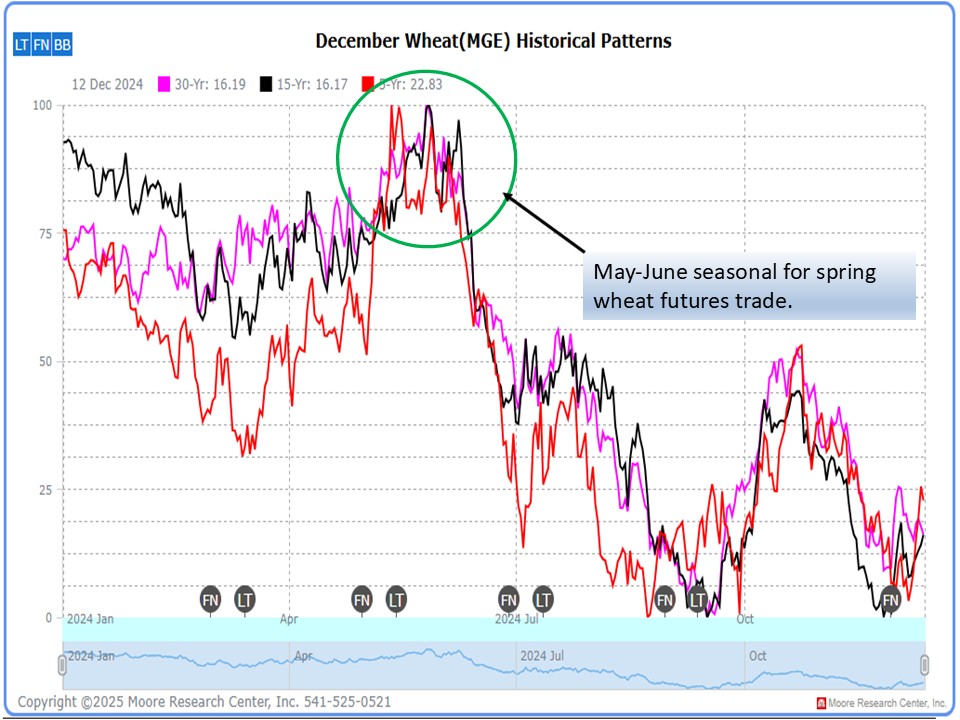
Note that the seasonal on Minnie spring wheat futures tends to turn down after mid-May.
CANADIAN GRAIN MARKET
ICE canola futures ended a bit weaker on Tuesday, pressured by weakness in crude oil and a softer tone across the broader oilseed complex. Declines in crude reduced support for vegetable oils tied to biofuel demand, weighing on canola values alongside losses in Chicago soyoil. Additional pressure came from improving planting progress expectations across North America and ample global oilseed supply prospects, including a record large Brazilian soybean crop outlook. Profit taking was also negative for canola.
July lost $1.50 on Tuesday to close at $757.30/tonne, and November was down $1.10 at $762.10.
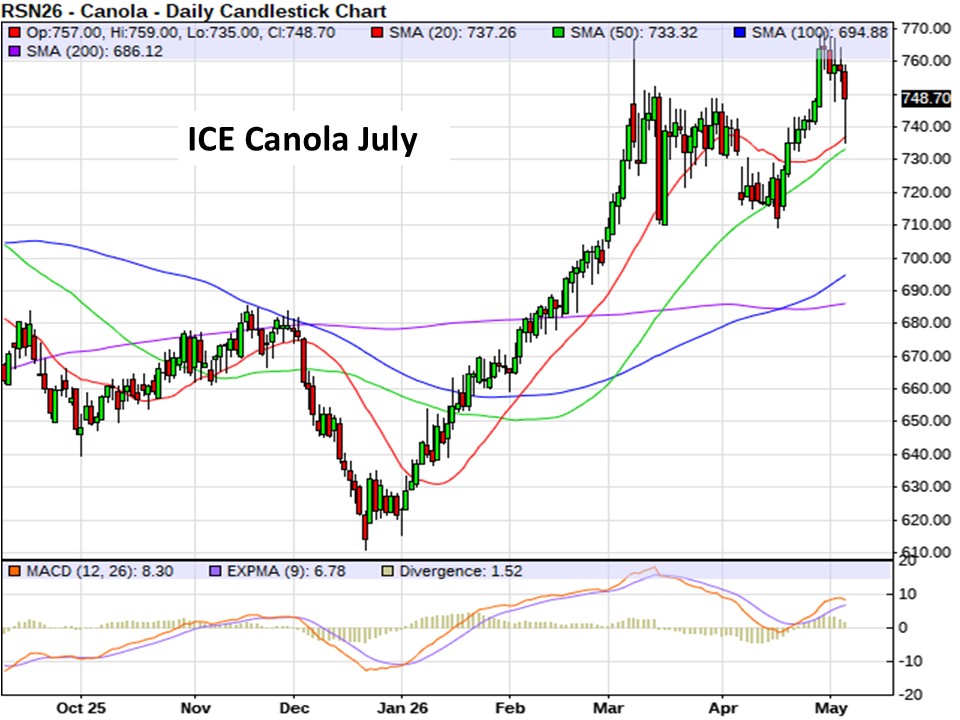
For today… canola futures are posting losses this morning…down $8 to $13/tonne. Benchmark July canola futures are trading $8.70 lower currently at $748.60/tonne. But that s far improved from the $22/t plunge we saw at the low of the overnight session which tested support at the 20-day moving average ($737).
Energy and ag markets are down pretty hard as reports suggest that Iran and the US are considering proposals to end the war. That is not an uncommon headline, but what has changed this time is the pattern leading up to it. The Trump administration has made it clear this week that they want to be done with the war with Trump’s trip to China on May 14 possibly being a consideration. The apparent one-page agreement that the US is proposing suggests part of the deal will be for both sides to lift restrictions on the Strait of Hormuz. With that, ag and energy markets have sold down.
Canola futures are down on the news, tracking the sell-off in CBOT soyoil and diesel markets. CBOT soybeans, EU rapeseed and Malaysian palm oil markets are all weaker today.
Not that it matters on a day like today, but persistent soyoil gains on most days resulted in another record ICE canola crush margin being set Tuesday at $410.04/tonne for May and $382.66/t for July according to exchange data.
The canola market outlook for the 2026 summer season remains cautiously optimistic but faces significant volatility…as we are seeing this morning. Prices recently rallied to four-month highs, with July futures trading above $760/tonne just a couple of days ago.
Market Drivers for Summer 2026
Bullish Supply Signals:
Tight Carryout Stocks: Agriculture Canada projects a sharp drop in ending stocks for the 2026-27 crop year to 1.06 MMT, which analysts describe as bullish for prices if realized.
Delayed Seeding: a cool spring and some areas of excessive moisture has created a “weather premium,” with potential late planting risks supporting current price levels.
Global Shortfalls: Australian canola production for 2026/27 is projected to fall by 19% due to supply constraints for diesel and fertilizer.
Bearish Pressures:
Forecast Discrepancies: The USDA projects Canadian ending stocks at 2.63 MMT, more than double AgCan’s estimate. This gap could lead to a sharp price correction if the USDA’s higher supply outlook proves more accurate.
Increased Acreage: Canadian farmers intend to plant 21.8 million acres of canola in 2026, a 1% increase over 2025, driven by strong domestic demand and record-breaking crush capacity.
Price Outlook and Seasonality
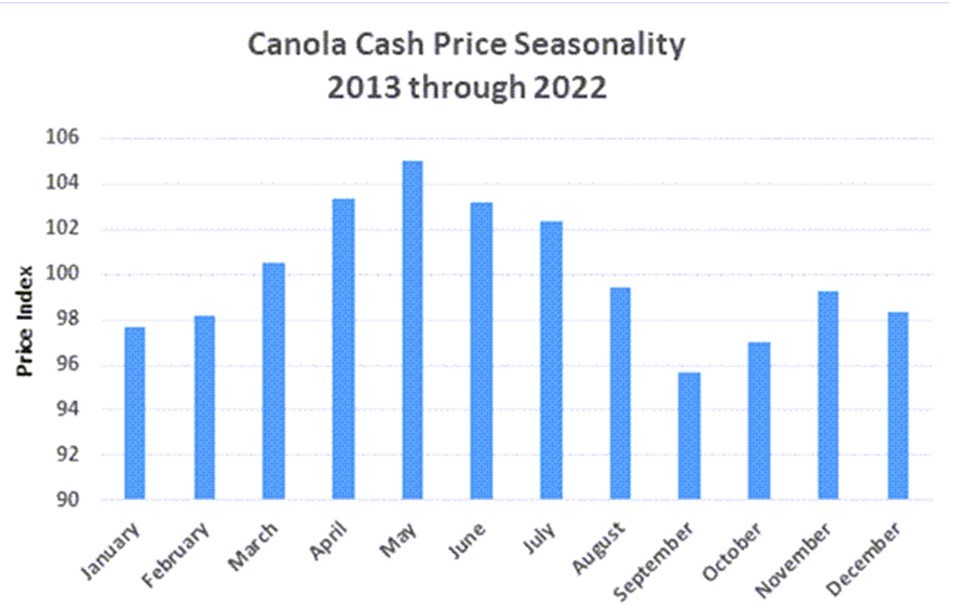
Historically, canola prices tend to peak in the May June period before eroding from mid-July into the harvest lows of September and October.
Summer Range: While recent momentum had pushed July canola futures above $760/tonne, AgCan s full-year average price forecast for 2026-27 remains more conservative at $650/tonne.
External Influences: Canola is tracking broader reverberations in crude oil and vegetable oil markets due to biofuel demand expansion and geopolitical tensions in the Middle East.
Seasonally…canola prices tend to make a low during the September-October period when there is the most abundant supply. Harvest progress, yield reports and buyer demand all affect timing of harvest price lows. After a harvest low, prices usually rebound as harvest-time selling pressure subsides and as demand again becomes evident.
Canola prices tend to level off into calendar year-end, trade sideways to lower into mid-February and then improve into spring. Canola prices tend to peak sometime in May-June and, unless production problems continue to support prices, canola prices usually erode from mid-July into a harvest low. Seasonal price declines through summer and into the harvest can interrupted by a frost concern in August or early September.
Seasonal price patterns are one factor to consider when developing a marketing plan and analyzing a market. Fall delivered prices tend to be the highest at the beginning of the growing season when production uncertainty is the highest. That is often a good time to forward price some expected production, considering cash flow needs and available storage for the expected new crop.
However, in a year of reduced crop production in a major northern hemisphere area, prices can rise during the growing season right into harvest. Because of this possibility and that of an unexpected production shortfall on your farm, it is recommended to forward contract with buyers no more than about 35% of expected production prior to harvest. To price a higher percentage of canola before harvest, it is prudent to use the futures or options market to avoid the additional physical delivery commitments of contracts.
Seasonal prices should be considered as more of a tendency than a certainty. However, of the many factors that can affect crop prices, the seasonal price pattern is a factor to keep in mind.
Stay informed with our daily market videos. Each video quickly covers key futures moves, price trends, and market signals that matter to Canadian farmers. Get clear, timely insights in just a few minutes. Bookmark https://www.producer.com/markets-futures-prices/videos
To access the latest futures prices, go to https://www.producer.com/markets-futures-prices/
Source: producer.com