
Drones and lasers good tools to measure methane emissions
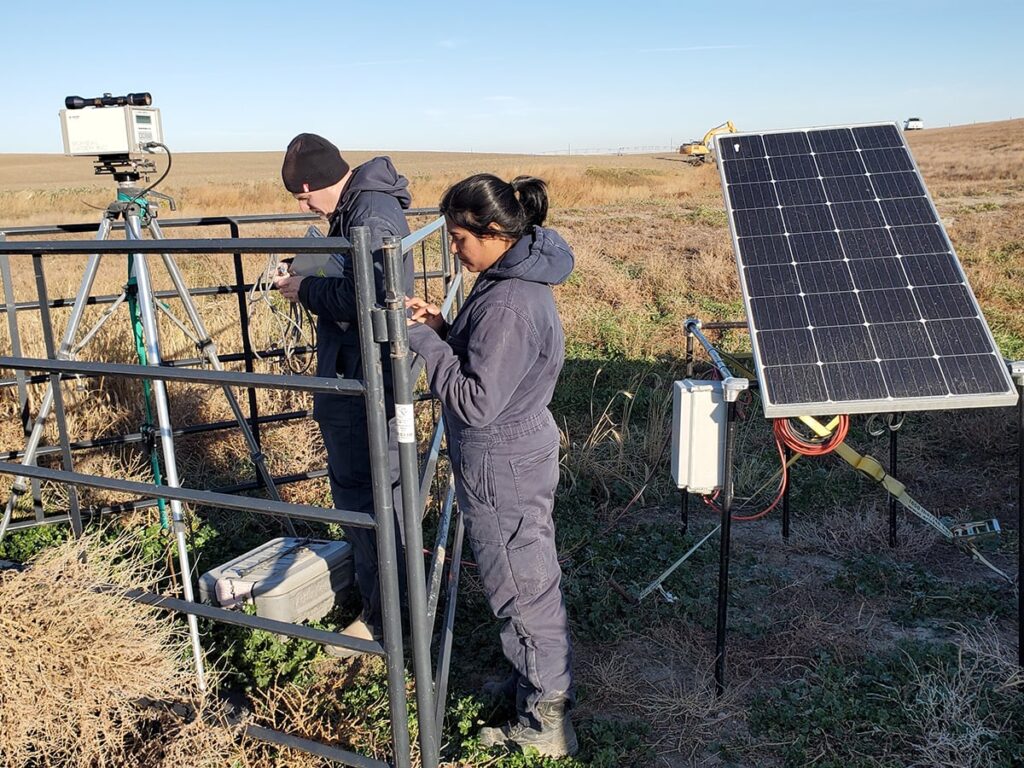
Drones and lasers can be used to accurately measure methane emissions from feedlots.
This research was presented by Sushree Dash, a PhD candidate at McGill University in Montreal, and a research participant at Agriculture Canada’s Lethbridge Research Centre.
“Beef cattle produce methane, which is mainly from their digestion, a process called enteric fermentation. Methane is an important greenhouse gas, about 80 times more warming than carbon dioxide over a 20-year period,” said Dash, who spoke during an Alberta AgriSystems Living Lab webinar.
“Canada has committed to reducing this agriculture emission intensity by 35 per cent by the year 2030. That’s a very ambitious target,” she said.
Methane measured
To make reductions, methane must be measured, she said.
“Before we can make a good policy, develop carbon credits or verify that mitigation strategies are actually working, we need some reliable numbers, and that’s exactly what this research is about, getting those reliable numbers, and using the latest technology right here in Alberta,” she said.
Read Also
The data was collected at Allied Cattle Co., a commercial feedlot near Iron Springs, Alta. The feedlot is roughly 150 acres with around 26,000 cattle on average. Data was collected from August 2024 to August 2025.
Methane emissions change depending on the season, weather, diet and animal activity.
“We captured all four seasons, and that’s important because methane emissions changed with weather, diet and animal activity. We also ran focused drone campaigns, a three-day campaign in 2024 and a five-day campaign in 2025,” she said.
Feedlot animal numbers go up and down throughout a year, and total emissions follow animal numbers. Having fewer cattle on site result in lower total methane.
“In our analysis, we separated total emissions from per head emissions to understand what is driving this methane change,” said Dash.
Lasers and drones
The team used two complementary technologies to measure methane.
One was an open-path laser, which acts as a tripwire made of laser light that stretches across the feedlot. Methane is detected when it trips the beam.
The system runs 24 hours a day, seven days a week all year long and gathers a continuous record.
The other tool is a drone equipped with a highly sensitive methane sensor made by a company called Aeris technology. The drone flies in a pattern over the feedlot and measures methane concentrations at each point.
“This is more like sending someone with a gas detector to walk through every room in a building and to tell us where the methane is coming from,” said Dash.
Importance of wind
Wind is one of the single most important factors controlling methane patterns on feedlots, more than temperature, season and time of day.
When the wind is calm, less than two metres per second, methane disperses and the reading can be lower, she said.
This can mean the methane level will measure lower than it is.
Cattle pens
“Occupied cattle pens are the primary source. Pens with cattle showed consistently higher methane levels, and pens without cattle showed up clearly as lower emission zones on the drone maps,” she said.
The source of methane from the pens is a combination of enteric fermentation, animals and manure. Elevated methane can appear near lagoons, but most of that were emissions from the pens drifting down to the lagoons rather than independent lagoon emissions.
“The practical implication for mitigation is clear. If we want to reduce emissions, we should focus our efforts on cattle pens first.”
Researchers compared the emission estimates from their open path laser against the estimates from the drone, and statistically, both estimates were close.
“The laser gave us an average of about 262 grams of methane per head per day, and the drone gave about 278 grams per head per day. The difference between the two numbers were not statistically meaningful, well within the margin of error of both the instruments,” said Dash.
Drone altitude
Drones are credible scientific instruments for measuring feedlot emissions, said Dash. They can survey multiple sites and could potentially be shared across operations through producer organizations.
The laser gives continuous monitoring, while the drones give more details and flexibility than the laser.
The height at which the drones fly does make a difference. In 2024, drones were flown at 12 to 15 metres in the air. In 2025, they were flown seven metres in the air, and that change turned out to be critical.
“At a very high altitude with a high wind speed, the drone underestimated emissions by about 27 per cent,” she said.
At a high altitude with high wind speed, the wind dilutes the methane plume before the drone even flies through it at that height.
“Under seven metres of height in low wind condition, the drone matches the laser very closely, almost perfectly, and the technology itself is sound,” she said.
Flying height, wind conditions and flight patterns all make a difference when measuring methane emissions.
Feedlot capacity changes throughout the year and more cattle means more total emissions.
Seasonal patterns
There are clear seasonal patterns in methane emission. Summer and fall had the highest emissions.
“This makes sense because cattle are on high energy diets and eating more to gain weight during that time. Winter was intermediate to slightly lower intake, and spring had the lowest emissions,” she said.
These changes all come down to diet.
High fibre diets produce more methane per kilogram of feed, while high grain diets produce less methane. This is because fibre fermentation produces more hydrogen in the rumen, which get converted to methane. Grain ferments differently and processes less methane per unit of intake.
“This helps explain why spring emissions are the lowest,” she said.
Cattle are often on high grain finishing diets at that time.
Total emissions are not dependent on fibre.
Digestibility matters because methane is produced by rumen fermentation. If feed is not being well fermented within the rumen, methane production drops, even if it’s a high fibre diet.
“In practice, emission depends both on diet type and how much of the diet is actually fermented,” she said.
Emissions change throughout the day.
The lowest emissions occurred between midnight and 6 a.m. when the cattle are resting and feed intake is minimal. They climb through the morning as feeding resumes, and the highest peaks are between 5 p.m. and 8 p.m.
The peaks are driven by active feeding, and the atmosphere becoming more stable in the evening, trapping gasses near the surface, rather than dispersing them upward.
“The daily pattern has a practical implication. If someone were to take a single methane measurement at midday, they would miss the daily peak and underestimate the emission. This is one of the reasons continuous laser monitoring is so valuable. It captures the full picture across all the hours of the day, every day of the year,” she said.
Dash said producers can use the open-path laser system themselves, but using drones is more complicated.
To use them, producers need access to a certified drone pilot and specialized sensors. On the cost side, the numbers do not pencil out for an individual operation, said Dash.
It would be more practical to share equipment with a producer organization or industry body, she said.
Source: producer.com