
AM Market Report – March 16, 2026
GOOD MORNING…HERE IS YOUR MORNING MARKET NEWS
OVERNIGHT GRAIN TRADE
ICE canola futures are weaker to start this morning…down $5 to $8/tonne (overnight session lows)…declining with the US soy complex. May canola futures rose $9.10/tonne for the week ended Friday.
Chicago soybean futures are selling down hard this morning…losing 9 to 32 cents/bu, with the nearby contracts seeing the sharpest declines on US President Donald Trump s weekend threat to postpone a face-to-face meeting with Chinese President Xi Jinping at month s end in Beijing unless Xi sends warships to help secure the Strait of Hormuz. More on that below. Soymeal and soyoil futures are also posting notable declines.
Read Also
AM Market Report – March 12, 2026
GOOD MORNING…HERE IS YOUR MORNING MARKET NEWS OVERNIGHT GRAIN TRADE Grain markets are trending higher this morning. ICE canola futures…
CBOT corn futures are trading 3 to 5 cents lower this morning.
US wheat markets are mixed this morning…spring wheat futures are down fractionally on the nearbys but 1 to 3 cents higher on the deferreds…SRW is 5 to 6 cents lower, but HRW wheat futures are fractionally to 2 cents higher.
Last week s trade…and continuing into the start of this week…had very little to do with fundamentals and everything to do with the US Iran conflict. Volatility continues to run rampant across the commodity markets as the war in Iran shows little sign of slowing down. The conflict is reminiscent of the Russian invasion of Ukraine in 2022, which many thought would be over in weeks/months, yet has now dragged on into its fifth year. That uncertainty is not likely to fade soon, so watching the underlying shifts in the market remains key in navigating risk management.
The Strait of Hormuz remains largely closed, disrupting energy flows and driving a risk premium into crude oil and fertilizer, which is also spilling over into broader commodity markets. Roughly 20% of global oil flows through Hormuz, and Iran figured out that even just the threat of bombings is enough to keep tankers from moving through. Without full and safe passage through the Strait, oil prices will likely continue trading with a war premium, and that premium is spilling over into commodities.
Spec funds have piled into hard assets like commodities over the past two weeks, including the grain markets.
Latest War news
Trump threatens hit on Iran s main oil-export terminal… Kharg Island: President Donald Trump said the US would strike the export terminal for 90% of Iran s oil shipments if Tehran kept attacking vessels in the Strait of Hormuz. He also said the US obliterated military targets on the island. Iran s military said it would respond by hitting facilities owned by oil companies cooperating with the US in the region. US intelligence suggests that Iran s leadership is not at risk of collapse any time soon.
Strait of Hormuz: Iran is holding the world s main oil lifeline as a hostage to counter US and Israeli military superiority, causing the biggest supply disruption in history. Crude oil futures prices remain high even after the US issued a 30-day waiver for countries to buy sanctioned Russian oil stranded at sea. That move and a record release of oil stockpiles by world governments will not end the pain of wayward US political/military adventures.
Trump appeals to allies in the Strait of Hormuz
No country stepped forward with a commitment to help keep the Strait of Hormuz open and safe on Sunday after US President Trump appealed to China, France, Japan, South Korea, Britain, Canada and others to send warships to the shipping route. Iran has said the strait is open to all except the United States and its allies, as oil prices continue to soar the longer the war goes on.
Trump on the weekend demanded a coalition to help reopen the Strait of Hormuz, but that s fallen on deaf ears. Trump insisted that nations relying heavily on oil from the Gulf have a responsibility to protect the strait.
Trump told the Financial Times on Sunday he was expecting China to help unblock the strait before his scheduled meeting with Chinese President Xi Jinping in Beijing at the end of this month and might postpone his trip if it did not provide assistance.
While China hasn t made any direct response to the request, the state-run Global Times dismissed the idea as Trump s attempt to spread the risk of a war that Washington started and can t finish. The commentary published by the paper on Sunday night explained why Beijing wouldn t sign up to the proposal. Chinese Foreign Ministry spokesman Lin Jian sidestepped the issue of sending ships to the strait on Monday at a regular briefing in Beijing, while reiterating both sides were in communication about the summit.
Trump also ratcheted up pressure on European allies to help protect the strait, warning that NATO faces a very bad future if its members fail to come to Washington s aid. European Union foreign ministers will discuss on Monday bolstering a small naval mission in the Middle East but are not expected to decide on extending its role to the choked-off Strait of Hormuz, diplomats and officials say. German Chancellor Friedrich Merz said the US war with Iran is not NATO-related. British Prime Minister Keir Starmer discussed the need to reopen the strait with Trump, and with Canadian Prime Minister Mark Carney, a Downing Street spokeswoman said on Sunday.
Zelenskiy seeks Europe s reassurances
Allies: Ukraine s president said the US decision to ease Russian oil sanctions would not help to end its war with Russia. German Chancellor Friedrich Merz s comments suggested that the move surprised Europe. Hungary returned armored bank vehicles to Ukraine while keeping $82 million it took off seven Ukrainians. Zelenskiy called it theft.
Canada vows closer collaboration with Nordic countries
At a weekend summit in Oslo, the leaders of Canada, Norway, Sweden, Denmark, Finland and Iceland announced plans to band together and form a bloc of middle powers to influence world affairs. They released a joint statement that was long on generalities about meeting more regularly and deepening co-operation in a range of areas, but short on specifics.
Discussions followed a massive NATO military exercise in northern Norway and focus on Russian military risks, the fallout from US threats to seize Greenland and energy security. Canada is boosting its Arctic defenses as it tries to decrease its reliance on the US.
Prime Minister Mark Carney ended his three-day trip to Norway Sunday and heads to London for a meeting today with British Prime Minister Keir Starmer and an audience with King Charles III.
In Other News
– Iran conflict and Hormuz threat send diesel prices surging higher... War in Iran and blockage of a key global oil shipping route have sent diesel prices sharply higher, creating uncertainty for world energy supply and farmers who rely heavily on diesel, reports RealAgriculture. “The Strait of Hormuz [is] probably the most critical waterway in the world to oil markets,” said Patrick DeHaan, head of petroleum analysis at GasBuddy,
Attacks targeting energy infrastructure and the possibility that Iran is laying mines have made tanker operators hesitant to move ships through the region. Fuel markets around the world are reacting immediately to new information from the region. Diesel prices in Canada have risen sharply, climbing close to 40 cents per litre in about ten days. The national average now sits just under $2 per litre, while US diesel prices have climbed to roughly US $4.75 per gallon, the highest levels since late 2022.
“Consumers alone are spending tens of millions of dollars more on fuel every day across the board…jet fuel, diesel, gasoline, it’s all up considerably,” DeHaan says.
Price increases are not uniform across the continent. Coastal regions tend to see larger swings because refined fuel can be exported and must compete with global buyers. Inland regions such as the Canadian Prairies and parts of the US Midwest are somewhat insulated due to limited export capacity and infrastructure constraints.
– Iran war deprives farmers of affordable fertilizer... Farmers in Canada and the US, already worried about another year of tight profits or losses, now could have spring planting disrupted as they struggle to find fertilizer. Prices for any available supplies have spiked more than a third since the war in Iran paralyzed global trade. The US, which in some years imports half of its urea fertilizer, is about 25% short of the usual supplies that farmers buy for spring planting, according to The Fertilizer Institute, which represents the US fertilizer supply chain. Supplies could grow still scarcer if fertilizer destined for the US gets rerouted to other places willing to pay more for it, says Josh Linville, a fertilizer market analyst at StoneX. The price offered in New Orleans, the port area where most offshore US imports enter and prices are set, is as much as $119/tonne less than global prices.
Farmers who do significant springtime fertilizer application and have not already purchased their supplies are finding retail centers empty, or stocked with supplies sold at such a premium that it’s unaffordable. “It sends shivers down your spine,” said Saskatchewan farmer David Altrogge, whose broker told him that a local fertilizer dealer had stopped offering prices for fertilizer due to the shortage.
The Iran war has cut off critical nitrogen fertilizer supplies from the Persian Gulf to the world’s farmers. More than 30% of world nitrogen fertilizer exports, as well as fertilizer components like sulfur, pass through the now effectively closed Strait of Hormuz.
– New US tariff investigation includes Canada... US President Donald Trump s administration late last week began its second tariff investigation in as many days, this time including Canada, continuing its effort to rebuild his key trade policy that was struck down by the US Supreme Court. The office of US Trade Representative Jamieson Greer on Thursday initiated the probe under Section 301 of the 1974 Trade Act into forced-labor practices in 60 economies. The European Union, China, Japan, South Korea, Canada, Mexico, India, Taiwan and the UK are among the targets of the inquiry. The move follows another sweeping inquiry announced Wednesday focused on industrial overcapacity in more than a dozen US trading partners, including major economies such as China, India, Japan and the EU…but didn t initially include Canada…until now.
Greer’s US Trade Rep office will look at whether the countries named have policies or practices that “are unreasonable or discriminatory and burden or restrict US commerce.”
Last month, the US Supreme Court struck down President Trump’s favourite tariff tool, which he used for his “Liberation Day” tariffs and fentanyl-related duties on Canada, Mexico and China. In response to the ruling, Trump implemented a 10% worldwide tariff using Section 122 of the 1974 Trade Act. Those tariffs do not apply to goods compliant with the Canada-US-Mexico Agreement (CUSMA) on trade. Section 122 tariffs can only increase to 15% and expire after 150 days unless Congress votes to extend them. An extension would be unlikely to get the approval of Congress.
Canada is also being hammered by Trump’s separate Section 232 tariffs on specific industries, including steel, aluminum, automobiles and cabinetry.
Trump is hoping to implement longer-term tariffs through Section 301 investigations, but the process does require public consultations and reports.
Greer said that “if we find that countries have been involved in unfair trading practices” such as subsidies, excess capacity or forced labour “we can quantify that harm to US commerce and then try to resolve that issue with that country.” If the country doesn’t resolve the issue, Greer said, the Trump administration will impose tariffs.
It’s not immediately clear what the 301 investigation of Canada could cover. There are long-standing irritants in the Canada-US trading relationship and Trump has complained repeatedly about Canada’s dairy supply management system. The 301 investigations are launching as Canada, Mexico and the US prepare for a mandatory review of CUSMA.
Trump has cast doubt on his commitment to the trade pact, which was negotiated during his first term. He has called it “irrelevant” and has said it may have served its purpose.
– Leaders in US ag and manufacturing stress stability of CUSMA… Leaders across American agriculture and manufacturing are stressing the importance of stability provided by the Canada-US Mexico Agreement. Basically do no harm to this agreement because it is working.
Dave Walton, Iowa farmer and vice president of the American Soybean Association, says CUSMA has established supply chains that are now vital to all three countries. As we are in these uncertain times, it s one of the things that we ve been able to rely on. He says, US soybean farmers have been able to quadruple our exports into Mexico and double our exports into Canada.
Stu Swanson, chair of the Iowa Corn Growers Association, says it s been beneficial for both producers and consumers. It s an agreement that we can visually see. He says, Trains loading in Iowa, heading south across the Mexican border. We see pigs farrowed in Canada that are imported into Iowa. That relationship back and forth of all of those types of products is critically important.
Curt Blades, senior vice president with the US Association of Equipment Manufacturers says, A tractor will cross the borders with Canada and Mexico eleven times before it becomes a whole tractor. He adds, That s just basically how the supply chain has been set up. We simply don t have all of that capacity in the United States, so we rely on our friends.
In a recent release, the US National Foreign Trade Council also underscored how the trilateral agreement supports American jobs, strengthens North American supply chains, and helps US industries compete globally.
– US, China discuss farm goods, managed trade in Paris talks… Top US and Chinese economic officials held “remarkably stable” talks in Paris on Sunday that touched on potential areas ?of agreement in agriculture, critical minerals and managed trade for US President Trump and Chinese President Xi Jinping to consider in Beijing, sources familiar with the talks said. The sources told Reuters that the “candid and constructive” Paris talks led by US Treasury Secretary Scott Bessent and Chinese ?Vice Premier He Lifeng would set in motion possible “deliverables” for Trump’s trip to China to meet with Xi ?at the end of March. But the talk so far seems more about diplomatic pleasantries rather than hard target advances in trade. But we ll see.
The Chinese side reportedly showed openness to potential additional purchases of US agricultural goods including poultry, beef and non-soybean ?row crops, one of the sources said, adding that China was still committed to buy 25 MMT of ?American soybeans for each of the next three years. But there was no official statement of such from Chinese officials who left the weekend talks at the OECD headquarters in Paris without speaking to reporters.
– Rains hamper Brazil s soybean harvest... Despite excessive rains hampering Brazil s soybean harvest in February, the crop remains on pace to establish another record for marketing year 2025-26, according to the latest forecast from the National Supply Company (Conab). The agency said about 51% of soybeans had been harvested, and 2025-26 production is projected to reach 177.8 MMT, in line with last month s outlook.
February was a challenging month for soybean producers, with excessive rainfall in the Central-West and Southeast regions, especially in Goi s and Minas Gerais, and irregular weather in much of Rio Grande do Sul, Conab said. At the beginning of March, the North and Northeast regions are experiencing hampered fieldwork due to excessive rainfall.
With record production, robust soybean exports are seen in 2026, Conab said, with projected shipments potentially reaching 114.39 MMT, which would be a new record if the volume is realized at the end of the oilseed s marketing year.
The rainfall that affected the southeast and midwest regions of the country also resulted in later planting of the second corn crop. Some states, such as Gois, Maranho, and Minas Gerais, are already indicating a reduction in the area dedicated to the cereal, Conab noted. The estimated area for the second corn crop is 43.72 million acres, with a projected production of 108.4 MMT, while the first corn crop has an outlook of 10.13 million acres and 27.4 MMT. Total production for all three corn crops for 2025-26 is expected to reach 138.3 MMT.
Outside Markets
The Dow Jones Industrial Average finished 119.38 points lower on Friday to settle at 46,558.47, while the S&P 500 dipped 40.43 points lower to 6,632.19. Early Monday, the March Dow Jones Futures are up 363 points.
Global stock markets are mixed to higher so far this morning as hostilities in the Persian Gulf kept oil prices in an elevated state…though weaker this morning…clouding an inflation outlook that should keep most central banks on pause at policy meetings this week.
The Bank of Canada is expected to hold interest rates steady this week while striking a more hawkish tone in its communications amid the surge in global oil prices that has reignited concerns about inflation. The US Federal Reserve also makes its next rate decision on Wednesday.
Wall Street futures pointed higher after major North American markets closed down on Friday. Canada s TSX composite stock index futures finished 298 points lower on Friday.
The US economy grew at a just 0.7% annualized pace in the fourth quarter of 2025, the US Commerce Department said Friday, down from an earlier estimate of 1.4%. The figure reflected downward revisions to exports, consumer spending, government spending, and investment, while imports decreased less than previously estimated.
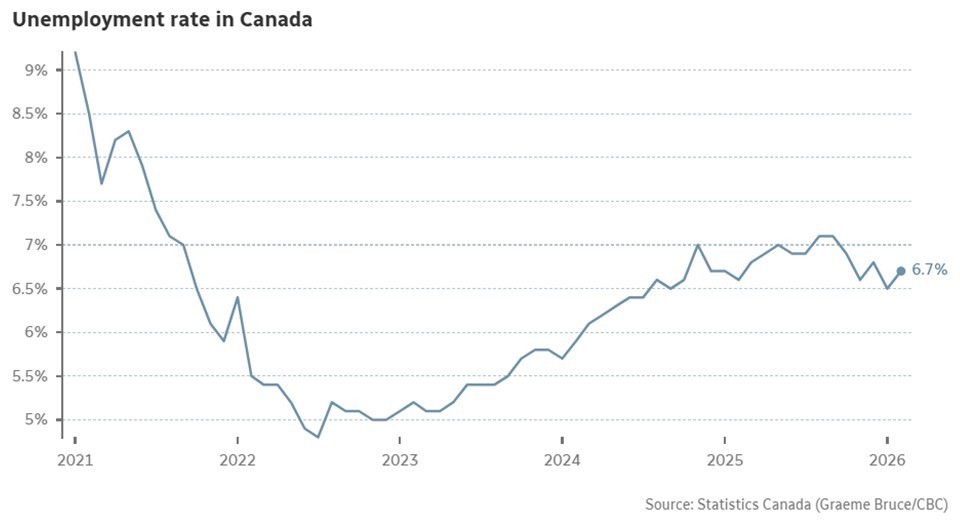
Meanwhile, the Canadian economy lost the most jobs in more than four years last month, driving the unemployment rate up to 6.7%. Employment fell by 83,900 in February, according to Statistics Canada on Friday. That followed a 25,000 employment decrease in January, when the unemployment rate was 6.5%. The job losses suggest the labour market remains soft as the economy bears the weight of US tariffs and an upcoming review of the CUSMA trade agreement looms over businesses.
Statistics Canada this morning reported says the annual rate of inflation in Canada dipped below 2% in February as the end of last year s federal tax holiday helped take some steam out of the yearly price comparisons. The agency said that February s inflation reading came in at 1.8% year-over-year, half a percentage point lower than January s figures and just under economists expectations for the month. The main factor driving the headline number lower was the end of last year s tax holiday, which saw the federal sales tax taken off a variety of household staples, gifts and dining out for a two-month period ending mid-February 2025. But economists expect higher headline inflation figures in the months to come as energy prices have spikes higher.
The Bank of Canada will be carefully analyzing the latest price figures as the central bank is set for an interest rate decision on Wednesday.
The March US Dollar Index is down 0.362 at 100.000. The Canadian dollar strengthened against its US counterpart…currently quoted at 73.10 US cents.
April crude oil futures are down $3.16 at US $95.55/barrel. Oil prices are lower this morning, but remain sharply higher since the start of the US-Israeli ?war on Iran which has disrupted oil production and shipping in the Middle East. US President Trump s call for global efforts to help fix the mess he has created in the Persian Gulf has been met with silence from countries around the world.
Grain Markets
Chicago soybean futures are trading sharply lower this morning, down 25 to 32 cents/bu in the three front month contracts, and 9 to 15 cents lower in the further out deferreds. Bean futures dipped 2 to 6 cents lower on Friday, though the nearby May contract still advanced up 24 cents for the week. Soybeans made new contract highs on Thursday night, and have pulled back since then.
Soymeal futures are losing $3 to $6/ton this morning after ending mixed on Friday, with May up $5.50/ton on the week. Soyoil futures are 77 to 124 points weaker this morning after finishing Friday mostly within 8 points of unchanged, with the May contract gaining 86 points for the week ended Friday.
US Treasury Secretary Bessent and Chinese counterparts met this weekend in Paris to prep for the planned meeting between President Trump and President Xi later this month. Following the meeting it was noted that China was open to buying more US ag goods. But late on Sunday, Trump stated he might delay the meeting with Xi if China did not help unblock the Strait of Hormuz.
Weekly CFTC data via the Commitment of Traders report indicated another 23,205 contracts added to the managed money net long in CBOT soybean futures. That took the spec fund net long position to 222,107 contracts as of last Tuesday (Mar 10). Specs in bean oil added another 33,329 contracts to their net long at 108,838 contracts.
Brazil s soybean harvest was tallied at 61% complete by Thursday according to AgRural, behind the 70% pace from last year. On Friday, CONAB cut its guess for Brazil s soybean crop by 0.1%, but it will still be record large at 177.847 MMT, and CONAB also anticipating an all-time high for exports.
Chicago corn futures are trading 2 to 5 cents lower this morning. The corn market finished Friday steady in some deferreds to 4.75 cents higher in the front months. May corn closed last week with a net 6.75 cent gain. Corn made some multi-month highs last week and new highs for the move which was an opportunity for producers to do some cash selling.
The weekly Commitment of Traders report from CFTC showed a total of 140,297 contracts of futures added to the spec fund net long position in the week ending on March 10. That was the largest Tuesday/Tuesday bull move since May 2019 and took their net long position to 193,271 contracts. If the war continues to escalate in Iran and crude oil continues to rally the funds will add to their length in the corn market.
Producer selling has been noted, as commercials added 143,803 contracts to their net short to 477,414 contracts.
AgRural estimate the Brazilian first corn crop at 50% harvested by Thursday, lagging the 72% pace last year. The second crop corn was at 91% planted, behind the 97% pace a year ago.
CONAB s guess for Brazil s total corn crop was 0.1% lower than last month at 138.27 MMT, largely due to some acreage changes for the first and second crops. The first crop is now pegged at 27.35 MMT, up 2.4% from February, with the second crop at 108.435 MMT, down 0.8%. A year ago, Brazil s corn crop was 141.158 MMT.
US wheat markets are mixed this morning…Minnie spring wheat futures are fractionally weaker in the front month contracts, but 1 to 3 cents higher in the deferreds. HRW wheat futures are fractionally to 2 cents higher this mo0rning, but SRW futures are 5 to 6 cents lower. The US wheat complex posted double digit gains on Friday…spring wheat posting 7 to 11 cent gains, May wheat up just 2.5 cents on the week.
Commitment of Traders data from Friday showed managed money cutting 3,455 contracts of their net short position in CBT wheat futures, taking it to 22,345 contracts as of Tuesday. In KC wheat futures, specs were net long 9,425 contracts, an increase of 7,559 contracts wk/wk. In spring wheat, spec funds piled onto the long side by 12,027 contracts to a net long of 15,990 contracts.
Spec fund traders have been short wheat futures for so many years…seem to be lifting out of that position. And I think with the war going on, higher energy costs, maybe a little weather premium, they just don t want to be short wheat anymore.
Traders are wary of potential freeze damage to US winter wheat ahead of a storm in the US Midwest and Plains, while Minneapolis is looking at weather ahead of spring planting. Globally, the trade s watching conditions ahead of full emergence in Europe and the Black Sea region, along with any further impact from Russia s ongoing war with Ukraine. Concerns about fertilizer prices are also supportive for wheat.
CANADIAN GRAIN MARKET
ICE canola futures rebounded on Friday, overcoming losses earlier in the session. Later advances in crude oil amid the war in Iran offered support to canola after the market was initially weighed down by early weakness in crude and profit-taking. Gains in Malaysian palm oil and declines in the Canadian dollar further underpinned canola. A weak employment report from Statistics Canada today sent the loonie to a 10-day low against its American counterpart.
Chicago soybeans ended a bit lower on Friday, while soyoil was just mixed. European rapeseed was mixed as well.
May canola was up $5.60 on Friday to finish at $739.90/tonne, and November added $3.70 to $734.20.
For today… canola futures are $5 to $8/tonne weaker to start this morning, declining with the US soy complex. May canola futures are off $8.40 this morning at $731.50/tonne after gaining $9.10 for the week ended Friday.
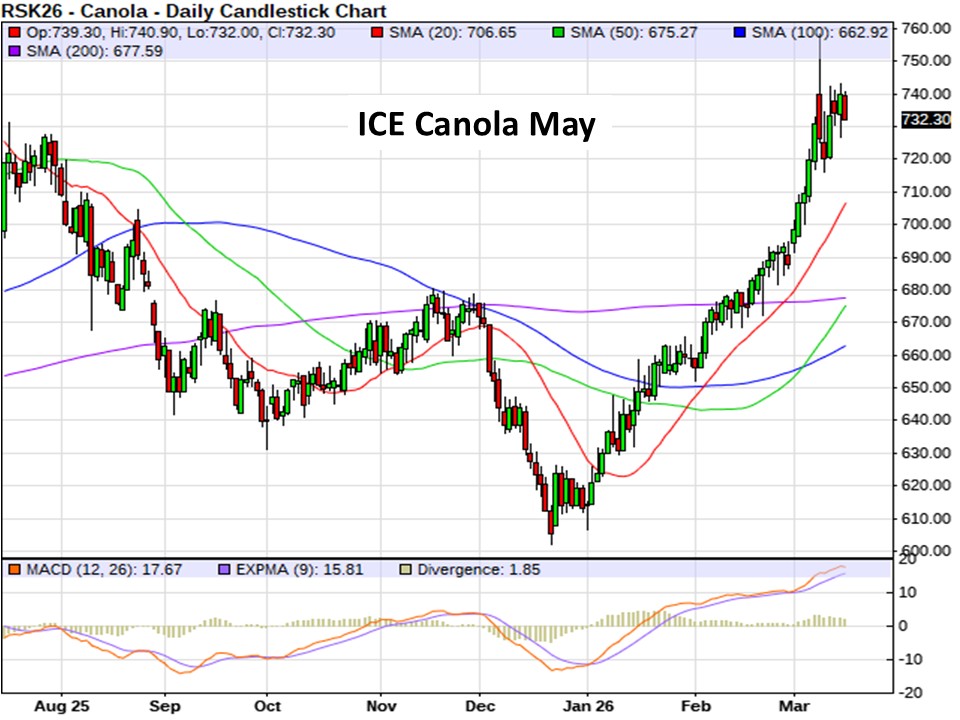
The canola market is following the US soy complex lower this morning. Trump s weekend threats to the world to come help fix the mess he created in the Persian Gulf has been met with near silence. And soybeans are down with his latest threat to postpone his trip to China at month s end unless China helps secure a reopening of the Strait of Hormuz. Plus… there is already increasing tension between the two countries over the US pushing ahead with another tariff investigation.
While CBOT soyoil futures are down this morning, they have rallied sharply since the start of January on expectations of stronger US biofuel mandates and as crude oil supplies tighten. Rumors circulating suggest the US EPA biomass-based diesel mandate could reach: 5.4 billion gallons, with refinery exemption reallocations added the effective level could rise to 5.61 billion gallons.
I m still inclined to be a seller of cash canola at/near $16/bu, depending on region…move to 60 or 70 per cent on old crop…maybe do the first 10% of new crop forward contracting.
We are trading in a highly volatile marketing environment…reward rallies with incremental cash sales.
On the feed grains… Prices for Prairie feed barley and wheat have been on the rise. Ag Value Brokers vice-president Darcy Haley says there are two main reasons for recent increases for feed grains…there remains an ongoing lack of farmer selling, plus stiff competition from the grain companies looking to export Canadian barley. That competition keeps moving a little more south, he said. The grain companies are very aggressive in purchasing barley for export.
Added to that, Haley said there s a minor third reason, a pickup in demand from end users after being on the quiet side for the last four months.
Feed barley is currently pegged at $295/tonne delivered Lethbridge for April-May-June and feed wheat at $287. He suggested barley could poke above $300/tonne in the coming weeks. Growers should be considering this an opportunity to boost old crop cash sales.
Stay informed with our daily market videos. Each video quickly covers key futures moves, price trends, and market signals that matter to Canadian farmers. Get clear, timely insights in just a few minutes. Bookmark https://www.producer.com/markets-futures-prices/videos
To access the latest futures prices, go to https://www.producer.com/markets-futures-prices/

Source: producer.com