
AM Market Report – March 9, 2026
GOOD MORNING…HERE IS YOUR MORNING MARKET NEWS
OVERNIGHT GRAIN TRADE
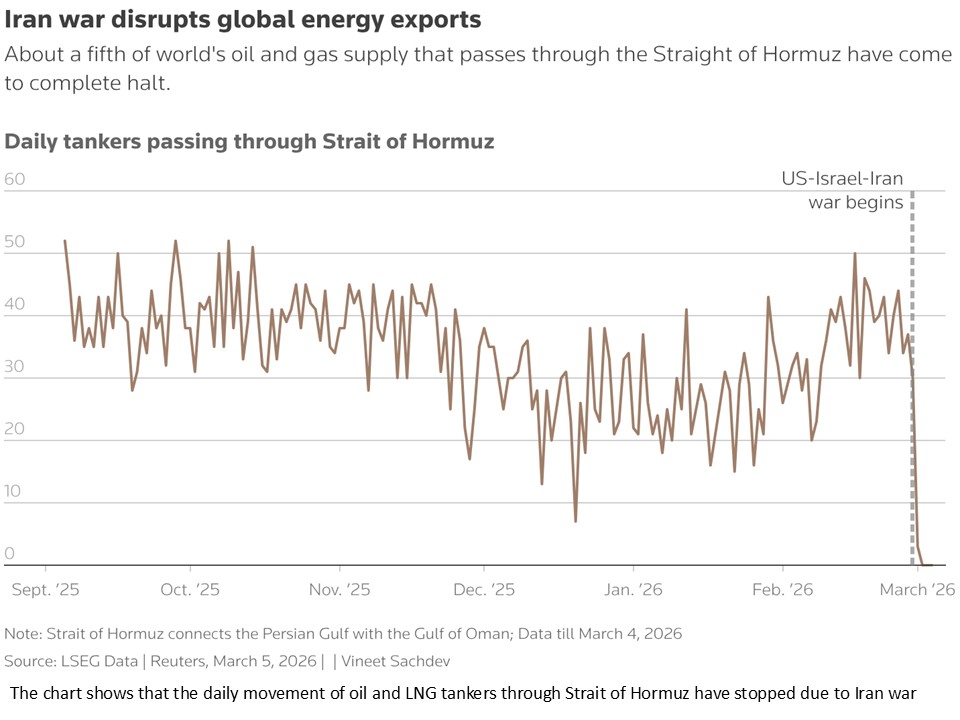
Today, fighting enters Day 10 of the US-Israeli war against Iran. Oil prices surged higher overnight to their highest since mid-2022…leaping over $100/barrel for WTI crude oil to what looked to be record one-day gain…but have now backed off their once stratospheric overnight highs. Still, oil prices remain on a steep trajectory higher as an escalating Iran war has squeezed world energy supplies, with some major Middle Eastern oil producers cutting output on fears of prolonged disruption to shipping through the Strait of Hormuz chokepoint.
Read Also
Prairie Weather
There is some light, scattered precipitation falling in northern and southern Alberta this morning while the eastern Prairies are mostly…
Agriculture markets, led by vegetable oils, have rallied last week and into this morning as they take their cue from oil prices due to the extensive use ?of vegoils in making biofuels.
“The violent reaction stems from the markets seeing no obvious offramp in the escalating ?Middle East conflict, now a high-stakes standoff where neither side appears willing to blink first,” Tony Sycamore, IG market ?analyst, said in a note. “The risk of more lasting economic damage continues to build by the day.”
Iran named Mojtaba Khamenei ?to succeed his father Ali Khamenei as Supreme Leader, signalling that hardliners remain firmly in charge in Tehran a week into its conflict with the United States and Israel.
In ag markets, Malaysian palm oil rose 9% at one point overnight and Chicago soyoil climbed to its highest in almost 3 years, buoyed by ?the crude oil rally. ICE canola futures also surged higher overnight…up as much as $28/tonne…but upward momentum has moderated now to gains of $1 to $8/tonne right now.
Latest on the war in Iran…
– Fitch Ratings says Strait of Hormuz closure likely temporary.
– Iran signals no letup as Khamenei s hardline son becomes leader.
– Crude oil pares to still strong gains after soaring muh higher at one point overnight.
– G7 to discuss release of oil from IEA reserves to tame prices.
– US, European stock markets drop, after South Korea, Japan lead Asian slump.
– Economist Ed Yardeni raises odds of US stock market meltdown to 35% on Iran war.
– US considers idea of special operation to seize Iran s uranium.
Currently…
ICE canola futures are trading $1 to $8/tonne higher this morning, led by the nearby May contract which already rallied $42.10/tonne higher last week. Chicago soybean futures are up 5 to 8 cents.
Chicago corn futures are 2 to 3 cents higher this morning, Minnie spring wheat up 6 to 8 cents, but the winter wheats are dipping 1 to 2 cents lower.
All ag markets are well off their overnight session highs.
War risk, energy spikes, and panic money flows dominate trade. Fundamentals and charts take a backseat as capital rushes into commodities alongside surging crude oil prices.
In Other News
– War in Iran raises crop prices worldwide… Palm oil prices surged as much as 10%, soyoil jumped and wheat neared a two-year peak as the war in the Middle East drove energy and fertilizer costs higher and threatened to tighten supplies across agricultural markets, Bloomberg reported overnight. Disruptions to crude oil supplies wrought by the conflict are boosting the appeal of crop-based biofuels, lifting demand for vegetable oils and corn.
The effective closure of the Strait of Hormuz…a major conduit for the fertilizer trade…has also led to a spike in the price of crop nutrients as farmers rush to secure supply. In addition, wartime food security concerns could spark some countries to stock up on staples like wheat, said the report.
Palm oil prices jumped the most since 2022, when top grower Indonesia halted exports. The macro and energy markets will continue to lead ag commodities on any escalation of the war on Iran, said Joe Davis, director at brokerage firm Futures International.
– Stagflation concerns grip stock, financial markets… Optimism for a quick resolution of the conflict in the Middle East is rapidly ebbing in financial markets, with investors pricing in a deeper and longer-lasting supply shock, Bloomberg reports. The shift in market sentiment gathered pace after President Trump said parts of Iran had yet to be attacked and that $100 crude was a very small price to pay for safety and peace, undercutting hopes the conflict would be relatively contained. Investors have had to increase their probability of the worst-case scenario, with the challenge being the stagflationary nature of the shock, and are now bracing for a long winter with no clear timeline of an end to it, said the report.
Meantime, International Monetary Fund Managing Director Kristalina Georgieva said lengthy hostilities in the Middle East would risk hitting markets and economies, while throwing up unexpected challenges that require policymakers to prepare for a new normal. Georgieva said a 10% increase in energy prices persisting for a year would push global inflation up by 40 basis points and slow economic growth.
– G7 to discuss joint release of oil reserves… G7 finance ministers will discuss a possible joint release of petroleum from reserves coordinated by the International Energy Agency, in an emergency meeting on Monday aimed at tackling the surge in oil prices following the conflict in the Gulf, according to the Financial Times. The ministers and Fatih Birol, IEA executive director, are meeting by teleconference this morning to discuss the impact of the Iran war, according to people familiar with the situation, including a senior G7 official.
Three G7 countries, including the US, have so far expressed support for the idea, according to the people familiar with the talks, said the Times. The 32 members of the IEA hold strategic reserves as part of a collective emergency system designed for oil price crises. One person said some US officials believe a joint release in the range of 300 to 400 million barrels…25 to 30 percent of the 1.2 billion barrels in the reserve…would be appropriate, said the report.
– Trump faces multiplying dangers from Iran war… Week two: The US-Israel attacks killed the supreme leader and hurt Iranian forces, but a prolonged military engagement and a regional conflict threaten fallout beyond Donald Trump s control. His struggle to articulate a detailed set of goals or a clear endgame and the risk of American casualties and economic costs could shake his influence on MAGA supporters. Then again, maybe the White House’s use of SpongeBob SquarePants, Iron Man and Call of Duty memes will do the trick.
Unconditional surrender : The president s call for Tehran to capitulate could make it more difficult to negotiate a swift end to the fighting. Iran apologized to its neighbors after strikes on Gulf Arab civilian targets. The war is rattling businesses worldwide and raising questions about trade routes critical to the flow of goods from food to clothing
– Canada-US trade talks are restarting… For the first time since US President Donald Trump called off negotiations last October…supposedly over a TV ad…Prime Minister Mark Carney’s point man, Canada-US Trade Minister Dominic LeBlanc, met face to face with his White House counterpart (US Trade Rep Jamieson Greer) in Washington on Friday. The meeting came at a pivotal moment for the $1.3-trillion Cdn annual trading relationship between the two countries. While Trump continues to impose punishing tariffs on Canadian steel, aluminum, automobiles, softwood lumber, copper products, kitchen cabinets and more, the Canada-US-Mexico Agreement (CUSMA) is up for renegotiation. The timing means Canada’s efforts to get rid of those tariffs targeting key industrial sectors will be intertwined into the CUSMA talks.
That gives the US negotiating leverage for the many changes it wants made to the trade deal, including greater access to Canada’s dairy market and an end to rules that force US streaming platforms to run Canadian content and fund domestic production.
Hovering over the talks: US threats to impose new tariffs to replace the ones struck down two weeks ago by the US Supreme Court, to break up CUSMA into separate deals with Canada and Mexico, and potentially terminate the agreement…a move that could expose all Canadian exports to Trump’s blanket tariffs. Tariffs will be part of whatever trade deal is negotiated with Canada, Greer told the CBC last month on the night of Trump’s state of the union address.
Despite that, the fact that Greer and LeBlanc are again holding face-to-face talks is significant, said Eric Miller, a Canada-US trade expert and president of Rideau Potomac Strategy Group, a Washington-based consulting firm. “This is something which I think is a very positive sign,” Miller told CBC News.
Miller said the resumption of talks now means the US needs to start providing Canada with some specifics of what it wants from the CUSMA negotiations, putting Canada in a better position to respond. “Of course, Canada will have views on all of those issues and will be looking to preserve as much of the agreement as possible,” he said.
The Prime Minister named Janice Charette, who served as head of Canada’s public service during both the Stephen Harper and Justin Trudeau governments, to be Canada’s chief trade negotiator with the US. Mark Wiseman, a global investment banker, pension fund manager and friend of Carney, is Canada’s new ambassador in Washington.
In related news… Twenty-four US states sued the administration over his newly imposed 10% tariffs across all world nations, saying he can t sidestep the recent US Supreme court s ruling that struck down his big tariff agenda.
– Carney signs agreement with Japanese counterpart to expand trade and defence ties… Prime Minister Mark Carney inked a series of agreements with his Japanese counterpart Friday designed to expand and modernize the bilateral relationship as he continues his push to develop deeper ties to like-minded countries in the Indo-Pacific…now that the Canada-US relationship is on shaky ground. Carney and Japanese Prime Minister Takaichi Sanae, who won a landslide election victory in February, put pen to paper on what Ottawa is calling a comprehensive strategic partnership, designed to spur bilateral co-operation in areas from defence, energy, critical minerals to trade and technology.
While the new agreement is effectively a expression of goodwill and a pledge to work together more in the future…there are no dollar figures or extensive details attached to these proposed initiatives…Carney still framed the new bilateral arrangement as something significant. This new partnership will deepen our economic and security relationship. It harnesses the scale of our ambitions, reflects the depth of our values, and positions Canada and Japan to seize enormous opportunities for both our peoples, Carney said.
The Prime Minister seems to have impressed Takaichi and the Japanese press when he recited some lines of his remarks in the local language. Carney worked in Tokyo for investment banking firm Goldman Sachs in the 1990s and picked up some proficiency in Japanese.
As part of this new partnership, there’s a commitment to do more joint military exercises in the region and Japan is considering joining Operation Nanook, Canada s annual Arctic sovereignty exercise. Together the two countries will also co-develop AI products, aggressively identify investment opportunities and deploy trade delegations to their respective countries sometime this year to stir up more business.
Canada has also agreed to support Japanese automakers desire to decarbonize their operations in Canada and expand battery supply chains, among other projects. The two countries will collaborate on international emergency response, joint Coast Guard exercises and action against illegal, unreported and unregulated (IUU) fishing in the North Pacific. Canada and Japan have also agreed to continue partnering on liquified natural gas (LNG) to deliver more of that fuel to the latter, which has relatively few natural resources of its own.
– No fertilizer relief from Russia… Fertilizer producers in Russia, the world s largest exporter, aren t in position to make up a feared global shortfall stemming from the US-Iran conflict due to a lack of spare capacity, Reuters reported, citing industry sources.
Around a third of global urea exports must travel through the Strait of Hormuz, along with other key crop nutrients. The conflict has sent urea prices soaring ahead of planting season in the northern hemisphere. US producers are seen as likely to somewhat scale back corn acres in favor of soybeans as a result, while experts have begun sounding the alarm over a potential global food shortage.
Russia accounts for around a fifth of global fertilizer trade, but limited capacity, domestic export caps and recent Ukrainian attacks on major plants all constrain its ability to ramp up output, Reuters reported.
– US probes fertilizer market for possible price fixing… US antitrust regulators are investigating major fertilizer producers…including Nutrien, The Mosaic Company, CF Industries, Koch Industries, and Yara International…over potential collusion to raise fertilizer prices, according to a Bloomberg report. The probe, led by the US Department of Justice Antitrust Division, is examining pricing practices for possible civil or criminal antitrust violations, though no companies have been accused of wrongdoing.
The investigation focuses on the highly concentrated fertilizer market, where a small group of companies controls most nitrogen, potash, and phosphate supply. Canadian-based Nutrien and Mosaic dominate potash and phosphate production, accounting for roughly 90% of capacity, while a small group of firms controls over 80% of nitrogen fertilizer supply in the US.
US officials have raised concerns that companies may be restricting supply to maintain higher prices. Attention has also been drawn to the Canadian potash export joint venture Canpotex Ltd., which markets potash from Nutrien and Mosaic globally.
Fertilizer prices have eased from previous spikes but remain historically high, putting pressure on farmers dealing with lower crop prices. Geopolitical tensions and reliance on foreign fertilizer supplies are also contributing to renewed price volatility.
– Japan, France, Canada work on alternatives to US-led trade bloc for rare earth supplies… Group of Seven members Japan, France and Canada are working on alternatives to a US-led trade bloc to secure critical minerals and reduce reliance on China, according to three senior officials from these countries. Some options include import quotas on certain rare earths, subsidies for mining companies to diversify the supply chain on critical minerals, and a buyers’ club, a Canada-led G7 initiative that aims to develop a reliable supply chain of critical minerals outside of China and break that country’s monopoly on these metals.
Outside Markets
The Dow Jones Industrial Average closed down 453.19 points on Friday to settle at 47,501.55, while the S&P 500 fell 90.69 points to 6,740.02. Early Monday, the March Dow Jones Futures are down 437 points, which is a marked improvement from far steeper losses overnight.
Global stock markets are slumping as surging oil prices exacerbated inflation worries with the US- Israeli war on Iran showing no signs of slowing down. Wall Street futures were in the red again this morning after major North American markets closed sharply down on Friday. Canada s TSX stock index futures have followed sentiment lower.
Faced with the worst oil supply shock since the 1970s, all eyes will be on Washington s response, said Helima Croft, head of global commodity strategy at RBC Capital Markets. With no clear definition of what winning looks like, it is hard to forecast whether this will be a multi-week or multi-month conflict.
On Friday…the US Dept of Labor reported the American economy lost 92,000 jobs in February, while the US unemployment rate rose to 4.4%. That follows a gain of 126,000 jobs in January and was well short of the average economist guess for a gain of 50,000 jobs. Strikes in healthcare and brutal weather likely played a role, but the figure was nonetheless disappointing and will further stir fears of stagflation…the pernicious combo of economic stagnation and inflation…as oil prices soar in response to the Middle East conflict.
The March US Dollar Index is up 0.156 at 99.135. The Canadian dollar strengthened against its US counterpart…currently quoted at 73.78 US cents.
April crude oil futures are running up $7.85 at US $98.75/barrel. Oil prices are charging higher again this morning, as some major producers cut supplies and fears of prolonged shipping disruptions gripped the market due to the expanding US-Israeli war with Iran. Unless oil flows through the Strait of Hormuz resume soon and regional tensions ease, upward pressure on prices is likely to persist, said Vasu Menon, managing director for investment strategy at OCBC in Singapore.
Grain Markets
Chicago soybean futures are trading 5 to 8 cents/bu higher this morning, but that s now steeply over 20 cents off the overnight highs. Bean futures rallied 16 to 21 cents in the old crop contracts on Friday, as other contracts were 5 to 12 cents higher. May beans were up 30 cents last week.
Soymeal futures are near unchanged this morning after posting gains Friday of $2.20 to as much at $7.90/ton. May meal was down $3.30 on the week ended Friday. Soyoil futures are up 71 to 81 points this morning after rising 41 to 89 points higher in the front months on Friday. May bean oil was up a whopping 473 points last week.
Strikes on Iranian targets continued over the weekend, with the resource flow through the Strait of Hormuz effectively at a standstill. Crude oil pricing continues to surge higher this morning, though now off the overnight highs as G7 countries hint at opening up strategic reserves.
Brazil s soybean crop was tallied at 51% harvested as of Thursday according to AgRural, with last year at 61% by this date.
Bottom Line… Large South American crops continue to cap rallies, but that doesn’t seem to even matter right now, as geopolitics and energy markets are driving the markets and money flow. Nonetheless, it is my opinion soybean cash sales are warranted on this price spike higher with nearby CBOT bean futures spiking above psychologically important $12.00/bu mark for the first time in nearly two years. If me, I d sell my next increment of old crop cash soybean to get to 70% sold. You could also entertain forward pricing a first increment of expected 2026 new crop production (10%) for harvest delivery.
Chicago corn futures are up 2 to 3 cents/bu this morning, though some contracts are now 12 to 15 cents off the overnight highs. The corn market posted gains of 3 to 8 cents across the board on Friday, as May managed a 12 cent gain on the week.
Gains are all about geopolitics…strikes on Iranian targets continued over the weekend, with the flow through the Strait of Hormuz effectively at a standstill. Crude oil is the leader commodity.
Brazil s AgRural estimates the for first corn crop at 42% harvested as of Thursday, behind the 54% pace last year. The second corn crop was pegged at 82% planted, lagging 92% from last year.
Bottom Line… Surging crude and excellent export demand for US corn remain the strongest supportive factors, while South American planting delays are worth monitoring.
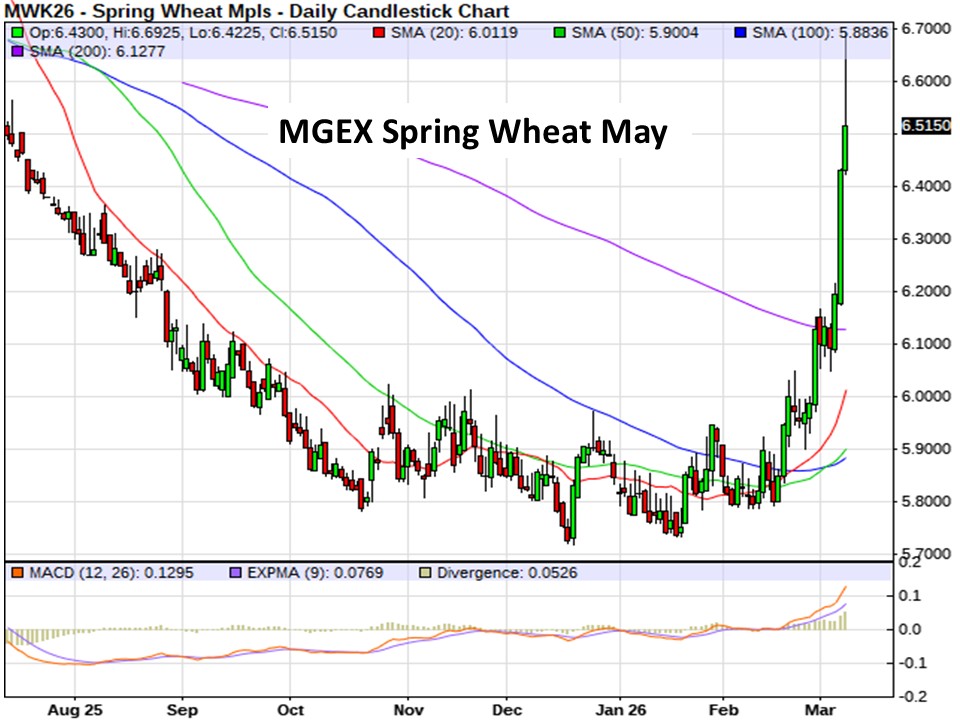
US wheat markets were higher this morning but are now mixed… Minnie spring wheat futures are up 3 to 4 cents, HRW are down 1 cent and SRW wheat down 1 to 2 cents. But like all other commodities, wheat futures have slipped off their overnight highs. The US wheat complex rallied Friday, with contracts up sharply across the three markets…spring wheat finishing the day 13 to 23 cents higher, with the May contract 30 cents higher on the week.
Wheat has rallied sharply alongside surging crude oil. However, fundamentals/supplies remain comfortable globally. The trade is anticipating minimal adjustments in Tuesday s USDA supply/demand report (Mar 10)…and even if there is a surprise, it might be glossed over quickly because of geopolitical issues.
Spring wheat futures are seeing fresh for-the-move highs posted overnight, but the chart shows the market backing off considerably from its overnight high. The dramatic push above US $6.00/bu may give credence to acreage buying as producers contemplate 2026 plantings. Highs last year were carved in mid-June. But rallies this week are being driven more by fickle macro risk and energy markets than wheat supply concerns…noted as Prairie cash basis levels are falling considerably as an offset to the futures rally.
CANADIAN GRAIN MARKET
ICE canola futures posted solid gains on Friday, supported by rising crude oil prices and strength across the global vegetable oil complex. Canola contracts closed higher for the fifth straight day as a powerful rally in energy markets lifted sentiment across oilseeds, amid escalating tensions in the Middle East and concerns about disruptions to shipping through the Strait of Hormuz.
Additional support came from strong price action in the Chicago soybean complex, particularly soybean oil. Soyoil futures rallied sharply alongside crude oil because of their role as a key feedstock for renewable diesel and other biofuels. European rapeseed and palm oil also closed higher on Friday, further underpinning canola.
On the other side, the Canadian dollar moved higher, with some strength coming from the gains in crude.
May canola futures finished Friday up $10.90 to $730.80/tonne, and November added $6.90 to $726.
For today… canola futures are trading $1 to $8/tonne higher this morning, but have now come as much as $20/t off their overnight surge higher. May canola futures are currently up $8.00 at $738.80/tonne, but traded overnight as high as $758. Hyper-volatile energy markets continue to lead ag markets.

Gaps higher overnight in CBOT soyoil and Malaysian palm oil futures inspired similar overnight gaps up in ICE canola and EU rapeseed futures. But in all cases, while still trading higher this morning, all these markets right now are trading well off their overnight highs. We are once again looking at this overnight gaps higher as either being a midpoint or exhaustion gap, with vastly different technical implications on price charts. With such uncertainty with respect to what happens in the Middle East conflict, it s impossible to now which at this time.
This is panic-driven buying in commodity markets generally…especially in the energy sector, and spilling over in the ag sector amid inflation hedging. Is there are lot higher to go in these commodity rallies…we just don t know.
Bottom Line… Energy markets and vegoil demand remain price supportive, while improving China relations provide additional upside potential for canola. Limiting factors: our discount to EU rapeseed has narrowed substantially and there are whispers of a drop-off in export demand, evident by some weakening (though not yet substantial) in Prairie cash basis levels.
During geopolitical shocks like this, markets often move on money flow…not fundamentals…which can create some wild roller coaster price action. There are pricing opportunities in front of us, but history shows these rallies can reverse extremely quickly once the fear premium fades.
We are seeing Prairie canola cash bids generally above $15.00/bu everywhere in the spot market, even above $16.00/bu at some locations…and a whole lot more $16s in deferred spring delivery positions. Following a $135/t rally in less than three months (based on the nearby active contract…sure looks like a good time for an incremental cash sale to reward the rally as part of a disciplined marketing strategy. Price trend remains admittedly bullish, but with the geopolitical risk premium in the markets already quite extreme, price gains could erode in an instant should worries calm.
I realize that typically, the Apr-June timeframe is the most price-friendly seasonal time of the marketing year for the canola market, so I do want to keep some power dry. But considering the overbought nature of the marketplace, we do want to carry on with our strategy of incrementally rewarding rallies. Want to be 60-70% now on old crop.
Stay informed with our daily market videos. Each video quickly covers key futures moves, price trends, and market signals that matter to Canadian farmers. Get clear, timely insights in just a few minutes. Bookmark https://www.producer.com/markets-futures-prices/videos
To access the latest futures prices, go to https://www.producer.com/markets-futures-prices/

Source: producer.com