
AM Market Report – November 12, 2025

ICE canola futures did not operate a day-session on Tuesday…remaining closed in observance of Remembrance Day. Back in action overnight and this morning, canola futures are trending $4 to $5/tonne lower.
Chicago soybean futures are weakening this morning…fractionally to 2 cents/bu weaker. Bean futures ended Tuesday mixed…1 to 2 cents lower on the Jan/Mar front months.
CBOT corn futures are a penny lower this morning…giving back a portion of yesterday s 2 cent gains.
US wheat markets are lower…down 5 to 7 cents on the winter wheats, while spring wheat futures are 1 to 2 cents weaker. On Tuesday, the spring wheat market gained 3 to 5 cents.

Trading in the grains may be more subdued and range-bound today ahead of Friday s monthly USDA supply/demand report, which will be the first major economic data from the US agency in over a month. The market expects USDA to lower its US corn yield and production estimates. The US soybean yield is likely to stay the same, but production may decrease. Attention will also be on demand figures. For wheat, reports could be bearish, potentially increasing US and global ending stocks for the 2025-26 marketing year.
In Other News
– Canada ag minister says canola trade prospects are improving after China visit… Canada’s agriculture minister said in an interview on Monday his weeklong trip to China is evidence of bilateral relations beginning to thaw, something desperately needed by Canada’s farmers and canola exporters. Canada’s canola exports have been effectively blocked from China, at times Canada’s biggest seed export market, for months due to import duties on Canadian canola seed, oil and meal. These were part of China’s response to Canada’s 2024 100% duties on Chinese electric vehicles.
Canola sales to China were worth $4.9 billion in 2024. “This is not 2018 anymore. This is 2025. It’s a new (Canadian) government. We have a new leader. We want to do business,” Canada’s Agriculture Minister Heath MacDonald said a week after his return.
China had blocked most Canadian canola imports and some other products in 2018 in response to Canada arresting a Huawei executive on a US warrant. After the executive was released, relations became less frosty and canola sales recovered, until former Prime Minister Justin Trudeau followed the US in imposing the EV tariffs.
MacDonald said his trip included meetings with senior Chinese government, research and commercial agriculture representatives whom he found willing to work together on agriculture issues. No timeline or promises have been made on removing the Chinese restrictions, MacDonald said, but the relationship is warmer. “We’re leaning on an open door and I think it’s important that we keep the communication open,” said MacDonald.
After the minister’s visit a delegation of technical officials began looking at resolving trade snags. The EV issue was raised in the agriculture talks, MacDonald said. Chinese President Xi Jinping met Canadian Prime Minister Mark Carney on the sidelines of the Asia-Pacific Economic Cooperation (APEC) economic summit in Korea on October 31 and invited him to visit China. MacDonald said this is a sign of the thawing relations. “I’m optimistic. I really am. I think we’re going to get somewhere. I think the willingness is there by both countries,” he said.
Meanwhile, China s Foreign Minister Wang Yi spoke by phone with Canada s Foreign Minister Anita Indira Anand on Tuesday, expressing Beijing s willingness to strengthen communication and accelerate the resumption of exchanges and cooperation across multiple sectors. Wang emphasized that both nations diplomatic, commercial, and other government departments should work together to properly address existing concerns and stabilize relations. The outreach signals a potential thaw after years of strained China Canada ties and suggests Beijing is seeking a pragmatic reset focused on trade, investment, and broader bilateral engagement.
– Biofuel sector happy with federal budget… Canada s biodiesel and renewable diesel producers are pleased with what they saw in the federal government s Budget 2025. Ottawa followed through on its September promise to create a $372 million Biofuels Production Incentive (BPI), which will run from January 2026 through December 2027. The government also said it would be updating the Clean Fuel Regulations (CFR) to reduce the reliance on imported fuels and strengthen domestic supply chains.
Fred Ghatala, president of the Advanced Biofuels Canada Association, said the industry appreciates the support, especially in an environment where Ottawa is focusing on fiscal responsibility.
Ghatala said the BPI will be a per litre incentive that will not completely offset the $0.24 per litre credit that US producers receive for soybean-based biofuels.
The CFR amendments is the more important of the two measures. It will put in place some sort of domestic demand requirement for Canadian biofuels, like there is in British Columbia and Ontario.
The Biofuel Production Incentive helps us survive. The CFR amendments help us thrive and expand, he said. The time-limited BPI is a lifeline for continued operation until the structural changes through the CFR amendments can be completed.
– Cordonnier reports on South American corn, soybean crops… Noted South American crop consultant, Dr. Michael Cordonnier reports his 2025/26 Brazil corn production estimate was left unchanged at a record large 140.0 MMT, with a neutral bias. The first corn crop in Brazil was 72% planted as of late last week, compared to 72.5% at the same tome last year. This represents an advance of 13% for the week. I am starting to get more concerned about potential delays in planting the safrinha corn (2nd crop corn), which accounts for approximately 80% of Brazil s corn production. Dryness in parts of Mato Grosso and Goias is delaying soybean planting, which also has the potential to delay the safrinha corn planting as well. As a result, some farmers have indicated that they will reduce their anticipated safrinha corn acreage. The ideal planting window for safrinha corn in central Brazil closes about the third week of February.
Planting of the first corn crop is essentially complete in southern Brazil, with planting now moving northward into the states of Minas Gerais, Goias and areas farther north.
Cordonnier left his 2025/26 Brazil soybean production estimate unchanged this week at record large 177.0 MMT, with a neutral bias. The production estimate was left unchanged for the time being, but it could move lower if the weather does not cooperate during the growing season. Later planted soybeans can still produce an acceptable yield if the weather cooperates, but late-planted safrinha corn on the other hand runs an increased risk of lower yields.

Rainfall in Brazil has been improving but there are still areas of Brazil that could use additional moisture such as southern Mato Grosso, northern Mato Grosso do Sul, parts of Goias, Bahia, and Tocantins.
Soybean planting in Brazil was 61% complete as of late last week compared to 67% last year. This represents an advance of 14% for the week. The planting has lost some of its momentum in recent weeks due to persistent dryness in east-central Brazil. This region is usually one of the last regions to plant soybeans, but planting this year is slower than average, said Cordonnier.
– China’s COFCO seals billion-dollar Brazilian soybean, palm oil deals…State trader COFCO’s oilseed unit said it has signed agreements to purchase Brazilian soybeans, soyoil, palm oil and other agricultural products, with a total volume of nearly 20 MMT worth over $10 billion. The contracts with traders including ADM, Bunge, Cargill and Louis Dreyfus were signed last week at the China International Import Expo in Shanghai, COFCO Oils & Oilseeds said.
The statement made no mention of US farm goods.
Beijing has made modest purchases of American agricultural products, including some soybean cargoes bought by COFCO as goodwill gestures amid improving trade ties with Washington. Despite easing some tariffs on a range of US ag goods, China has kept a 10% levy on all US imports, limiting expectations for a broader trade recovery. Soybean tariffs, for example, have dropped from 23% to 13%, still too high for private buyers. Traders are watching for any large purchases by state firms such as COFCO after the White House claims Beijing pledged to buy 12 MMT by the end of the year. China has not confirmed the figures.
Also noteworthy… China is already grappling with a glut of soybeans after months of record imports, curbing prospects for US exports despite a recent trade truce that Washington said includes a pledge by Beijing to resume heavy purchases. Traders and analysts warn that vast stockpiles at ports and in state reserves, coupled with weak crush margins, limit Beijing’s appetite for further purchases.
“State firms may be waiting for margins to recover before making large-scale purchases,” said Johnny Xiang, founder of Beijing-based AgRadar Consulting. “Even with tariff waivers, margins remain negative and Brazilian beans are still cheaper.”
– Brazilian plants cleared to export sorghum, distillers grains to China...Brazil has received its first approvals to export sorghum and dried distillers grains (DDG) to China, the Brazilian Agriculture Ministry said on Monday. China gave the green light for 10 Brazilian plants to export sorghum, while five were cleared to ship corn-based DDG and DDG with solubles (DDGS), which are used as animal feed, to the Asian country, the ministry said in a statement.
China is Brazil s top soybean buyer and has been seeking to diversify both animal feed ingredients and sourcing after a trade dispute with the United States curbed US sorghum shipments to the Chinese market this year. China accounts for more than 80% of global sorghum imports, which totaled more than $2.6 billion last year, the ministry said. With these authorizations, Brazil now has a regular channel for shipments to the world s largest importer of grains and feed inputs, improving contract predictability and creating room to increase export volumes in coming harvests, the ministry added.
– Analysts estimates for Friday s USDA supply/demand report… USDA will release its monthly supply/demand report for November on Friday morning at 11:00 am CST. The agency did not release a monthly report in October due to the US federal government shutdown. The averages of a Bloomberg poll of grain analysts forecasts show the following:
–US corn production: 16.566 billion bu vs 16.814 billion in its September report. US average corn yield: 184.0 bu/acre versus 186.7 bu reported by USDA in its September report.
–US soybean production: 4.271 billion bu vs 4.301 billion in reported by USDA in its September report. US soybean average yield: 53.1 bu/acre vs 53.5 in the September USDA report.
–2025-26 Argentina corn production: 53.3 MMT vs 53.0 MMT in USDA s September report. Argentina soybean production: 48.6 MMT vs 48.5 MMT in USDA s September report.
–2025-26 Brazil corn production: 132.8 MMT vs 131.0 MMT in USDA s September report. Brazil soybean production: 175.7 MMT versus 175.0 MMT in USDA s September report.
–2025-26 US corn ending stocks: 2.168 billion bu vs 2.110 billion in USDA s September report. 2025-26 US soybean ending stocks: 306 million bu vs 300 million in USDA s September report. 2025-26 US wheat ending stocks: 869 million bu vs 844 million in USDA s September report.
–2025-26 world corn ending stocks: 283.2 MMT versus 281.4 MMT in USDA s September report. 2025-26 world soybean ending stocks: 124.4 MMT vs 124.0 MMT in USDA s September report. 2025-26 world wheat ending stocks: 265.9 MMT vs 264.1 MMT in USDA s September report.
– German rapeseed sowings for 2026 crop little changed on year… Germany’s winter rapeseed planted area for the 2026 harvest is estimated between 2.72 and 2.84 million acres, compared with 2.72 million acres planted for the 2025 harvest, German oilseeds industry association UFOP said. German farmers were encouraged to sow rapeseed because of good crop yields achieved in the summer 2025 harvest, UFOP said. Weather during sowing in August and September was also favourable. Currently Germany s rapeseed plants are generally in a good to very good condition for this time of year, it said, putting the crop in a good state for winter.
– US government shutdown nears end… A record-setting 41-day US government shutdown is on a path to end as soon as today after the US Senate passed a temporary funding measure backed by a group of eight centrist Democrats. The Senate s 60-40 vote Monday comes amid escalating flight disruptions, food aid delays and frustrations in a federal workforce that has mostly gone without pay for more than a month. The Republican-controlled House must still approve the spending package, which keeps most of the US government open through Jan. 30 and some agencies through Sept. 30. But Speaker Mike Johnson said he expects it will pass quickly.
Outside Markets
The Dow Jones Industrial Average rallied 559.33 points higher on Tuesday to settle at 47,927.96, while the S&P 500 gained 14.18 points to 6,846.61. Early Wednesday, the December Dow Jones Futures are up another 120 points.
World stock markets rallied yesterday as the US Congress looked set to end a federal shutdown, paving the way for an end to a data fog that has fuelled uncertainty over the US economic outlook. Wall Street futures are higher again this morning, with Canada s TSX stock index futures also up.
The December US Dollar Index is up 0.204 at 99.520. The Canadian dollar was little changed against its US counterpart…currently quoted at 71.39 US cents.
Dec crude oil futures are down $0.95 at US $60.09/barrel. Oil prices fell, weighed down by oversupply in the market, while expectations that an end to the US government shutdown could boost oil demand curbed losses.
Grain Markets
Chicago soybean futures are trading mixed this morning…fractionally to 2 cents/bu lower. Bean futures closed Tuesday with contracts down 1 to 3 cents. The trade is waiting for more confirmation of Chinese demand for US soybeans…which remains slow in coming. US soybean prices are at a premium to Brazil, and China usually buys the cheaper beans.
Soymeal futures are less than a $1/ton higher this morning after ending Tuesday down $2 to $3/ton. Soyoil futures are 265 to 38 points lower this morning after rallying 41 to 54 points higher yesterday.
Ag commodities in general are preparing for the USDA supply/demand report and CONAB s updated outlook for Brazil, both of which are out Friday.
Analysts anticipate USDA will report the US soybean yield at 53.1 bu/acre on Friday, consistent with its September estimate of 53.5 bu. Production is projected at 4.27 billion bu, slightly below the USDA’s September estimate of 4.30 billion. US soybean stocks are estimated at 306 million bu, up from USDA’s previous forecast of 300 million. Global soybean stocks for 2025-26 are expected to be 124.4 MMT, up a touch from September.
Chicago corn futures are trading a penny lower to start this morning. The corn market saw gains Tuesday of 2 to 3 cents/bu across most contracts at the close.
Ahead of the Friday s USDA production and supply/demand report, a poll of analysts showed US corn yield expected to drop 2.7 bu to 184 bu/acre, as production is seen at 16.566 billion bu, a 248 million bu drop from the September report if realized. US corn stock estimates of 2.168 billion bu remain nearly unchanged from the USDA’s previous estimate. Global corn stocks for 2025-26 are projected at 283.2 MMT.
Export demand fit US corn has been solid during the first quarter of the 2025/26 marketing year, and corn for ethanol use is also supportive.
Late US corn harvest weather and South American conditions are mostly favorable. Safras e Mercado now has Brazil s 2025/26 corn crop at a record 143.6 MMT, 1.1 MMT more than the previous guess. Brazil s government has reportedly approved several DDG and sorghum plants to export to China.
US wheat markets are weaker this morning…winter wheats are losing 5 to 7 cents, while spring wheat futures are trending 1 to 2 cents lower, as bulls are failing to hold recent ground gained. The US wheat complex saw mixed trade on Tuesday, with spring wheat leading the way higher…up 5 to 6 cents at the day s close.
Analysts expect USDA on Friday to peg US wheat stocks for 2025-26 at 869 million bu, above the USDA’s previous estimate of 844 million. Global wheat stocks for 2025-26 are seen coming at 265.9 MMT, up from 264.1 MMT in September.
Traders continue to monitor US winter wheat development weather and early harvest activity in Argentina and Australia. Analysts think US winter wheat planting is nearly complete and the crop is approaching dormancy in many key growing areas. Traders are also monitoring planting and development conditions in Europe, Russia, and Ukraine.
CANADIAN GRAIN MARKET
ICE canola futures recovered from earlier losses to end higher on Monday. The canola did not trade on Tuesday in observance of Remembrance Day.
Gains in the Chicago soy complex…partially linked to optimism over the possible end of the US government shutdown…spilled over to support canola on Monday. Advances in palm oil and European rapeseed also underpinned. On the other side, the Canadian dollar was higher while canola exports so far in 2025-26 remain well behind the year-ago pace.
January canola gained $5.50 to finish Monday at $645.50/tonne, and March was up $5 at $656.80.
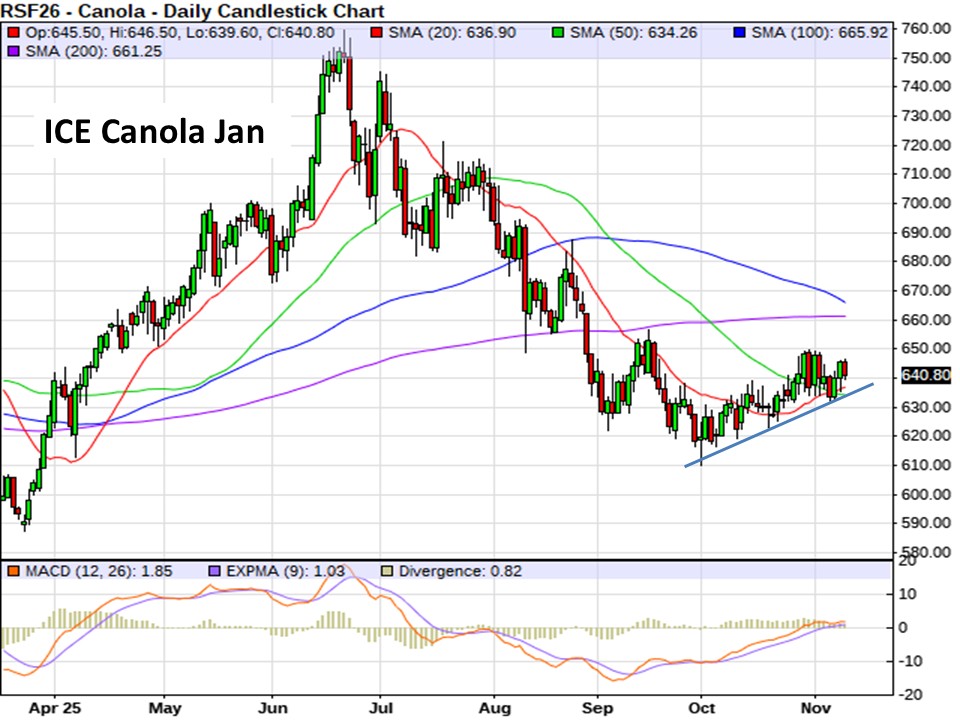
For today… after staying closed Tuesday for Remembrance Day, canola futures are trading $4 to $5/tonne lower to start this morning. Benchmark Jan futures are $4.90 weaker at $640.60/tonne…but still trying to grind higher over the past month of trade and still holding above both its 20- and 50-day moving averages.
Related outside markets…feeling a little soft for CBOT soybean/soyoil futures this morning. Malaysian palm oil futures have been flattening out of late following a late October collapse lower. Data from the Malaysian Palm Oil Board showed end-October stocks at a 6.5 year high, while production surged 11.02% to its highest since August 2015. On the export front, cargo surveyors reported shipments of Malaysian palm oil dropped between 9.5 12.3% during the first ten days of November, on softer foreign demand.
EU rapeseed futures are slightly weaker this morning…flattening out of late following a late October bounce of recent lows.
Quick Flax Thought
Not a whole lot happening in the Prairie cash market for flaxseed. Major line companies in many cases have stepped away from flax…leading to more user buyers…companies that clean and export. The export market for Canadian flax remains largely tied to the US human health and pet food markets, with demand of the past from the likes of China and the EU getting supply from the Black Sea region. Russian flax has been moving at a discount ahead of potential European import tariffs, pressuring prices lower overall.
While no burning reason for Prairie flax producers to advance cash sales, might nonetheless be a time to implement another incremental sale with cash bids as high as $17.00/bu, but have been slowly leaking lower now. As long as US market demand holds steady, Canadian values should remain supported, though significant price rallies appear unlikely given more ample global supply.
To access the latest futures prices, go to https://www.producer.com/markets-futures-prices/
Source: producer.com