
Careful consideration urged for drone spraying
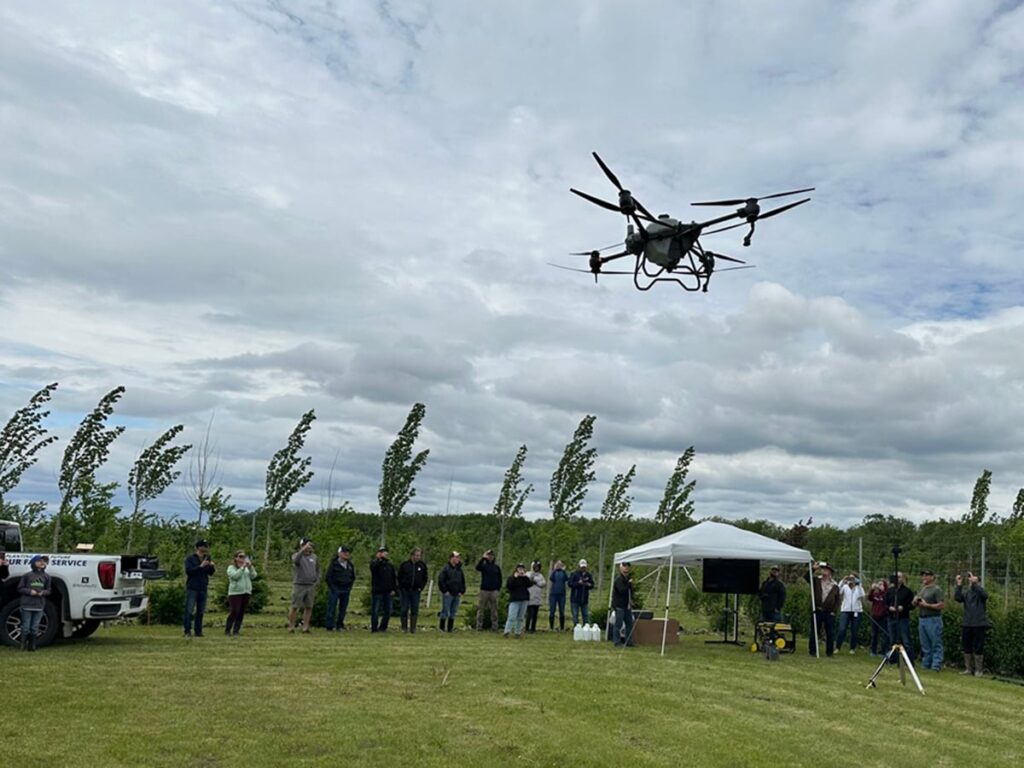
Proposed Health Canada regulations would make any pesticides available for aerial application also legal to apply by drone, and while that would remove many barriers for farmers and researchers, industry experts caution that planes and drones are different birds.
Health Canada’s Pest Management Regulatory Agency opened consultation on the proposed regulations late last month.
To date, only pesticides registered for use with drones, often called remotely piloted aircraft systems — can legally be applied by drones. Almost none are registered for drone application.
Read Also

Five reasons why there are seasons
In our last article, we looked at insolation and the solar constant, and in this article, we are going to look at global net radiation and seasons.
Why it Matters: The proposed regulations would make many existing pesticides available for application by drone. To date, almost no products have been made available for legal application by drone.
The PMRA proposes to allow any pesticides currently registered for aerial application — that is by fixed wing or rotary aircraft — to be applied by drone.
Applicators would need to comply with all the label directions for aerial application,such as spray volume, droplet size and buffer zones.
The PMRA has said that when using the aerial application directions, the value of the pesticide application shouldn’t be affected. Based on crop residue data, dietary exposure to pesticides shouldn’t be greater than with aerial application.
Based on global spray drift studies, aerial application buffer zones should be more than adequate.
While the PMRA acknowledged safety studies are too limited for a full risk assessment, “evidence suggests that the risk is unlikely to be higher than with conventional equipment,” the PMRA said.
“This is because some tasks, like mixing and loading, are similar and others —such as application — must be done by different people as required on pesticide lables for conventional aerial spraying.”
Drone operators would also need to be licensed according to Transport Canada requirements, and all workers who handle or apply the pesticides are expected to complete training on the handling or application of pesticides using drones or conventional aerial equipment.
To be recognized nationwide, these programs must follow the Standard for Pesticide Education, Training and Certification in Canada that was developed by the federal-provincial-territorial standing subcommittee on pesticide education, training and certification.
The good and the unclear
“There’s good and ‘question marks’ to this,” said Erica Carrasco, a partner with law firm MLT Aikins who has expertise in technology law, including drone regulation.
She spoke as part of an online panel discussion hosted by EMILI late last month.
Carrasco said it will be important to hear opinions from drone operators and chemical companies.
Do current product labels have clear, feasible and enforceable descriptions that are applicable for drones and conventional aerial application? Will they achieve the intended outcome of the pesticide? Companies may need to look at their labels and revise them.
The personal protective equipment requirements are significant.
If, for example, the drone operator is nowhere near the site or at risk of contact with the pesticide, will PPE requirements be strange, onerous or even not applicable?
The consultation process will be important because the industry has been waiting for these regulations, so it needs to ensure they’ll be usable and not need to be fixed again in a couple of years, Carrasco said.
She also noted that it still remains to be seen what the mandatory training and certification requirements will be.
“Right now, it doesn’t appear that there is that mandatory requirement across the board.”
In its proposal, the PRMA says it’s committed to working with provincial and territorial partners to inform development of training materials.
Lack of data
While the proposed rules would put drones on par with other aerial application, that doesn’t guarantee equality of outcome.
“Treating drones equivalent to conventional aircraft may simplify regulation, but scientifically, you know, it’s very different,” said Kevin Falk, a field modernization scientist for Corteva who has been conducting drone spraying field trials in Manitoba.
He spoke alongside Carrasco and EMILI Innovation Farms manager Leanne Koroscil.
“Spray drones can work, but with some caveats,” Falk said.
Water volume, drone speed, altitude and swath width all affect the the end result.
If drones are allowed to be used without guardrails, inconsistent results might be blamed on the chemical rather than application, he added.
These regulations, if passed, would remove some of the largest barriers to spray drone trials in Canada — namely the cost and difficulty of getting real-world spray drone data, said Falk. To date, generating that data has required special research authorizations.
However, there are hundreds of untried products and many will get tested in the marketplace rather than in a research plot.
“We saw in the U.S. Midwest a whole bunch fell on its face this year,” Falk said.
“There’s striping in corn fields across the Midwest because applicators were spraying in swath lines that were far too wide.”
To prevent negative outcomes, chemical companies might decide to opt out and — as the proposed regulations would allow them to do — prohibit application of certain products by drone.
There should be more questions around this ability to opt out, said Carrasco — “not just a blanket, ‘we won’t allow this.’ ”
It would be good to know why companies want to opt out, such as because of efficacy concerns.
When will these rules be ready?
On the whole, Falk, Koroscil and Carrasco were bullish on the proposed regulations.
Koroscil, a board member for the Canadian Agricultural Drone Association, said that organization’s position is that pesticides available for aerial application should be available for drone application.
“Being able to recognize drones as a legitimate aerial tool is going to be able to provide farmers with a safe and regulated access to additional tools in their belt,” she said.
Those tools will be “backed by manufacturer guidance and peer support but also, at the same time, being able to protect consumers and the public by having clear science based regulation.”
Carrasco said she hoped the takeaway was optimism around the proposal — the agriculture sector is much closer to being able to capitalize on drones’ potential.
How close?
Carrasco said it would depend on how many changes are made to the proposed rules.
New regulations go through a process of consultation and drafting, they’re published in the Canada Gazette, Part I, and further comments are taken under consideration before the regulations are updated and finalized, according to a federal explainer.
The final regulations are published in the Canada Gazette, Part II, and come into force on the day set out in the regulation.
However, it’s important to get the rules right, Carrasco said.
“I would rather see this done a little more carefully than just rolled out and have a whole bunch of issues that we didn’t think of,” she said. Small things such as wording around PPE “could have larger implications and drawbacks.”
Public consultation closes March 25.

Source: producer.com