

EFAO’s Farmer-Led Research Program marks first decade with award
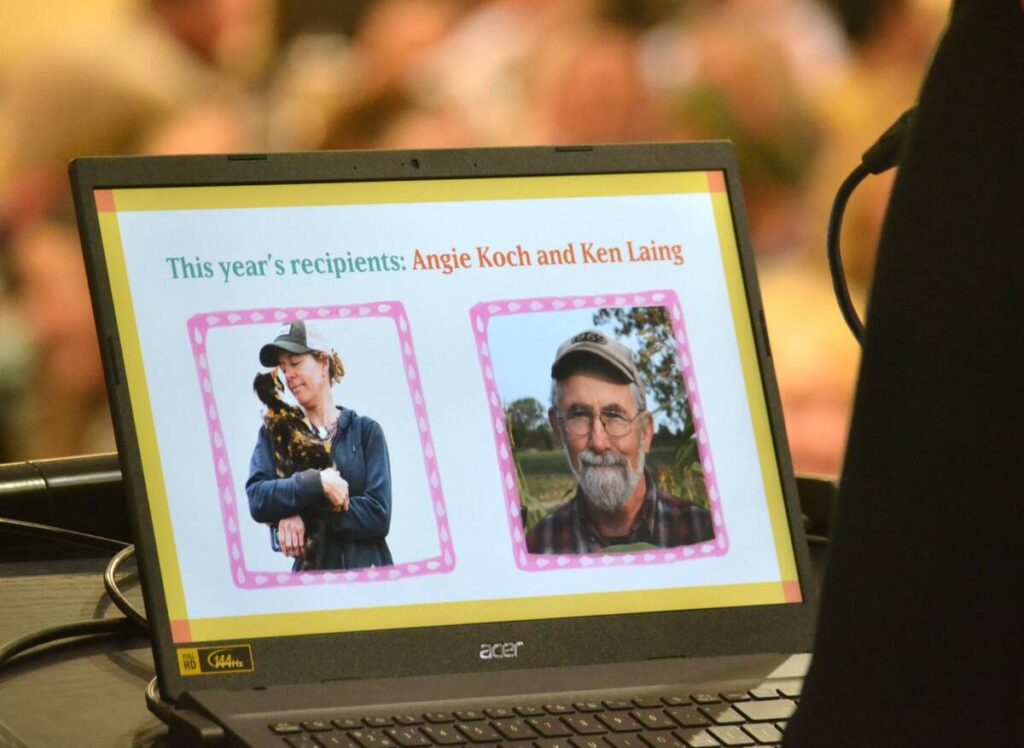
At its recent annual convention in London, the Ecological Farmers Association of Ontario (EFAO) celebrated the 10th anniversary of its Farmer-Led Research Program with a newly introduced award for two of the program’s long-time supporters.
Angie Koch of Fertile Ground Farm — which recently relocated from St. Agatha to Neustadt — and Ken Laing of Orchard Hill Farm near Sparta “used farmer-led research to dig deep into their areas of focus,” said Sarah Larsen, EFAO research and small grains program director.
Read Also
Modernized Veterinary Assistance Program expands eligibility
Ontario’s modernized Veterinary Assistance Program (VAP) recognizes honeybees and fish as livestock, and veterinary technicians and telemedicine services.
In recognition, during EFAO’s Dec. 3 celebration, Larsen announced Koch and Laing as co-winners of the inaugural Constantly Curious Award.
Why it matters: An award for the ‘constantly curious’ in Ontario agriculture shows how on-farm research not only helps farmers find answers, but also yields more and/or better questions.
A key to keeping the program running for a decade, Larsen told Farmtario in an interview, has been strong advocacy by EFAO membership on behalf of farmer-led research.
“The members had done a lot of work and contributed a lot of knowledge about ecological farming in Ontario over those 10 years, and we thought that was a great thing to celebrate,” she said when asked about introducing the Constantly Curious Award in conjunction with the 10-year celebration.
Inspired by Iowa
The award, and the entire program, was inspired in part by a pioneering farmer-led plan operated for decades by the Practical Farmers of Iowa (PFI). At PFI, program “co-operators” are recognized at the organization’s annual meeting.
After some brainstorming about how to emulate the award in Ontario, a new EFAO team member, Jessica Gale, suggested the idea of “constantly curious.”
It quickly became apparent, Larsen said, that Gale’s suggestion encapsulated what the Farmer-Led Research Program is all about.
“It embodies the idea that research begets research; that you often have more questions after you conduct a study than you do before you start.”
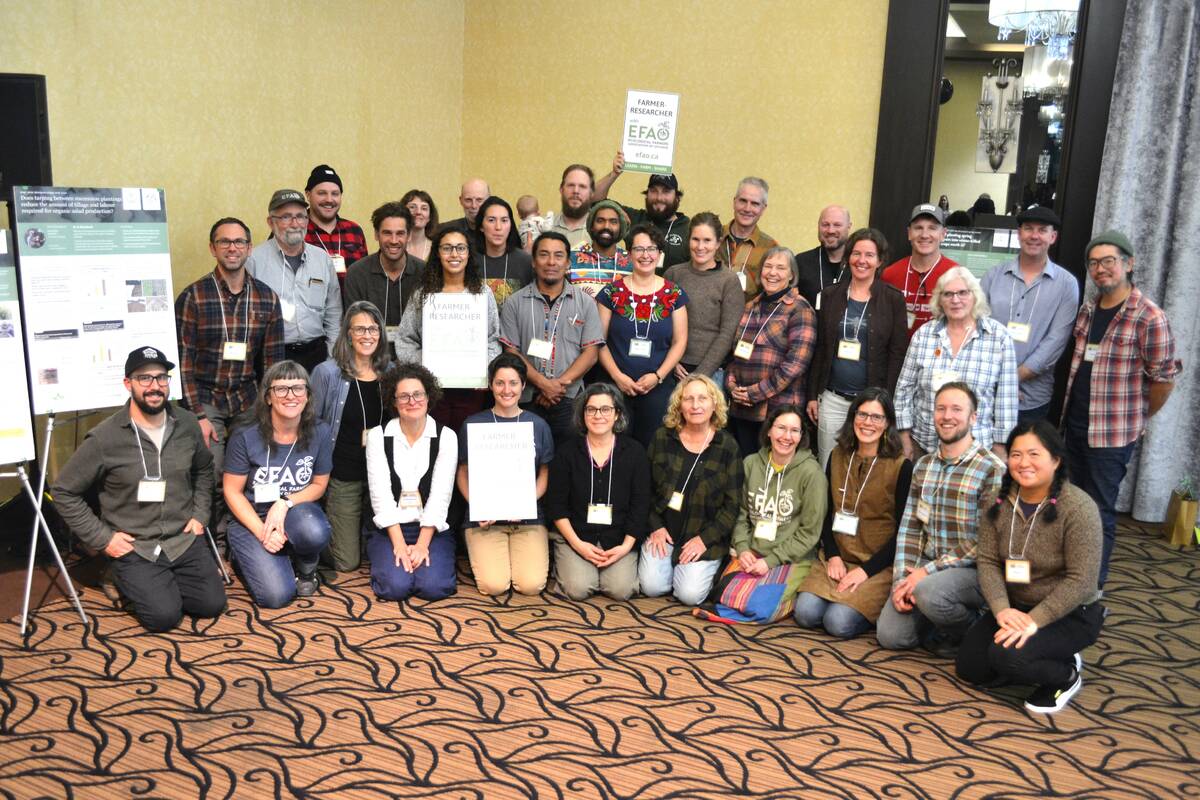
Larsen also noted “it was pretty obvious to us who the two (inaugural) winners would be.”
Koch was the EFAO board chair when the program started 10 years ago; she knew of the PFI program and went to executive director Ali English with a request to investigate an Ontario counterpart.
Around that same time, Larsen returned to Ontario following a few years spent with her partner living and working with farmers in Iowa — including through workshops hosted by PFI. Inspired by the Iowa model, she contacted English wondering if the EFAO might be interested in exploring an Ontario iteration.
With the thought put in English’s mind through two different sources at the same time, “it seemed like a no-brainer” to kick off the Farmer-Led Research Program, Larsen said. A request-for-funding proposal led to an Ontario government Trillium Grant, and the rest is history.
Both Koch and Laing were on the inaugural research advisory committee, which assesses proposals for on-farm trials to determine if they should be forwarded to EFAO staff for follow-up.
“They really helped shape the program in those early years,” Larsen said of the Constantly Curious Award’s first co-recipients. “And they have continued to be very supportive ever since.” Koch, through participating in trials with a focus on vegetable seed selection and Ontario-adapted vegetable varieties. Laing, through his explorations of minimum-till practices and cover crops in organic vegetables.
The first year’s funding supported a handful of projects. Farmers with a question — any question — about their operation were encouraged to submit it along with a suggestion about how to explore the question on their farm.
“It doesn’t have to be detailed,” Larsen said as the details will come later.
Now, the program supports 16-20 studies per year, some of them multi-farm in nature. “So we’re typically engaging anywhere from 30-40 farmers per year,” she said.
At the PFI, decisions about which proposals to support are made by members at the annual meeting. The EFAO examined that model but rejected it due to the logistical challenges of bringing together the membership and presenting the proposals.
“It takes three or four hours to drive across Iowa,” Larsen noted. “It’s just not practical in Ontario.”
Proposal perusal
Instead, the research advisory committee — a combination of EFAO members and staff along with non-EFAO agricultural sector stakeholders — decides which proposals should move forward.
“Not every question necessarily lends itself to being explored through research,” Larsen explained. “That’s really what the committee is evaluating, to see if this is something that has the potential to expand knowledge of agriculture in some way.”
Proposals approved for study are passed on to EFAO staff (initially only Larsen but now an official staff of three, with support from other EFAO employees) to formulate methods, determine the equipment and create a record-keeping protocol to complete the trial.
EFAO helps set up the trials (if it’s a multi-farm study, they organize joint meetings to ensure each farm gets what it needs) from February through April and helps the farmers get things set up in the spring, then leaves them to fit the measurement and record-keeping into their busy growing-season schedules.
“We do check-ins through the growing season,” Larsen noted but, in keeping with the PFI program’s philosophy, “it’s really up to the farmer to perform the trial and take the measurements.”
Data is submitted in the fall, then EFAO staff works with the farmer “to come up with a story about what their research trial can tell us.”
The day before EFAO’s annual conference begins in early December, it hosted an online research symposium. Larsen loves the event because it allows each participating farmer/researcher to present that story “using their own voice.”
Dozens of such stories have been told in the 10 years of the program and, according to Larsen, “they’re all unique. And they’re all fabulous.”
For one example, she highlights a multi-year, multi-farm study that eventually led to the commercialization of a pepper variety well-suited to growing in southern Ontario under an organic regime. There was also a province-wide exploration of lettuce varieties for organic market gardens.
Last year, a trial Larsen described as “very ambitious” explored orchard grafting practices. Results supported one option to “a high degree of certainty,” she explained, and as a result, the farmer “could understand that a little bit more labour put into the grafting method was very much going to pay off in sales.”
Larsen also noted the organization’s three-way partnership, now entering its second year, with the Ontario Soil Network and Farmers for Climate Solutions in a study labelled “Adaptive Nitrogen Trials” through which numerous farmers are exploring options to decrease their need for synthetic fertilizer.

Source: Farmtario.com