
Oat Mafia pushes for big increase in U.S. acres
SASKATOON — A movement to dramatically increase oat production in the United States is gaining traction.
“It is becoming very popular really quick,” said Martin Larsen, a farmer from Byron, Minnesota.
Larsen is one of the founders of the Oat Mafia, an informal collection of Midwest farmers who share information about growing the crop and pool bushels for marketing.
Read Also

VIDEO: Yield EyeQ camera system measures harvest loss at header
Harvest equipment manufacturer Geringhoff won a silver Innovation Award at Agritechnica for its Yield EyeQ camera system.
The group started six years ago with Larsen and two other farmers trying to resurrect “a forgotten crop.”
It now has hundreds of members growing a combined 6,000 acres of oats.
Larsen has big ambitions for the U.S. oat industry.
“In the next 10 years, I’d like to see a million acres,” he said.
To clarify, he is talking about an additional one million acres of food grade oats over what is grown today.
U.S. farmers harvested 943,540 acres of oats in 2025. That is down from the record of 40 million acres grown in 1930.
Why it Matters: The U.S. accounts for three-quarters of Canada’s oat exports.
Randy Strychar, president of OatInformation, admires Larsen’s vision.
“I applaud these guys for what they’re doing. I really do,” he said.
However, he is highly skeptical that U.S. farmers will be planting an additional one million acres of oats in the next decade because the net returns for the crop simply don’t justify an increase.
“If you could economically grow oats in the United States, you’d grow them, but it is corn and soybean country,” he said.
The returns, subsidies and transportation and storage logistics all favour corn and soybeans, he said.
Larsen acknowledged that corn and soybeans provide stiff competition. The biofuel boom of the mid-2000s was the real death knell for oats because it greatly improved the economics of growing those two competing crops.
However, farmers increasingly want to add a third crop to the mix for a variety of reasons, including rotational and environmental considerations.
He also believes there is a good environmental case for growing oats because it can reduce nitrate levels in ground water caused by growing corn and soybeans.
However, the demand must be there, and that is where the group has been running into difficulty.
It has been hard for U.S. oat growers to capture the attention of the big players such as Quaker Oats and General Mills, which have been sourcing their oats from Canada for decades.
Larsen said the Quaker Oats mill in Cedar Rapids, Iowa, hasn’t accepted a truck load of oats in more than 30 years. The plant gets all its product by rail.
He can’t even get the big mills to tell him what they’re looking for in terms of test weights and other quality attributes.
Strychar doesn’t think the mills are ignoring the U.S. growers,; it’s just that they already have an established supply chain that works well.
“It isn’t that anybody is blocking them out or doesn’t want to talk to them. It’s just simple economics,” he said.
The other issue at play is that there is overcapacity in the U.S. oat milling sector, so there is plenty of pressure on profit margins.
“Some of the mills have told me they’re running at zero margin. They’re just running to keep the doors open,” he said.
Larsen said the lack of interest from the big players prompted many members of the Oat Mafia to invest in a mill of their own.
Farmers contributed US$20 million to the $68 million Green Acres Milling project, an oat mill under construction in Albert Lea, Minn.
The plant is scheduled to open in time for this year’s harvest . It will be capable of processing four million bushels of the crop per year.
Larsen said that is the production from about 40,000 acres of oats.
It means they will either need to build a lot more of those plants or attract the attention of the big guys if they’re going to achieve his goal of one million additional acres of the crop.
The good news is that the global oat milk market is forecast to grow to US$14.51 billion by 2034, up from $3.98 billion in 2025, according to Fortune Business Insights.
Larsen hopes U.S. farmers can supply the oats required to keep up with the growth in demand in the U.S. market, while Canadian farmers can continue to supply their traditional amounts.
The Oat Mafia and Green Acres Milling project have been getting plenty of press recently, including an article in the New York Times.
“Never did I ever think a project that I have worked on would be warranted to be in the New York Times,” said Larsen.
He hopes consumers will take notice of all the press oats are getting and start demanding that more of the supply originates domestically.
There is already a mini-revolution happening in his neck of the woods.
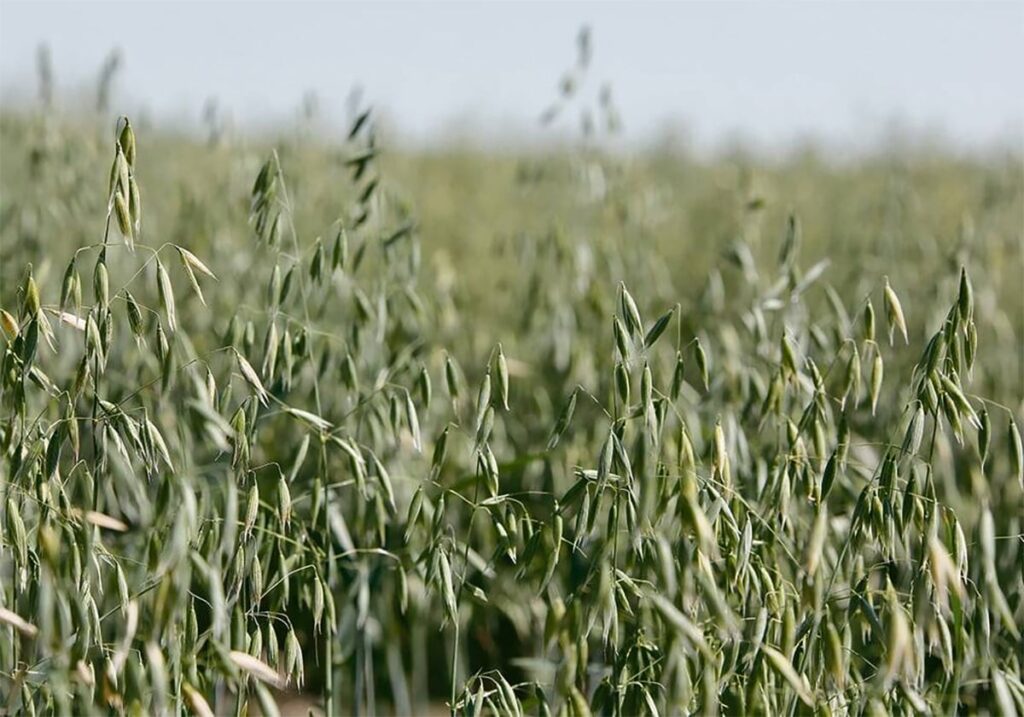
“You can drive through my township now and it is very noticeable how many oats are on the landscape,” he said.
“The interest in it is exponentially growing.”

Source: producer.com