
Support from Americans in trade fight has its limitations
It may be tempting for Canadians to feel like they are on their own as they face the most hostile American government since the War of 1812.
The feeling isn’t necessarily a bad thing, fostering such movements as Buy Canada and Elbows Up.
It has been encouraging to see most Canadians unite against a common enemy in a time of existential threat.
From refusing to buy American products to putting the brakes on American travel, many Canadians are doing what they can to voice their displeasure with the current American administration.
Read Also

Saskatchewan premier heads to India for trade talks
Saskatchewan premier Scott Moe said a trade mission to India will focus on agriculture, potash and uranium as the province seeks trade opportunities and solid trading relationships in that market.
These movements have prompted some American government officials to decry what they see as unjustified anti-Americanism, but rational thinkers can easily see through this ridiculousness.
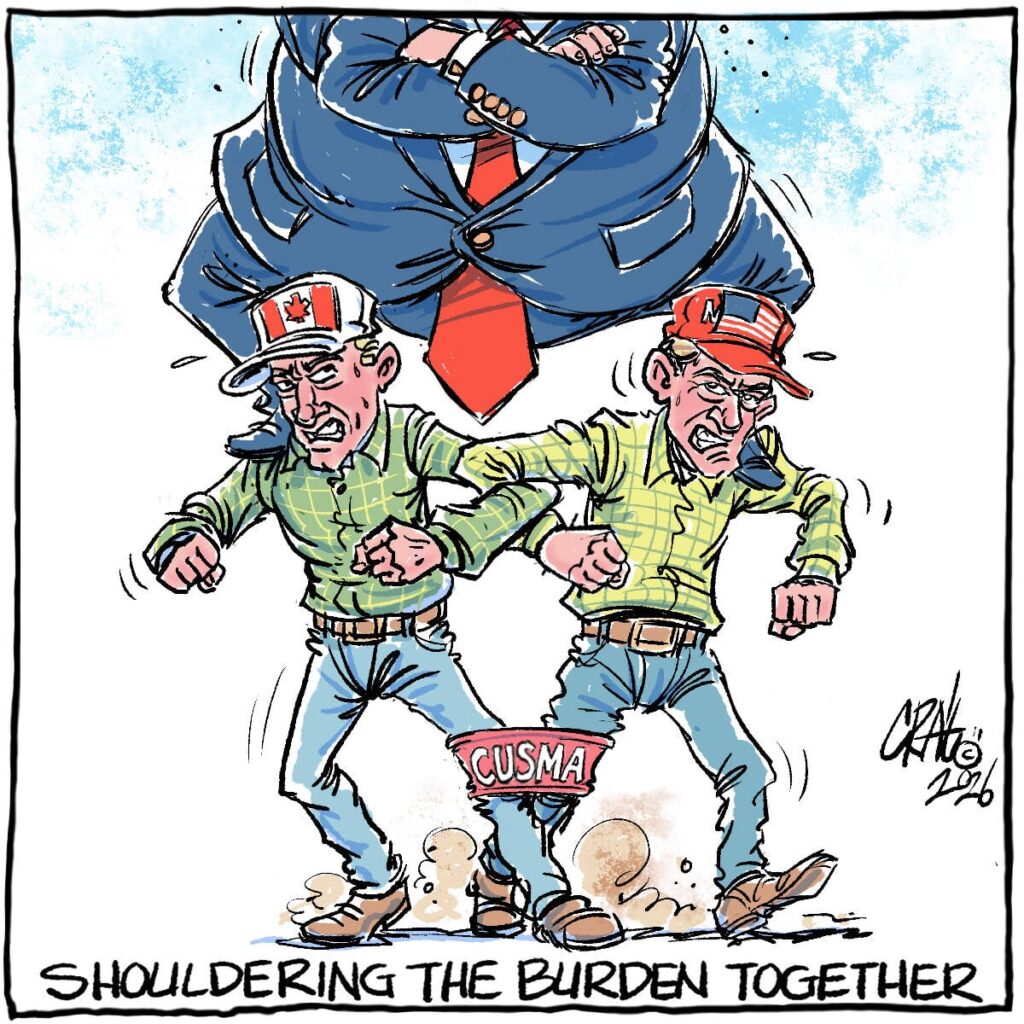
In the face of such hostility, Canadians are banding together to protect themselves any way they can, and yes, it can be tempting to think that we’re doing it on our own.
But we’re not.
Millions of Americans, even some who voted for U.S. President Donald Trump, aren’t happy with what’s happening to Canada-U.S. relations.
This is probably not completely altruistic.
Communities that have previously relied on Canadian tourists for their economic health have practical reasons for bemoaning the current state of affairs. So too do manufacturing sectors that are heavily reliant on exporting to what has become an increasingly unwilling Canada.
And then there are the fair-minded Americans who must be horrified by their government’s actions.
The latest example likely falls more into the former camp, although we would hope that there might also be a bit of the latter.
About 40 American farm organizations have formed the Ag Coalition for USMCA, which is what they call the Canadian-U.S.-Mexico Agreement down south.
The coalition is campaigning for the trade deal to continue after this year’s review.
Once upon a time, such a coalition would have been considered unnecessary because North American free trade, which has been around since the 1980s in one form or another, has been seen as too important to fail.
But those days are gone.
The United States now has a leader who has nothing good to say about his country’s trading relationship with Canada, and on his worst days even suggests tearing up CUSMA entirely.
Thus, U.S. agricultural groups have deemed it necessary to join forces to do what they can to save the deal.
As has been mentioned, this isn’t mere altruism.
American agriculture sees much to like about having structured trading rules with Canada and Mexico.
In a recent news conference, members of the coalition said that total agricultural exports from the U.S. to its CUSMA partners reached US$60 billion in 2024, along with $1.2 billion in seafood exports.
A study commissioned by the coalition found that agricultural and seafood exports to Canada and Mexico generated $149 billion in total economic contribution and supported nearly 500,000 jobs and $36 billion in wages.
For every $1 in exports under the deal, there is an additional $2.45 of economic activity.
Other key numbers include $64 billion in gross domestic product and $13 billion in tax revenue that the country earns from the agreement.
The coalition’s message isn’t all sunshine and roses.
Members also see areas where the agreement can be improved, such as forcing Canada to “hold up its end of the bargain on dairy,” particularly in how Canada manages tariff rate quotas.
However, the coalition’s main message is clear: CUSMA is vitally important and must continue.
It’s heartening to have this level of support, especially when considering that many of its members are fervent Trump supporters.
Surely this will send a crystal clear message to the president and his administration and saner heads will prevail.
Unfortunately, we better not count on it.
Just look at what’s happening in the U.S. beef sector.
American ranchers are solid Trump supporters, but that hasn’t stopped the president from going after them over high beef prices.
He must feel he can get away with this, rightly assuming most agricultural producers will support him, no matter what.
So, while it’s nice to have powerful allies, it’s also important to recognize that their influence will have its limits.

Source: producer.com