
A list of top tips for achieving optimal canola stands this season
With more than 30 years’ experience in agronomy, Clinton Jurke knows a thing or two about how Prairie canola growers can achieve the Holy Grail plant stand of five to eight plants per sq. foot.
The key thing to remember this canola seeding season, says the regional technical services manager for BASF, is all roads should lead to that sweet spot. Everything else underpins that goal.
Why it Matters: With crucial inputs such as fertilizer set to spike in price due to brinkmanship over shipping, canola producers need to do everything they can to get the most from their crops.
Read Also
ArrowTube a new tool for uniform corn emergence, says U.S. company
A seed delivery system for use in planters is being marketed as a tool for seed orientation, a growing interest among corn producers.
“Your stand establishment is the most important operation when it comes to growing canola,” he says.
“Canola requires more attention to the details of getting it established than other crops.… Getting your seeding operation done well and done right is essential to being successful.”
However, because there are no 100 per cent effective ways to build the ideal stand, the best bet is managing risk. Jurke, who was previously an agronomist with the Canola Council of Canada, has some advice on how to manage the uncertainty all canola growers face at seeding.
A minor disclaimer: BASF has adjusted the ideal plant stand recommendation for its InVigor canola hybrids from five to eight to five to seven per sq. foot. Users of those hybrids will want to take note.
Get behind the seeder
Precision seeding equipment has generally made it easier for canola producers to achieve optimum stands than, say, an air seeder from the 1990s. For example, seed survivability has grown to the point where recommended seeding rates have been reduced compared to that era.
In a 2017 Western Producer article, Marieke Patton with Bayer Canada noted a shift from a seven to 11 plant per sq. foot standard to the then-nascent five to eight.
However, the reality is many farmers have been unable to adopt, largely due to cost,digitally based precision equipment. Instead, they’re keeping the aforementioned 30-year-old air seeder together with baler twine and faith.
Whether you’re rocking a brand-new air drill with sectional control or relying on a machine that came out when Jean Chrétien was prime minister, Jurke’s advice is the same: start looking at results as soon as possible. Then, later in the season, scout for emergence. Write the numbers down because that information, plus other detailed seasonal records, can help you make decisions next year.
“Once we get to four plants and less, the opportunity to maximize your yields, to achieve that full yield potential that’s built into seeds, the odds of you hitting that go down significantly,” he says.
“So that’s why we need to get to that five plants per sq. foot because that four, three, two yield … puts you into a higher risk for things like flea beetles.”
Check openers
Openers can damage seed if an air seeder’s fan speed isn’t set correctly, says Jurke. Managing this comes down to knowing your equipment, including how much fan speed is too much.
“If you don’t have your fan speed set right through the distribution system, (seeds get) bounced around a little bit too much and could end up cracking or losing viability.”
Build a seed ‘buffer’
Say you have an older seeder you’ve been using for 10 years. Every year you put down 10 canola seeds per foot with only three or four becoming plants.
Maybe you need to put down more seeds, says Jurke. These extra seeds can act as a “buffer” that can help hedge your bets against uncooperative weather.
Although the past two Prairie growing seasons generally granted sufficient moisture — with some forecasting more of the same — Jurke recommends building buffers into seeding operations in case things don’t go as planned.
“You have to always build into your plans that Mother Nature is not going to co-operate.
“So you need to have a buffer. And if it looks like adverse conditions, instead of targeting five plants, maybe you should be targeting seven plants in order to give you that buffer to survive whatever Mother Nature does throw at you.”
Trade-offs
Seeding canola either early or late both have their pros and cons. Seeding late, possibly due to circumstances earlier in the season, can mean exposing seed to higher soil temperatures and possibly more moisture, setting you down the road toward the stand you want.
“The general rule of thumb, though — and this had been a pretty good rule up until the last couple of years — is that earlier seeding usually gives you higher yields than late seeding,” says Jurke, adding there are “trade-offs” between early and late seeding.
“(If) I get my canola in early, my yield potential is higher, but the risk to my plant stand is also higher. You seed later (and) your yield potential is usually lower, but the risks are also lower.”
Watch for volunteers
A major benefit of scouting for emergence shortly after seeding (Jurke recommends the beginning of June if seeding was done in May) is observing whether there are enough weeds to require a herbicide pass. However, you may have to pay extra attention if that weed is volunteer canola.
“Say you put 10 seeds in the ground per sq. foot, then you get five come up, but then you’ve also got six or seven volunteers coming up,” says Jurke.
“You need to be able to differentiate between what is an actual seeded canola plant and what is a weed.”
Be flexible with settings
Don’t assume equipment set up for one field is going to be the best setting for the next field, Jurke says.
“Soil conditions change. Previous crop changes. If you are changing between the hybrids, seed size may be a factor that you’ll need to recalibrate for seed placement.”
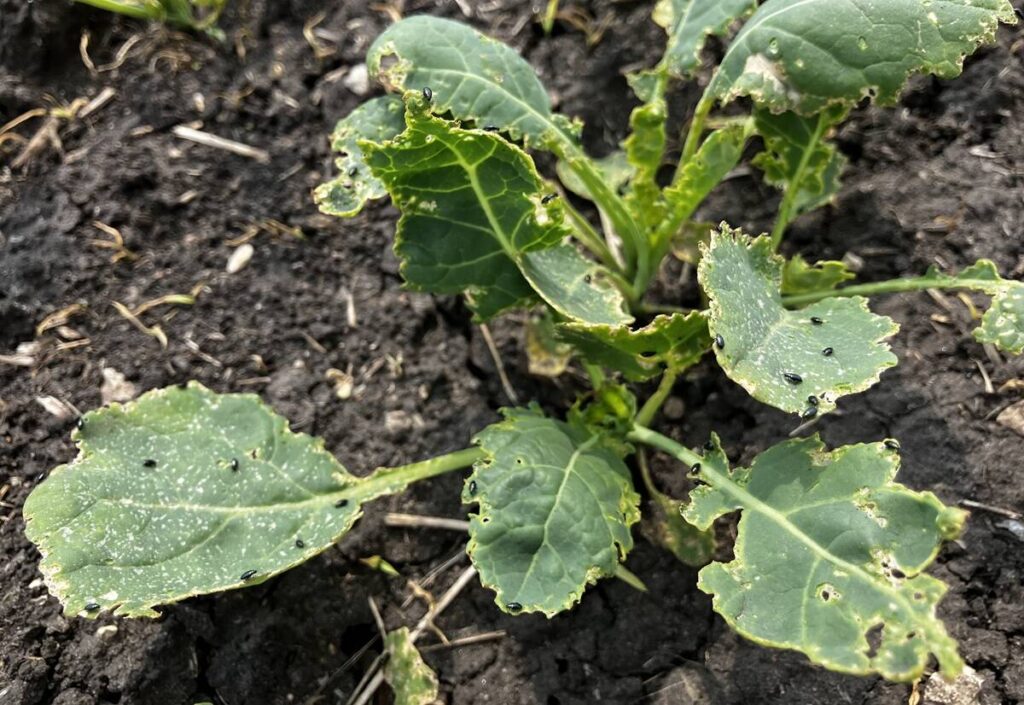
Assume flea beetles
Although flea beetles tend to favour warm, dry conditions, they are also unpredictable. The best rule of thumb, says Jurke, is to assume flea beetles are going to be a problem and manage accordingly.
“That means getting out as the crop is coming up, watching for damage, watching it every few days until your crop can get to leaf stage with good, warm growing conditions. And then the plants are going to be well on their way, (and) they’ll be able to out-compete any flea beetles.”
Scouting, particularly in low-growth areas, is also crucial because flea beetle damage can go from bad to worse very quickly once the action threshold of 25 per cent defoliation is met.
“Be willing to pull the trigger on applying an insecticide once you hit that threshold,” he says.
“Plants can go from 25 per cent damage to 50 per cent damage within a day if the flea beetle pressure is really high.”

Source: producer.com