
AGRIWEEK – May 22, 2026

Commentary
Artificial intelligence tools pick up speed, but farmers have the final say
As agriculture technology moves toward more ‘agentic’ systems, agronomists say the farmer still holds the reins.
At last month’s World Agri-Tech summit in San Francisco, speakers framed the next phase of artificial intelligence in agriculture as something new: systems that don’t just offer advice but begin acting on it, also known as agentic AI, wrote Glacier FarmMedia’s Don Norman.
AI tools are improving quickly, but understanding where they fit in decision-making helps farmers use them without giving up control.
“Agentic” refers to systems that move beyond analyzing information or making recommendations and begin taking on tasks and acting more like digital agents.
“What does it mean for farmers to have a digital assistant or be managing a set of agents that are doing work for them?” asked Ranveer Chandra, chief technology officer of agri-food at Microsoft, who hosted the opening session at the summit.
It’s easy to see how AI is working in corporate settings. During the same session, Reza Rasourpour, a vice-president with Corteva Agriscience, pointed to how artificial intelligence is massively speeding up product development. Those advances are making their way to the farm, with examples such as field data being set to optimize fungicide applications.
But beyond examples such as fungicide timing, the panel discussion stopped short of exploring what a fully “agentic” system would look like in day-to-day farm management. That’s where the question shifts from the conference stage to the field.
On Prairie farms, where decisions are shaped by weather, field variability and farmer risk tolerance, agronomists say there is still a clear line between a recommendation and a final call.
Even when farmers work closely with trusted advisers, they generally keep control over decisions that affect input costs, crop risk and yield potential. That is unlikely to change quickly just because the recommendation is coming from software instead of a person.
Rob Warkentin, a Saskatchewan-based private agronomist, said some AI applications already look realistic, especially in areas such as disease forecasting. “AI is a great fit when it comes to things like disease,” he said. “But maybe not so much on fertility recommendations.”
That distinction is important. Disease risk, insect movement and weather-driven threats are all areas where more data, better pattern recognition and faster analysis could improve timing. In those cases, AI may help narrow down a decision faster than an agronomist or farmer working alone.
However, that is not the same as handing over control, as farmers still want the final say.
Warkentin was uncertain computer models will ever gain that same level of trust with farmers as a human advisor.
Brunel Sabourin, co-owner of Antara Agronomy in St. Jean Baptiste, Man. said AI will be disruptive and already has obvious uses in helping agronomists and farmers process more information faster. However, he also sees hard limits in a business where no two seasons are the same.
“The biggest overarching challenge that I see is being able to capture all of the variability in a field and being able to make proper decisions with that,” he said.
For Sabourin, that variability is the reason agronomy still resists full automation. Soil, weather, moisture, field history and management all interact. A small change early in the season can ripple through everything that follows.
That does not mean AI has no role. In fact, both agronomists see it becoming more useful, not less.
Sabourin said his own business was already using AI heavily for lower-level tasks such as reports and analysis, and increasingly to dig through large agronomic datasets more quickly.
He described using it to sort through benchmarking data and test relationships between variables that would have taken far longer to examine manually. That’s valuable. But even there, Sabourin cautioned against assuming more data automatically leads to clean, scalable answers.
While the push is on for integrating AI into agriculture, the collective wisdom and knowledge in the farming world is astounding, wrote Glacier FarmMedia editor John Grieg in a recent op-ed.
It’s been there for a long time. In the past surfacing through coffee shop conversations, chats through the windows of two pickup trucks stopped beside each other on a side road, and in phone calls. Those still happen, but the internet has brought the hive mind of the agriculture community into the open, “and it’s pretty awesome,” said Grieg.
He questioned how many more generations it will continue, as more people are further removed from the farm. Some of it is nostalgia, but there are still serious problems being solved quickly and inexpensively without AI every day.
This Week in Agriculture
Room for optimism seen in Prairie agriculture says large landowner
High grain prices could be around the corner and may remain high for a while, says the owner of 250,000 acres of cropland in Western Canada.
Robert Andjelic is feeling bullish about Canadian agriculture because a global shortfall of wheat and other grains is a realistic possibility for 2026 and 2027, reported Robert Arnason of the Western Producer.
Prices may spike, and Canadian farmers can take advantage of the opportunity.
“I’m not talking a 10 per cent (increase). Wheat and some (others) could double (in price),” Andjelic said recently. “Wheat is going to surprise a lot of commodity brokers and producers as to how much it’s going to go up, potentially.”
A shift toward hotter and drier weather around the globe, combined with fertilizer shortages in some countries, should increase demand for Canadian grain.
Andjelic is the owner and founder of Andjelic Land, which leases cropland to more than 250 producers, mostly in Saskatchewan.
Because Canada has a domestic supply of fuel and fertilizer, and competitors such as Australia do not, Canadian grain farmers have an edge right now, said Andjelic.
“Canada, along with most likely … Russia, are best positioned to take advantage of what’s coming,” Andjelic said.
There’s a 90 to 96 per cent chance that an El Niño will develop this summer or autumn, says the NOAA Climate Prediction Center in the U.S. Looking beyond this spring and into the winter of 2026-27, an El Niño weather pattern is not helpful for the central U.S. Plains.
“That drought is not going to be solved in any short time in the near future,” Andjelic said.
Fertilizer scarcity is another issue. Countries in the Persian Gulf region produce about 30 to 35 percent of global urea exports. With the chaos in the Strait of Hormuz, Australia and other countries who rely on imports are coping with a shortage of nitrogen fertilizer. Farmers are making hard decisions about what they grow and how much fertilizer they apply.
Market watchers say the threats to wheat supplies are much larger than the drought in the central U.S. Plains, given the likelihood of reduced fertilizer applications in the Southern Hemisphere and acreage cuts in Australia.
There is a chance that the U.S. and Iran find a solution to the Strait of Hormuz stalemate, restoring shipments of urea and other products this summer. However, global fertilizer supplies won’t snap back to normal.
Export terminals in the Persian Gulf could be damaged, and rebuilding such infrastructure doesn’t happen in a week, Andjelic said. “Some of those (terminals and production plants) won’t be coming on stream for years.”
While the risks to global grain production will stick around, Andjelic said he was optimistic that Canadian farmers were in a relatively good situation for 2026 and 2027.
U.S. flour consumption continues long slump
Per capita wheat flour consumption in the U.S. fell to 126.6 pounds in 2025, continuing a trend that started around the turn of the century, according to the Wheat Sector at a Glance report produced by the U.S. Department of Agriculture’s Economic Research Service. That is a loss of about 20 pounds per person from 2000. With a population of 349 million, that works out nearly seven billion pounds, or just more than three million tonnes.
The U.S. buys a lot of Canadian wheat
That is not great news for Canadian farmers, reported Sean Pratt of the Western Producer. The U.S. was Canada’s fourth largest wheat market from 2021 to 2025, accounting for an average of seven per cent of sales.
Jane DeMarchi, president of the North American Miller’s Association, said there are several reasons consumption has tumbled.
It began with the widespread adoption of low-carbohydrate diets, such as the Atkin’s Diet. The rise of the gluten-free movement exacerbated the problem.
There was a brief reprieve from the downward trend during COVID-19, when people started eating comfort food at home and making their own bread. Sourdough became particularly popular during that time.
But that was short-lived.
“Now we’re in a downward trend again,” said DeMarchi.
The growing popularity of GLP-1 medications that treat Type 2 diabetes and obesity, such as Ozempic, is having a negative impact on a wide variety of foods.
Ardent Mills conducted a study that determined seven per cent of U.S. adults are on GLP-1 medication and another 32 per cent are considering it.
Nielsen Company estimates people on GLP-1 medications consume 700 fewer calories per day than they did before going on the medication.
There is also a new trend of people shifting to high protein/low carbohydrate diets.
SNAC International estimates half of the population is swapping snacks for meals with adults snacking 3.5 times per day and kids five times.
Those multiple snacking sessions are replacing meals where people tend to consume bread, pasta and cereal.
Clearly, there are a lot of factors conspiring against flour consumption, but millers remain optimistic.
Bakery product prices increased by 0.1 per cent in April compared to overall food inflation of 0.5 per cent. The lower inflation rate makes it a more competitive item in grocery carts.
Consumer interest in fibre is on the rise, and grain-based foods are highly associated with fibre.
There is also mounting interest in Asian and Mexican food, which feature products such as buns, noodles and tortillas.
The gluten-free movement appears to have stalled compared to a few years ago when it was very much in vogue.
DeMarchi said some older mills are closing in the U.S., but others are modernizing, becoming more efficient and automated.
They are also diversifying. Instead of producing massive amounts of commodity flour, they are shifting into specialty products such as high-fibre flours.
DeMarchi said while it is undeniable that the flour industry has been confronted by “headwinds,” grain-based foods are still a popular choice for many U.S. consumers.
DP World to improve rail capacity at Fraser Surrey
DP World Canadia is expanding rail capacity at a key export terminal at the Port of Vancouver, investing $13.3 million in a project that is expected to be complete by Dec. 31, 2026.
Doug Smith, chief executive officer of DP World Canada, said the terminal is seeing increased demand from exporters of agriculture and value-added agri-food products.
“This investment helps create additional rail staging and handling capacity at the terminal, which improves overall cargo flow and supports more reliable export movements,” he said in an email to the Western Producer.
“It also aligns with a broader industry focus on strengthening inland connectivity and ensuring Canada’s trade infrastructure can support long-term growth.”
The project will help improve West Coast rail capacity.
The project will allow the terminal to accommodate longer trains, reduce the need to rearrange rail cars within the yard and improve the flow of inbound and outbound rail traffic.
The expansion allows Fraser Surrey to accommodate two unit trains at the same time, reducing downtime between train movements and improving cargo flow during peak periods.
The Fraser Grain Terminal is permitted to move four million tonnes of grain. An additional one million tonnes of canola oil can be exported through its oil transload facility.
“While the project is primarily focused on improving efficiency and fluidity within existing permitted capacity, it also positions the terminal to better support future growth and evolving customer demand over time,” said Smith.
Canadian mushroom growers warn U.S. duties will raise prices, threaten jobs
Industry leaders say duties on Canadian mushrooms could drive up prices, hurt growers on both sides of the border
Canadian mushroom growers are sounding the alarm after the U.S. Department of Commerce announced new countervailing duties on fresh mushroom imports from Canada effective May 18 — a move industry leaders warned will drive up grocery prices and threaten jobs on both sides of the border, writes Glacier FarmMedia reporter Sarah McGoldrick.
The duties could slow cross-border mushroom trade and raise prices for consumers — with a second anti-dumping ruling that could stack more duties on top expected later this summer.
The ruling requires U.S. importers to post cash deposits on Canadian fresh mushrooms, with Champ’s Fresh Farms Inc. facing a tariff rate of 1.62 per cent and Farmers Fresh Mushrooms Inc. hit with a 4.97 per cent rate.
Ryan Koeslag, Mushrooms Canada executive vice-president and CEO, told Farmtario the added costs will inevitably be passed on to consumers at the checkout aisle.
“As the price increases, the demand will decrease. This could significantly impact the production in Canada with less demand for mushrooms exported to the U.S. and could eliminate jobs in Canada,” he said.
The implementation of the duty is not an indication of unfair trade. Under U.S. trade law, a subsidy must meet specific legal requirements before it can be countervailed, including that the alleged benefit be limited to a specific enterprise, industry or group.
Koeslag said the reasons for the U.S. Department of Commerce continuing its investigation and implementing duties are based on two issues: general agricultural tax exemptions, which he said open the door for any commodity produced in Canada to be considered subsidized.
He said this exposes the U.S. agricultural industry to countervailing duties in return. He added the U.S. has historically never targeted tax exemptions because producers there operate under the same exemptions.
Like similar measures imposed against Canada in recent months, Koeslag believes these duties will ultimately increase the price of mushrooms entering the U.S. and raise overall food prices. He said the duties will also decrease demand and continue the overall decline in mushroom consumption across North America.
Miscellany
Deere beats second-quarter profit estimate but maintains full-year forecast
Farm equipment maker Deere beat second-quarter profit estimates on Thursday, helped by improved demand for its small agriculture and construction machinery, but kept its full-year profit forecast unchanged, reported Reuters.
Its construction segment proved a bright spot as years of weak crop prices and rising costs have led farmers to delay purchases of new farm equipment.
Deere’s Small Agriculture segment posted a 16 per cent rise in revenue while the Construction segment’s revenue jumped 29 per cent for the three months through May 3. The two segments contributed 62 per cent to the company’s net sales, which grew 5.4 per cent to $11.78 billion.
The tractor maker also said it was helped by a $272 million tariff refund but cited challenges in the agricultural market and kept its full-year net income target range of $4.5 billion to $5 billion unaltered.
Potato wart detected in P.E.I. for first time in three years
Potato wart has been detected in a soil sample on a Prince Edward Island farm for the first time since 2023. The sample was part of annual potato field testing by the Canadian Food Inspection Agency, which said in a statement it was investigating.
The detection was limited to one field, and there was no evidence of spread. It also said the farm where the detection occurred primarily produces seed potatoes only for its farm, and the resulting potatoes are used for on-Island processing.
First national feedlot benchmark released
A survey of 87 feedlots across seven provinces mapped grain processing, byproduct use, receiving protocols and growth-technology adoption, and flagged gaps that point to where research and extension should focus next.
Benchmarking involves analyzing industry practices to identify strengths, opportunities for improvement and common challenges faced by producers. The resulting data offers insight into how operations compare with industry averages and peer enterprises. Benchmarking can also help re-prioritize research and extension efforts toward the industry’s most pressing needs. Ultimately, the information will help producers make better-informed decisions and identify innovative approaches that improve productivity and support the long-term competitiveness and sustainability of the industry.
Feeder market continues consolidation
Western Canadian prices of yearlings and backgrounded cattle were relatively unchanged during the week ending May 16. The calf market was hard to define given the limited numbers, said analyst Jerry Klassen of Resilient Capital.
Smaller packages were on offer and appeared to trade $10-15 per hundredweight lower on average.
Canada Beef back in China as diversification strategy takes shape
In April, Canada Beef embarked on its first trip to China since the restoration of market access, due in part to the inroads achieved in this market since January 2026 and an export diversification strategy focused on the markets with the most promise for Canadian beef.
Canada Beef vice-president, export market development, Albert Eringfeld participated in activities in Haikou, Beijing and Shanghai during the trip, which ran April 10 to 18. Canadian beef was featured prominently at special events throughout the trip, including a Taste of Canada cooking demonstration, a Canadian beef promotional dinner and a Canadian government reception.
Canada’s inflation rate accelerates to 2.8 per cent as Iran war pushes up gasoline prices
Canada’s annual inflation rate accelerated to 2.8 per cent in April from 2.4 per cent in March, driven largely by a surge in gasoline prices after the Iran war pushed global crude oil prices sharply higher, Statistics Canada data showed on May 19.
This marks the first time in almost two years that the annual consumer price index reading hit 2.8 per cent underscoring how the war in Iran, which started on Feb. 28, was quickly trickling down through the economy.
Higher gasoline prices, which rose by 28.6 per cent in April and more than 38 per cent since the war began, drove transportation costs up by 7.6 per cent in April, their highest since November 2022. Gasoline prices also went up on an annual basis as the impact of the carbon levy ended.
Global food and beverage giants join forces on regenerative agriculture
Forty major food and agriculture groups, including Carlsberg, Diageo, Nestle and Mondelez have signed a joint declaration to advance and scale regenerative agriculture, a non-profit network said on May 19.
SAI Platform’s regenerative agriculture program aims to address climate change, biodiversity loss and soil degradation while securing agricultural supply chains.
Signatories, which include ADM, McCormick and Unilever, said no single organization or solution can drive the systemic change required.
SAI Platform’s program incorporates input from farmers, NGOs and academics to align efforts across the supply chain.
Wind storm affects eastern Prairies
A rare dust storm hit southeastern Saskatchewan and southern Manitoba on May 14 and 15, bringing winds up to 90 kilometres per hour and low visibility, triggering warnings from Environment and Climate Change Canada.
The storm caused growers to halt seeding and leave their fields, while the winds caused downed power lines and property damage. However, rain fell on both regions a few days later.
Shippers want action on Vancouver bridge
More than 20 agricultural and shipping groups penned a letter to Prime Minister Mark Carney and transportation minister Steve MacKinnon urging them to improve the Second Narrows Rail Bridge in Vancouver.
The bridge, owned by Canadian National Railway and built in 1969, enables bulk exports of grain, fertilizer and other products from the Port of Vancouver. The bridge is the only way for trains to access the North Shore grain, potash and coal terminals. Last February, it malfunctioned which halted marine traffic and restricted rail service for four days.
Groups behind the letter include the Canadian Federation of Agriculture, the Canadian Canola Growers Association, Sask Wheat, Soy Canada and Fertilizer Canada. Options towards improving the bridge could be twinning it or replacing it entirely.
Livestock auctioneer honoured
The Livestock Markets Association of Canada inducted former president Brock Taylor into its Hall of Fame at its 45th annual convention in Medicine Hat, Alta.
Taylor, who runs Taylor Auctions, Exports and Assembly Yard in Melita, Man., one of three family-owned auction markets in the province, is a long-time member of the association. Also a former president of the Manitoba Livestock Marketing Association, he has competed at the Canadian Livestock Auctioneer Championships over the past 27 years. Taylor also runs a cattle ranch in southwestern Manitoba.
Alberta-made tractor prioritizes basics
Ursa Ag from Bowden, Alta. is struggling to keep up with the demand for its low-tech tractors, which are gaining popularity for being half the price of other tech-rich tractors in their respective classes.
Ursa Ag tractors don’t include GPS, autosteer or Isobus, as those three features bring machinery costs up. Its most popular model, the Ursa Ag 260, includes options for a front-end loader, a front three-point hitch and a front power take-off. Under the hood is an 8.3 litre, 260 h.p. diesel engine with a 32 forward, 32 reverse synchro shuttle shift transmission. The model has gained interest from large U.S. dairy operations which buy tractors in fleets.
Doug Wilson, founder and owner of Ursa Ag, said he has no ideological objection to technology and added his tractors can be made to accommodate any additional features if needed.
Weekly Markets
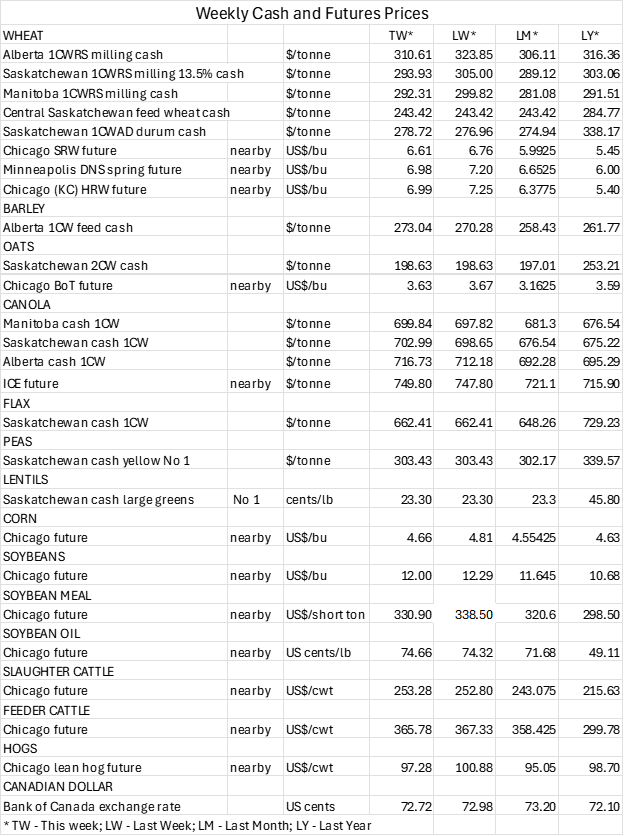
North American grain and oilseed markets experienced some wide price swings during the third week of May, reacting to shifting developments in the Middle East and a trip by Donald Trump to China.
Trump’s visit with Chinese President Xi Jinping failed to result in any detailed trade deals, although China did reportedly agree to purchase US$17 billion worth of U.S. agricultural goods over and above their previously announced soybean commitments annually for the next three years.
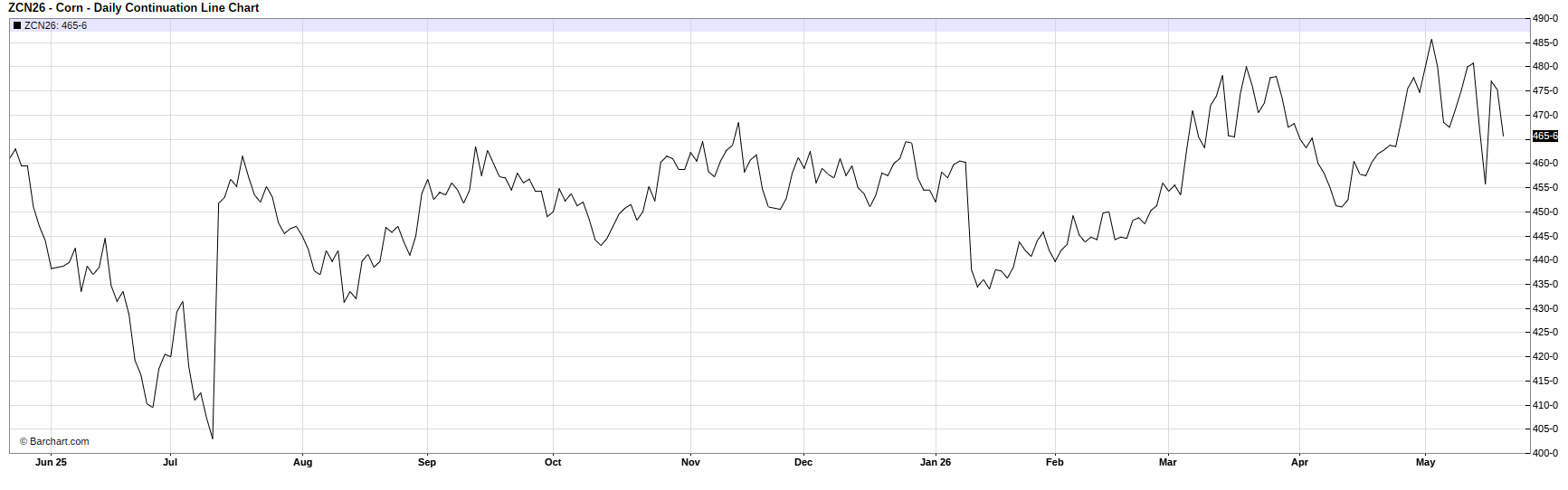
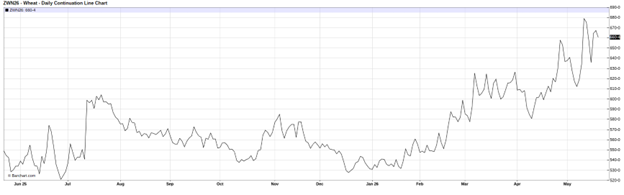
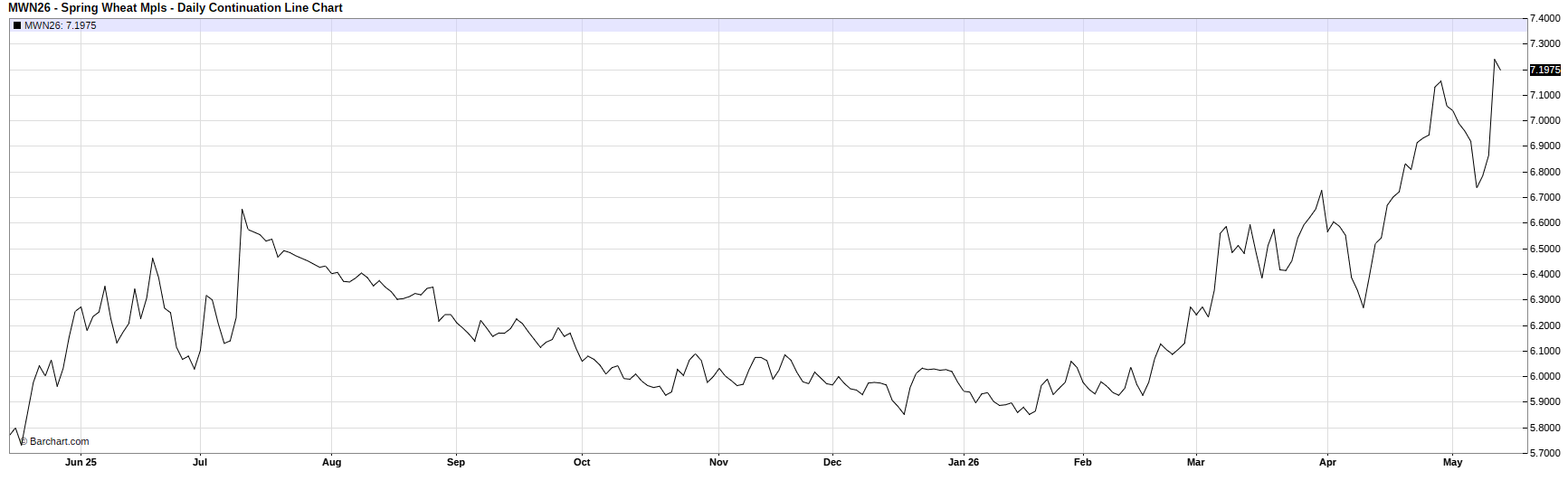
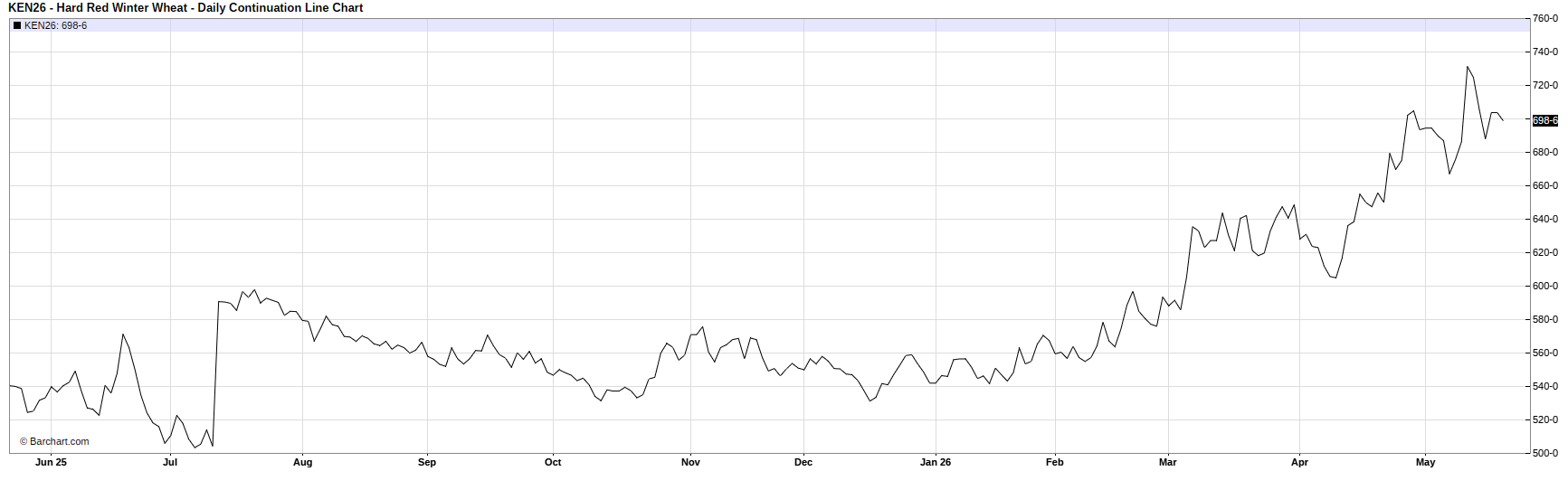
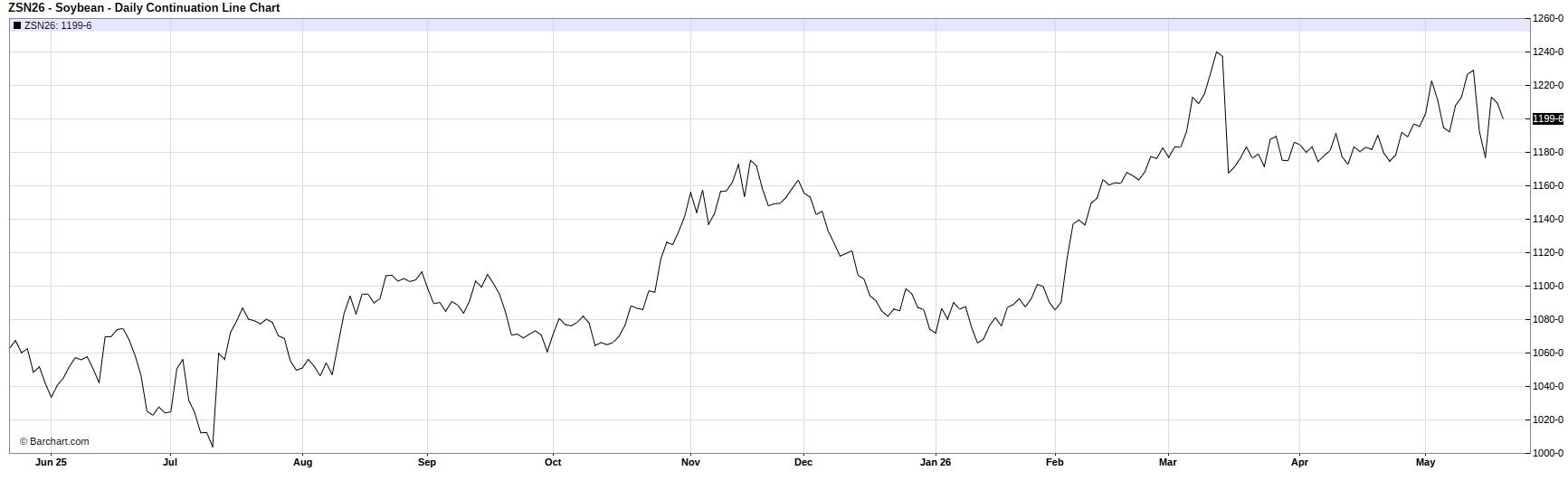
Soybeans lost 29 cents on the week, and corn was down 15 cents. U.S. wheat futures were also down across the board, despite the fact crop conditions continue to deteriorate across the U.S. Plains.
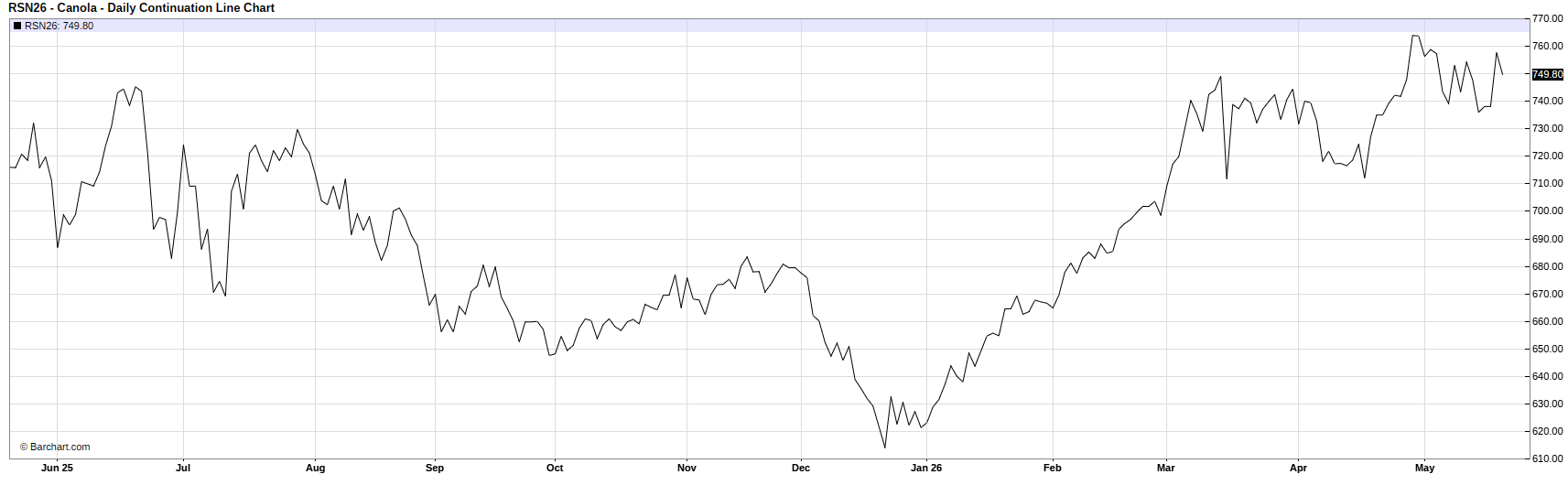
Canola futures managed to move higher, running up against nearby resistance as world vegetable oil markets remained supported by the ongoing strength in crude oil. The old crop July contract was up by about C$2 per tonne on the week but had traded in a $30 per tonne range.
Cattle futures were mixed, with losses in the feeder market and small gains in the slaughter market. Hog futures were weaker, losing nearly US$4 per cwt. on the week.
The Canadian dollar softened relative to its U.S. counterpart, losing a quarter cent at 72.72 U.S. cents.
Charts and tables
Weekly Chicago Corn Futures
Weekly Chicago Wheat Futures
Weekly Minneapolis Wheat Futures
Weekly Kansas City Wheat Futures
Weekly Chicago Soybeans Futures
Weekly ICE Canola Futures
Backgrounder
I recently had the forced opportunity to spend a Saturday morning in a waiting room with my teenage son who needed bloodwork taken on an empty stomach. The screen on the wall told us when we arrived just before 8 a.m. that the wait would be about 40 minutes. Dozens of others were already there for the same purpose, and more continued to stream in behind us — the queue stretching outside the door.
The promised wait eventually stretched to two hours as the projections on the screen ebbed and flowed. My son and I had a good chat, but what stood out to me was how the general waiting room experience has changed in a relatively short span of time.
Likely due to pandemic precautions, there are no longer any magazines in waiting rooms. Aside from a few outliers, like a lone woman with a paper book, most everyone in the room kept busy scrolling their devices. The algorithms spooning them a personalized feed.
That made me wonder what is lost in the absence of the waiting room magazine? I don’t play golf but would usually learn something new about putter technology whenever I was at my dentist. I don’t keep up on the latest entertainment news but could always count on some pop star gossip (from two years ago) at my optometrist.
It’s a small thing in the grand scheme but speaks to the conversation on artificial intelligence and “real” intelligence at the top of this issue. What is lost when we increasingly rely on AI and algorithms? Ursa Ag with their low-tech tractors may be on to something.
I’m filling in for the AGRIWEEK newsletter one more week. My work typically focuses on futures markets. The fundamentals and technicals of why prices rise or fall. However, that is only one small facet of the wide world of agriculture, and AGRIWEEK is here to look beyond the headlines. I think I’ve barely scratched the surface. What is missing? What would make for the perfect waiting room (agriculturally focused) newsletter?
Thanks for reading,
Phil Franz-Warkentin
Source: producer.com