
AM Market Report – March 26, 2026
GOOD MORNING…HERE IS YOUR MORNING MARKET NEWS
OVERNIGHT GRAIN TRADE
ICE canola futures are posting gains of $2 to $3/tonne this morning on the front month contracts…holding near overnight session highs…supported by higher world vegoil and energy markets.
Chicago soybean futures have shifted to either side of unchanged in overnight trade, but are now up 1 to 3 cents/bu. Soymeal futures are lower, but soyoil is higher.
CBOT corn futures are fractionally mixed this morning.
US wheat markets are mostly in the red… spring wheat futures are fractionally to 3 cents lower, HRW steady to leaning fractionally weaker (May up a quarter cent), while SRW wheat is shedding 2 to 5 cents.
Read Also
Prairie Weather
A low pressure system is pushing from southern Alberta into southwestern Saskatchewan bringing some light to moderate snow flurries to…
In Other News
– What Peace talks?… Iran s top military leadership has scornfully dismissed US President Donald Trump s claims that the Islamic republic was ready to make a deal after Washington presented Tehran with a 15-point plan to end the war, according to the Financial Times. The world seems to be accepting the fact that there are currently no real negotiations for peace, with both sides essentially demanding surrender from the other amid signs of escalation.
Iran rejected the US peace proposal and set five stiff conditions to end the war:
1. Immediate end to attacks and assassinations on Iran
2. Establishment of concrete guarantees against future U.S. attacks
3. Clear determination and guaranteed payment for war damages
4. International recognition of Iran s authority over Strait of Hormuz
5. An end to the war across all fronts, including for all Iranian proxies in the region
– Trump threatens to hit Iran harder… The United States on Wednesday issued a stern warning to Iran saying President Donald Trump would hit them harder if Tehran fails to accept that they have been “defeated militarily”, White House press secretary Karoline Leavitt said. “President Trump does not bluff and he is prepared to unleash hell. Iran should not miscalculate again,” Leavitt told reporters in a press briefing.
“If Iran fails to accept the reality of the current moment, if they fail to understand that they have been defeated militarily, and will continue to be, President Trump will ensure they are hit harder than they have ever been hit before,” she said.
As the joint US-Israeli war on Iran entered its fourth week, there have been efforts by multiple countries such as Pakistan, Turkey and Egypt to mediate a possible negotiation to try and end the war, but uncertainty persisted on where and when any talks would materialize.
As the Middle East war continues, the price of everything from gas to jet fuel to plastics is rising sharply…and it’s only set to get worse over the next few weeks.
In the final days before the war began and the Strait of Hormuz was effectively blocked, many ships made it out to sea. The last of them should arrive in Japanese and Korean ports over the next eight to 10 days, but after that, nothing is coming. Right now, there’s a shortage in “paper oil,” meaning contracts representing oil that can be shipped. But soon there will be a shortage in physical oil (and natural gas), which is what actually powers our world. As soon as the actual, final shipments of oil out of the Strait arrive at their destinations, the shortage moves from the paper world into the real, physical world. When that happens there will be a lack of tangible oil to actually power things.
– Nations rush to secure fertilizer… Governments are rushing to secure supplies of critical crop nutrients ahead of spring planting, as the Middle East war chokes off the flow of commodities and amplifies fears of a global food crisis, according to a Bloomberg report. Fertilizers exemplify the tight link between energy and food prices, underpinning harvests worldwide. The Middle East is a vital supplier, rich in both mineral reserves and the gas needed to produce nutrients for staples like corn, wheat and rice. With the Strait of Hormuz effectively shut, shipments have ground to a halt, said the report.
Prices of urea…the most widely used nitrogen fertilizer…have surged, with phosphate supplies also at risk. Much of global stock is tied to the Persian Gulf, and panic is spreading across major agricultural economies.
Top exporters China and Russia are curbing some crop nutrient sales, while the US is loosening shipping restrictions to facilitate domestic flows. India, the largest urea buyer, is scrambling for supply and weighing a tender. Canada, Greece and France have expanded financial support for farmers, and in Africa, Ghana has rolled out a free fertilizer program.
Rising fertilizer prices could push food costs higher, just as inflation in agricultural goods had started to ease after years of shocks from the pandemic to the war in Ukraine and extreme weather, said Bloomberg.
– US/China to meet… US President Donald Trump and Chinese Leader Xi Jinping will hold their highly anticipated summit in Beijing on May 14-15, following a delay due to the war with Iran…something that sparked fresh uncertainty around relations between the world s largest economies, Bloomberg reports.
White House Press Secretary Karoline Leavitt announced the rescheduled dates on Wednesday and said that Xi would visit Washington at a date later this year.
– US EPA issues emergency fuel waiver for E15… The US Environmental Protection Agency (EPA) has issued a temporary emergency fuel waiver to allow sales of E15 throughout the summer months. The decision to lift restrictions on the sale of higher-ethanol fuel again this summer could help soften the blow of higher gas prices, but it s not the big win the US biofuels industry has been seeking, notes Politico.
Since 2022, EPA has used an emergency waiver each year by way of the Clean Air Act to allow gas stations to sell E15 fuel in summer, but allowing those sales permanently is up to Congress, where a deal appears close, but also far away.
Consumers, fuel producers and farmers alike desperately need Congress to pass legislation that would delivery permanent year-round access for E15 and finally break the cycle of ad hoc, stop-gap emergency waivers, stated Geoff Cooper, CEO of the US Renewable Fuels Association.
If ever there were justifiable conditions to merit an emergency waiver for E15, it would be now as fuel prices have skyrocketed from war with Iran and a historical oil market disruption in the Strait of Hormuz, noted Brian Jennings CEO of the American Coalition for Ethanol.
The petroleum industry has been skeptical of E15 waivers. In late February, American Fuel & Petrochemical Manufacturers urged EPA Administrator Lee Zeldin to use the waiver authority judiciously, citing limited circumstances under which they re allowed. Domestic (US) gasoline supplies are robust, the group told EPA in a letter dated February 25, citing statistics from the US Energy Information Administration.
– Weakened Russian energy infrastructure... At least 40% of Russia s oil export capacity is at a halt following Ukraine drone attacks, a disputed attack on a major pipeline and the seizure of tankers, according to Reuters calculations based on market data. Reuters reports the shutdown is the most severe oil supply disruption in the modern history of Russia, the world s second largest oil exporter. Oil output is one the main sources of revenue for the country s national budget and is central to its $2.6 trillion economy.
Ukraine has intensified drone attacks on Russia s oil and fuel export infrastructure this month, hitting all three of Russia s major western oil export ports, including Novorossiysk on the Black Sea and Primorsk and Ust-Luga on the Baltic Sea.
With its westward export routes under fire, Moscow must rely on oil exports to Asian markets, but those markets are limited due to capacity.
Russia continues uninterrupted supply shipping via pipeline to China, including the Skovorodino-Mohe and Atasu-Alashankou routes, as well as ESPO Blend exports by sea via the port of Kozmino. Together, the three routes account for some 1.9 million bpd of oil, notes Reuters.
Russia also continues to load oil from its two far eastern Skhalin projects, shipping about 250,000 bpd from the island. Traders also report that Russia is supplying the refineries in neighboring Belarus with around 300,000 bpd of oil.
Outside Markets
The Dow Jones Industrial Average rose 305.43 points higher on Wednesday to settle at 46,429.49, while the S&P 500 was up 35.53 at 6,591.90. Early Thursday, the June Dow Jones Futures are down 309 points.
Global stock markets are weaker this morning amid dimming hopes for ?a quick end to the Middle East conflict as the US and Iran issued conflicting statements about ceasefire talks. Wall Street futures are in the red now after major North American markets closed higher yesterday. Canada s TSX compositive index rallied 441 points yesterday, but index futures this morning are following broader stock market sentiment lower.
It looks like the market s relief trade is starting to wobble, said Charu Chanana, chief investment strategist at Saxo. Traders are also remembering that one peace rumour does not undo the inflation and rates damage already in the system.
The June US Dollar Index is up 0.191 at 99.590. The Canadian dollar weakened against its US counterpart…currently quoted at 72.45 US cents.
May crude oil futures are up $3.51 at US $93.83/barrel. Oil prices are on the rise again, clawing back yesterday s losses on concerns that protracted fighting in the Middle East will further disrupt energy flows.
Optimism regarding a ceasefire has faded, said Tsuyoshi Ueno, senior economist at NLI Research Institute. He added that the bar set ?by Washington appeared high, leaving oil prices vulnerable to further volatility ?depending on negotiations and military actions by both sides.
Grain Markets
Chicago soybean futures are jockeying between small gains and losses this morning…currently 1 to 3 cents/bu higher. Bean futures rallied late on Wednesday, with contracts up 6 to 16 cents at the close. Soymeal futures are down less than $1/ton after losing 70 cents to $2/ton yesterday. Soyoil futures are up 32 to 69 points after rallying 90 to 137 points higher on Wednesday.
USDA this morning reported US soybean export sales of 668,900 tonnes for the week ended Mar 19…higher than the trade expectations which ranged between 200,000 to 500,000 tonnes.
Traders are handicapping whether the EPA will announce 2026/2027 US biofuel blending quotas at this Friday’s farmer visit to the White House or at the end of the month. Regardless, the expected higher US renewable volume obligations are seen as bullish for the soybean complex.
Renewed optimism set in on Wednesday when the White House announced that US President Trump will head to China for a rescheduled meeting with China s President Xi on May 14-15.
But the looming bear in the market remains Brazil’s harvest progress of another record large soybean crop. Brazil’s soybeans offer for export is $1/bu below the US price. Also of note, China and Brazil have reportedly reached an agreement over phytosanitary issues that had slowed down bean shipments for much of March.
Chicago corn futures are fractionally mixed this morning. The corn market posted 3 to 5 cent gains across the board on Wednesday despite early session weakness.
EPA Administrator Lee Zeldin announced a waiver allowing E15 sales through the United States starting May 1, following a pattern from previous years of lifting the fuel restrictions during the summer months. Corn, and other commodities linked to biofuels, are waiting for the EPA s blending numbers for 2026-27, which are expected to be released by the end of the month.
EIA data was released on Wednesday morning, with US ethanol production bouncing 23,000 barrels per day in the week ending on March 20 to a daily average of 1.116 million bpd. That helped to take the stockpiles of ethanol 763,000 barrels higher to 27.17 million barrels.
USDA this morning reported US corn export sales of 1.218 MMT for the week ended Mar 19…about middle of trade expectations which ranged between 0.7 and 1.5 MMT.
The USDA will release its 2026 US Prospective Planting report on Tuesday (Mar 31), along with US Quarterly Grain Stocks data.
US wheat markets are weaker this morning…fractionally to 3 cents lower for Minnie spring wheat futures, HRW futures are mixed to mostly down a fraction of a penny, while SRW wheat is losing 2 to 5 cents. The US wheat complex showed strength on Wednesday…spring wheat saw gains of 4 to 9 cents on the day. Not a lot of direct-wheat news driving prices at the moment…seems more following the lead of corn and soybeans.
USDA this morning reported US wheat export sales of 397,200 tonnes for the week ended Mar 19…near-ish the middle of trade ideas which ranged between 100,000 to 500,000 tonnes.
The next week looks on the drier side for much of the US Plains and HRW country, which is not beneficial to the crop with quality ratings already spilling. A few spots in SRW country are looking at a wetter pattern in parts of the Eastern Corn Belt.
Until rain arrives in the western HRW Plains states, the dryness will be somewhat market friendly. Longer-term forecasts do call for rain for the impacted crop.
Hard red winter wheat futures traded at its biggest premium to soft red winter in more than seven months, as heat in the Plains and Midwest is set to exacerbate the stress on wheat crops there. Overnight, May HRW carried a 23-cent premium to May SRW futures.
The uncertainty surrounding the global transportation of fertilizer supplies will be on traders’ minds if the conflict in the Middle East remains unsettled.
CANADIAN GRAIN MARKET
ICE canola futures closed higher Wednesday amid strength in Chicago soybeans and soyoil. Those gains spilled over into our canola market and outweighed pressure from lower crude oil. Reports attributed some of the buying in bean oil to speculation ahead of a White House agriculture event on Friday, where the Trump administration could unveil or signal a decision on long-delayed US biofuel blending quotas.
A weaker Canadian dollar also supported canola yesterday. European rapeseed and palm oil were both mixed on the day.
May canola finished Wednesday up $3.30 at $727.20/tonne, and November added $3.90 to $734.10.
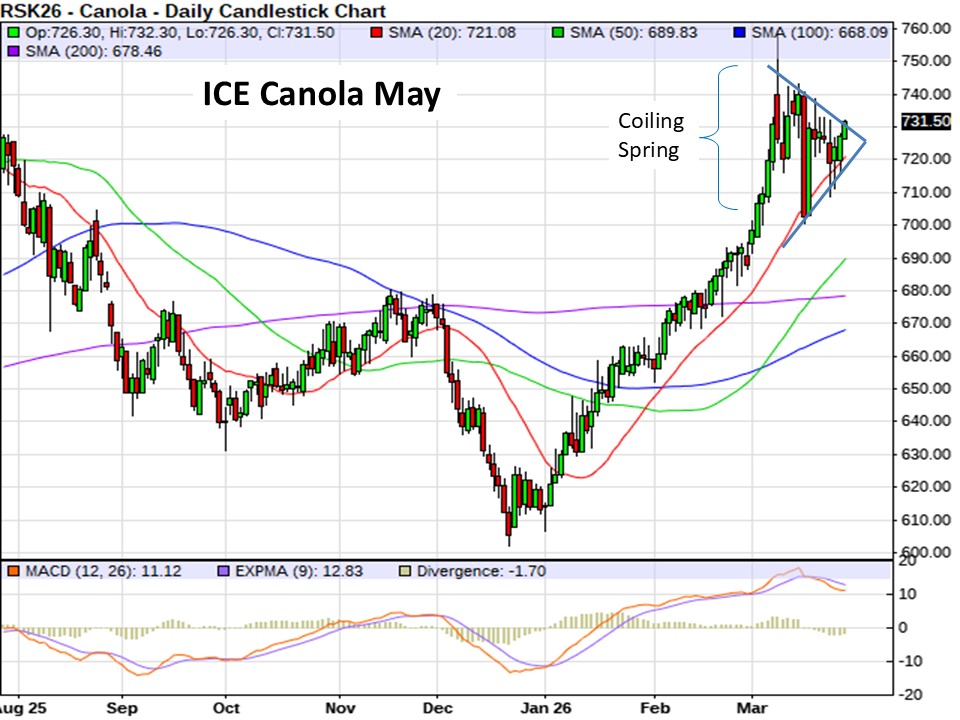
For today… canola futures are showing gains of $2 to $3/tonne this morning in the front month contracts. The nearby May contract is leading the advances, up $3.40 at $730.60/tonne, and up a third consecutive session, while maintaining upward trendline and 20-day moving average chart support. All market participants to trying to assess the current technical structure of symmetrical triangle coiling pattern in canola futures trade…or are we witnessing an interim topping pattern?
CBOT soybean and soyoil futures are starting to turn higher this morning. Malaysian palm oil is higher thanks to stronger energy markets and bean oil. European rapeseed is quietly higher following its recent bull market correction.
Aside from the Iran war and wider geopolitics, oilseed markets in North America are also on pins/needles with respect to pending announcements of US renewable fuel and biodiesel policies that are expected before the end of the month…could be Friday or Monday). Renegotiations of the Canada-US-Mexico agreement is also of great interest.
Stay informed with our daily market videos. Each video quickly covers key futures moves, price trends, and market signals that matter to Canadian farmers. Get clear, timely insights in just a few minutes. Bookmark https://www.producer.com/markets-futures-prices/videos
To access the latest futures prices, go to https://www.producer.com/markets-futures-prices/

Source: producer.com