
AM Market Report – May 14, 2026
GOOD MORNING…HERE IS YOUR MORNING MARKET NEWS
OVERNIGHT GRAIN TRADE
ICE canola futures this morning are pulling back a second consecutive day…currently trading mostly $7 to $8/tonne weaker. Chicago soybean futures are plunging 20 to 30 cents/bu lower, with soymeal and oil also selling down.
CBOT corn futures are losing 7 to 8 cents/bu this morning.
US wheat markets are also lower… Minnie spring wheat futures are down 4 cents, HRW losing 9 to 10 cents and SRW wheat off 8 to 10 cents.
So far, the grain markets bulls have not been impressed with news coming out of the Trump-Xi summit in China…friendly diplomatic gestures, but no evidence of hard progress being made on trade and geo-political issues. (See item below.)
Latest on US-Iran war…
US efforts to end the war with Iran were dealt a setback after a commercial vessel was apparently seized by unauthorized personnel near the United Arab Emirates, increasing uncertainty over control of the critical Strait of Hormuz, Bloomberg reported. The ship, whose identity wasn t immediately clear, was taken 38 nautical miles off the UAE coast and is now bound for the Islamic Republic, the UK Maritime Trade Operations said in a statement on Thursday. The incident came amid an apparent uptick in vessels transiting the strait, which usually handles about a fifth of the world s oil and liquefied natural gas supply.
In Other News
– Xi/Trump do their diplomatic dance… China’s Xi Jinping told US President Donald Trump that trade talks were making progress at the start of a two-day summit on Thursday but warned that disagreement over Taiwan could send relations down a dangerous path. The Chinese leader’s remarks set the stage for what Trump described as possibly the “biggest summit ever” following a pomp-filled reception at Beijing’s imposing Great Hall of the People. Xi began the summit by telling Trump that stable relations between the world’s two biggest economies benefit the entire world. “When we cooperate, both sides benefit; when we confront each other, both sides suffer,” he said in brief remarks that were open to media.
Xi said negotiations between US and Chinese economic and trade teams in South Korea on Wednesday had reached “overall balanced and positive outcomes,” according to a readout by China’s foreign ministry. The negotiations had aimed to maintain the trade truce struck between Trump and Xi last October and establish mechanisms to support future trade and investment, officials with knowledge of the matter said.
Xi also broached the subject of Taiwan, the democratically governed island claimed by China and armed by the United States. The Chinese leader told Trump that Taiwan was the most important issue in US-China relations and if handled poorly could lead to conflict and an extremely dangerous situation, according to the Chinese readout of the talks.
The leaders also agreed to expand cooperation in trade and agriculture and exchanged views on the situations in the Middle East, Ukraine and the Korean peninsula, according to state broadcaster CCTV…though without any specifics.
Trump enters the talks with a weakened hand. US courts have hemmed in his ability ?to levy tariffs at will on exports from China and other countries. The Iran war has also boosted inflation at home and escalated the risk that Trump’s Republican Party will lose control of one or both legislative branches in November’s midterm elections.
Though the Chinese economy has faltered, Xi does not face comparable economic or political pressure. Nevertheless, both sides are eager to maintain a trade truce struck last ?October, in which Trump suspended triple-digit tariffs on Chinese goods and Xi backed away from choking global supplies of rare earths, which are vital in making items from electric cars to weapons. They are also expected to discuss forums to support mutual trade and investment, as well as dialogue on AI issues.
Washington is looking to sell Boeing airplanes, farm goods and energy to China to cut a trade deficit that has long irked Trump, while Beijing wants the US to ease curbs on exports of chipmaking equipment and advanced ?semiconductors.
Aside from trade matters, Trump is expected to encourage China to convince Tehran to make a deal with Washington to end the conflict with Iran. But analysts doubt that Xi will be willing to push Tehran hard or end ?support for its military, given Iran’s value to Beijing as a strategic counterweight to the US.
– Manitoba seeding pace behind average… Manitoba farmers made some seeding progress in early May, although the pace remains behind average, according to the latest crop report from Manitoba Agriculture released May 12. Provincial seeding progress came in at 13%, which was up 11 points from the previous week, but 10 points off the five-year average of 23% and well behind the 33% progress at the same time a year ago.
Field pea planting was the farthest ahead, at 40 to 50 per cent complete, while farmers were also planting corn, soybeans, spring wheat, canola and sunflowers. Little to no precipitation and cooler temperatures were reported across agricultural regions of the province during the week.
Winter wheat and fall rye survival was reported as very good, with minimal winterkill. Winter cereals were at the 3-leaf stage and greening up well, although growth was slow due to cool conditions.
Moisture conditions remain a concern. While soil moisture is sufficient to support initial pasture and crop establishment, levels are not adequate for sustained growth. Timely rainfall will be important over the coming weeks, said the report.
– US House passes measure to allow year-round E15 gasoline… It appeared nip and tuck for a while Wednesday, but the US House of Representatives passed legislation that allows year-round sales of E15 gasoline blended with 15% ethanol, in a 218-203 vote. US corn growers and biofuel groups are elated. The bill now goes to the Senate.
The American Soybean Association, however, has some reservations about the bill. Following passage, the ASA in a statement said that while it supports year-round access to E15, the legislation passed today contains more than just E15 provisions. The group cited a study by the Food and Agricultural Policy Research Institute and Congressional Budget Office analyses. The findings show the House version of the bill would result in reduced net farm income and negative economic impacts for soybean growers and the broader agricultural economy, the ASA said. The National Corn Growers Association hailed House passage of the bill and urged the Senate to quickly take action.
– Timely rain helps EU grain crops after dry start to spring... Rain this ?month has brought relief to grain crops in Western and Central Europe ?after a very dry start to spring, reducing the risk of widespread yield losses ahead of this summer’s harvest. A parched April in countries including France, Germany and Poland had heightened concern in a wheat market already grappling with severe drought in ?the US Plains and the risk of an El Nino cycle hurting Australian ?crops. But showers in early May have improved the outlook in Europe, though analysts warn regular ?rain will be needed to sustain soil moisture during the peak growth period.
Improved moisture could help ?limit an ?expected drop in EU wheat output after last year’s ?bumper yields, while keeping the bloc on course for a bigger rapeseed crop following an increase in planted area.
– Brazil corn crop soon to overtake soy volume... Brazil s corn crop, boosted by a rapidly growing corn ethanol industry, is on course to overtake soy as the South American country s most-produced grain, said Paulo Bertolini, president of industry group Abramilho. Brazil s Conab crop agency in April forecast total soy production in the 2025/26 season would hit a record large 179.2 MMT, while total corn output…split across three harvests…was forecast at 139.6 MT.
Some states like Mato Grosso have already seen corn exceed soy in terms of production while Parana…the country s second-largest grain producer…s just two or three years away from seeing corn become its biggest crop, Bertolini said. Corn has enormous growth potential in Brazil, as it is produced in three harvests throughout the country, Bertolini told Reuters on the sidelines of Abramilho s annual congress, held in Brazil s capital Brasilia.
Corn ethanol output has exploded in Brazil in recent years, making impressive gains on an industry long controlled by sugarcane growers. The booming grain-ethanol industry and interest from China are also driving increased output of sorghum, Bertolini said.
Outside Markets
The Dow Jones Industrial Average finished 67.36 points lower on Wednesday to settle at 49,693.20, but the S&P 500 pushed up 43.29 points to close at 7,444.25. Canada s S&P/TSX composite stock index ended yesterday down 249 points to 34,041.
Global stock markets are on the rise this morning, lifted by technology stocks, though concerns over stalled US-Iran peace talks kept investors cautious, while a ?high-stakes US-China summit ?provided few surprises. Early Thursday, the June Dow Jones Futures are up 445 points after the S&P 500 and Nasdaq posted fresh record closes yesterday. TSX stock futures are following sentiment higher this morning.
Charu Chanana, chief investment strategist at Saxo, said markets were looking for the absence of a new shock. So far, that seems to be enough. With expectations low and AI momentum still ?strong, investors are treating vague diplomacy as a reason to move on rather than a reason to de-risk.
In other news…the US Senate yesterday confirmed President Trump s nominee Kevin Warsh to lead the US Federal Reserve when Jerome Powell s term at the helm comes to an end this month at a fraught moment for the world s most powerful central bank. Warsh will be presiding over a Fed wrestling with a significant pickup in inflation resulting from the oil supply shock created by Trump s war with Iran. That s served to squelch market expectations that Warsh will lead the US central bank on the sort of aggressive interest rate-cutting plan President Trump has repeatedly insisted upon.
The June US Dollar Index is up 0.117 at 98.540. The Canadian dollar weakened against its US counterpart…currently quoted at 72.89 US cents.
June crude oil futures are down $0.60 at US $100.42/barrel. Oil prices are modestly softer after a ?Chinese readout from a meeting between US President Trump and Chinese President Xi tried stressed co-operation and stability.
Oil prices are in a wait-and-see mode, ING analysts said in a note on Thursday, adding that the market could be pinning too much hope on the US-China talks yielding some positive results on the Iran war.
Meanwhile, the International Energy Agency (IEA) is reporting that global oil supply will fall short of total demand this year as the Iran war wreaks havoc on Middle East oil production and drains inventories at an unprecedented pace…upending its earlier outlook calling for a surplus. The US and Israel’s war with Iran, subsequent damage to Iran and its Gulf neighbours’ oil infrastructure and the effective closure of the Strait of Hormuz have caused the largest oil supply crisis in history in the IEA’s view, sending oil prices skyrocketing.
Grain Markets
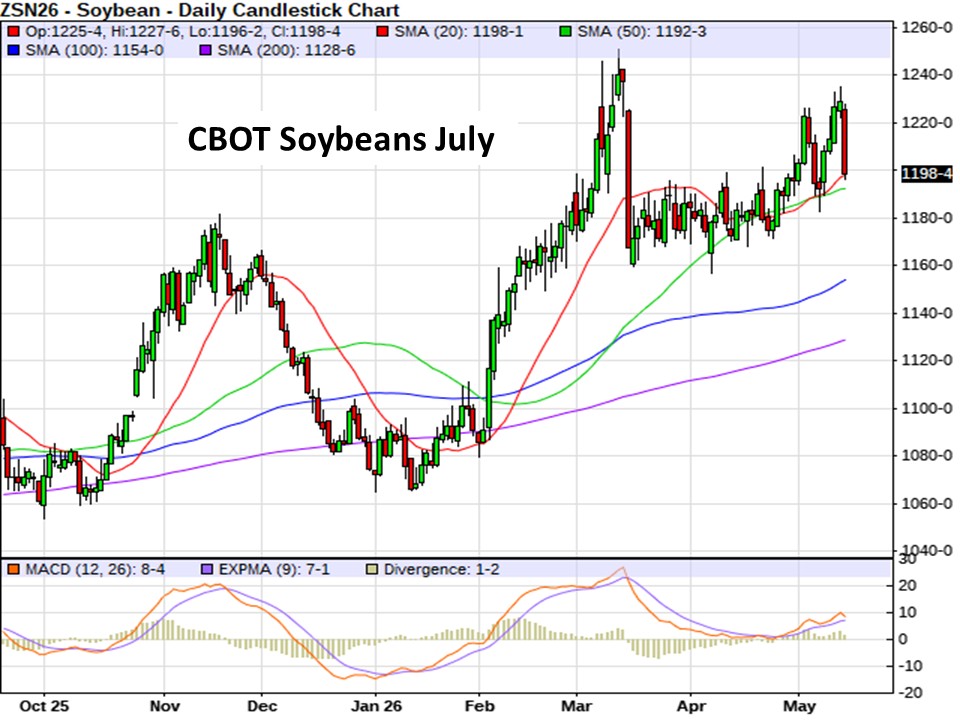
Chicago soybean futures are down sharply so far this morning…plunging 20 to 30 cents/bu currently. Bean futures saw modest strength on Wednesday, with contracts closing fractionally to 3 cents higher on the day. While still holding the short-term upward trendline of the past month or so, July soybean futures are down 30.5 cents this morning at $11.98/bu, dropping just below psychological support at $12.00, and now testing its 20- and 50-day moving averages.
Soymeal futures are down $3 to $5/ton this morning after rallying $4 to $10/ton higher on Wednesday. Soyoil futures are losing 111 to 117 points this morning after falling into yesterday s close, down 27 to 104 points.
A meeting between US President Trump and China s President Xi in Beijing concluded early this morning. Bloomberg reported the two sides discussed increased agricultural trade, without offering any details…though US Treasury Secretary Bessent stated that soybeans are all taken care of. The soy market right now seems skeptical. The US delegation is not ag heavy, and China is currently able to source a significant supply of soybeans from Brazil at cheaper prices.
USDA this morning reported US soybean export sales of 102,100 tonnes for the week ended May 7…a marketing-year low, with the trade expecting a number ranging between 100,000 to 500,000 tonnes.
US domestic soy crush margins remain solid, and US planting is likely past the halfway point thanks to mostly favorable weather. Some areas will see rain delays later this week, but that s generally expected to be long-term beneficial.
Chicago corn futures are mostly 7 to 8 cents/bu lower this morning. The corn market finished mixed on Wednesday, with contracts within a penny of either side of unchanged. A sudden double-toppy feel to corn price charts as trader await news on the Trump-Xi talks in Beijing.
A bill to approve year-around sales of E15 was passed by the US House of Representatives on Wednesday evening. It will now go through the Senate, facing some hurdles from oil state senators.
Weekly EIA data from Wednesday showed a 65,000 barrel per day hike in average daily US ethanol output in the week ending May 8, taking the total to 1.082 million bpd. Ethanol stocks saw a draw of 1.15 million barrels to 24.87 million barrels…suggesting strong demand.
USDA this morning reported US corn export sales of 684,800 tonnes for the week ended May 7…a disappointing results considering traders looking for old crop corn business of between 1.0 to 1.9 MMT.
Traders are watching US planting weather, expecting generally good progress in much of the Corn Belt this week. While parts of the US will see near-term rain delays, that soil moisture recharge is welcome.
The Rosario Grains Exchange estimates the Argentina corn crop at a record large 68 MMT, up 1 MMT from their previous number.
US wheat markets are weaker this morning, with spring wheat futures losing 4 cents, while the winter wheat markets are down 8 to 10 cents. The US wheat complex followed Tuesday s strong, even limit-up gains, with all three exchanges closing lower on Wednesday…spring wheat ending yesterday down 4.
Day 2 of the Kansas Wheat Quality Tour showed an average of 39.3 bu/acre yield, the lowest Day 2 total for the tour since 2023 and well below the 53.3 bu/acre last year. Thursday is the final day of the tour with the average released later in the day. US winter wheat production will be a multi-decade low…notably HRW wheat…but that s still blunted by the current large global supply.
USDA this morning reported old crop US wheat export sales of 133,500 tonnes for the week ended May 7…within trade expectations ranging between 50,000-150,000 tonnes. Sales for new crop starting June 1 were 221,100 tonnes, with trade ideas ranging 100,000 to 350,00 tonnes.
Expana raised their outlook for 2026/27 EU wheat production by 0.1 MMT from last month to 128.8 MMT. The Rosario Grains Exchanges projects the 2026/27 Argentina wheat crop at 18-19 MMT, a sharp decline from 29.5 MMT in the year prior.
CANADIAN GRAIN MARKET
ICE canola futures edged lower on Wednesday, giving back recent gains as weakness in the broader vegetable oil complex outweighed supportive macro factors. July canola futures fell $6.40 yesterday to close at $747.80/tonne after trading as high as $756 earlier in the session.
For today… canola futures are falling back for a second consecutive session this morning, currently down $7 to $8/tonne. July canola is $7.100 lower this morning at $740.70/tonne, pushing down below its 20-day moving average ($745), with the 50-day average just below at $738.
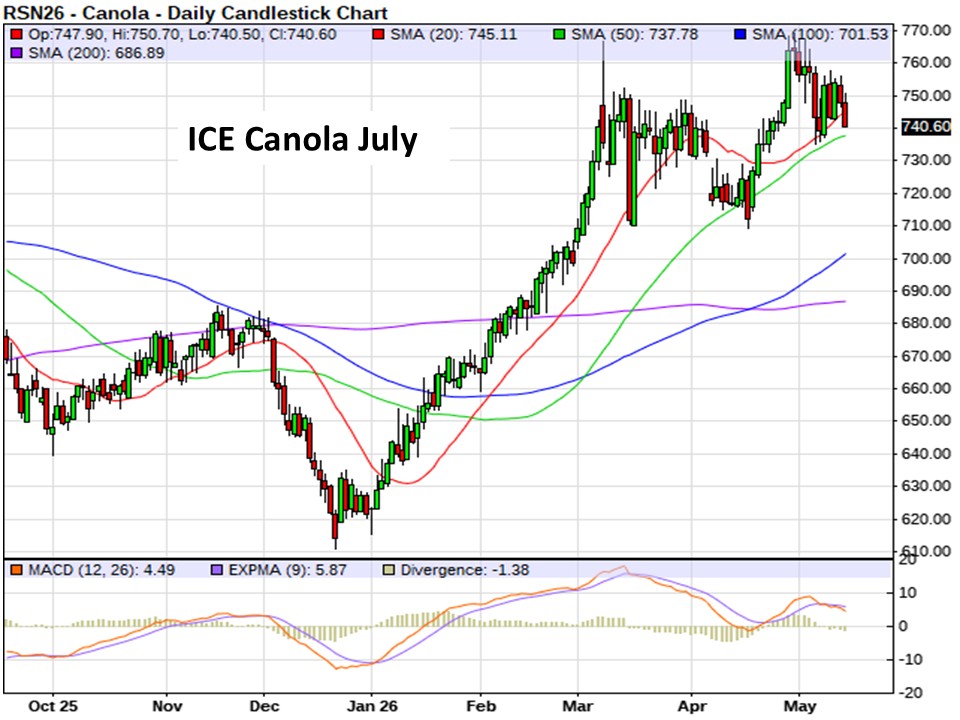
Canola is lower with CBOT soy futures as a lack of details of any new US ag business out of China weighs on crop markets across the board.
Another go at cool, wet weather on tap for the Canadian Prairies will not be so beneficial with further seeding delays virtually guaranteed. Planting delays may become a factor going forward considering the increased demand expected for the coming crop.
This latest price pullback comes despite an otherwise supportive backdrop. Still strong crude oil prices and ongoing biofuel demand expectations have been underpinning the market, alongside solid domestic crush margins. Exports and the domestic crush during the summertime frame are likely going to be higher than earlier anticipated. A relatively soft Canadian dollar, holding near 73.00 cents US, has also helped maintain export competitiveness.
However, the canola market is facing increasing headwinds from global oilseed competition. Palm oil continues to lag, limiting upside in the vegetable oil complex, while improving rapeseed production prospects in Europe are easing some supply concerns.
The result is a market caught between supportive macro drivers and softer global fundamentals. For now, canola appears to be consolidating, with further direction likely tied to whether energy markets can extend their rally and reassert upward momentum.
Stay informed with our daily market videos. Each video quickly covers key futures moves, price trends, and market signals that matter to Canadian farmers. Get clear, timely insights in just a few minutes. Bookmark https://www.producer.com/markets-futures-prices/videos
To access the latest futures prices, go to https://www.producer.com/markets-futures-prices/
Source: producer.com