
AM Market Report – May 19, 2026
GOOD MORNING…HERE IS YOUR MORNING MARKET NEWS
OVERNIGHT GRAIN TRADE
ICE canola futures are trading $6 to $10/tonne higher so far this morning (nearbys leading), playing catch-up to rebound gains in the US soy complex after Canadian markets remained closed Monday for the Victoria Day holiday. On Monday, July corn futures rose 21 cents/bu, July soybeans surged 36 cents, and July KC wheat rose 15.75 cents.
Chicago soybean futures this morning are steady to a penny higher this morning after Monday s strong rebound rally. Meal is slightly stronger, but soyoil is weaker this morning.
CBOT corn futures are fractionally to a penny lower this morning.
US wheat markets are mixed to slightly higher…Minnie spring wheat futures up 4 to 10 cents, HRW up 2 to 4 cents, while SRW wheat is narrowly mixed.
Grain market bulls were back in the saddle on Monday after getting taken to the woodshed late last week. What a difference a weekend can make. US grain and soy complex futures ended last week with a bearish drubbing after a lack of detail from US President Donald Trump s summit meeting with Chinese leader Xi Jinping. But a White House fact sheet over the weekend highlighting what the administration says is a commitment by Beijing to buy $17 billion in agricultural goods…in addition to purchases of soybeans previously committed to in October…over the next three years sparked a sharp Monday rally that saw July corn and July soybean futures erase last week s losses.
Monday s bullish price action across US corn, soybean and wheat markets was entirely about the White House fact sheet re: China and buying Ags. But there remains little news out of China confirming much, if anything…but they seem to agree that discussions were seen about moving forward on more Ag trade. So now we sit, waiting to see whether China will or won t do buy and when/if they ll come around. The market now wants proof of sales rather than just rhetoric. Any higher purchases of US farm goods, if they come, are likely to come at the expense of exports from rival suppliers such as Brazil, Australia and Canada.
US Crop Start
US weather for me seems very normal for spring corn/soybean seeding and early conditions should be good. US corn and soybean planting is moving quickly this spring, running well ahead of the national average. The USDA says 76% of US corn has been planted as of Sunday, ahead of the five-year average of 70%. 39% of the crop has emerged up from 23% the previous week. US soybeans are 67% planted, ahead of 53% on average, with 32% of the crop emerged.
US winter wheat conditions were reported at 27% good to excellent, down a percentage point from the previous week, and down considerable from the 52% that was reported this time last year. The data showed US winter wheat rated 43% very poor to poor and 30% fair.
The US spring wheat crop is 73% planted, ahead of the average pace of 66%, and 39% of the crop has emerged.
Latest on US-Iran war…
– Trump says he held off bombing Iran after Gulf states appealed
– UAE restores power to drone-hit nuclear plant, watchdog says
– India raises fuel prices again as US-Iran war squeezes refiners
– Australia urgently needs a lot more gas, energy executives say
US President Donald Trump said he paused a planned attack against Iran today to allow for negotiations to continue. Iran sent a new peace proposal to the United States through Pakistan, which has been acting as mediator. Tensions remained high in the Middle East and the notion of renewed attacks on Iran sent oil prices up. Government bonds continued their selloff with interest rates rising on fears that the continued blockade of the Strait of Hormuz will keep boosting energy costs and stoking inflation.
Trump s package of public threats, insults and ultimatums seems to have hit a wall with Iran and may undermine his efforts to end the war. Trump said Xi Jinping agreed that Tehran must open the Strait of Hormuz, but China gave no indication it would weigh in.
In Other News
– Cordonnier s US corn and soybean crop estimates… Noted crop consultant, Dr. Michael Cordonnier, said in his latest weekly report: Below are my starting estimates for the 2026 US corn and soybean crops. The planting pace for both corn and soybeans continues to be ahead of average, and the crops are getting off to a better than average start. I am rating both crops at a scale of 6 (with 5 as average). The two areas of concern for the crops are dry conditions in the western Corn Belt and in the southeastern US.
Corn planted acreage: 93.8 million acres (down 1.5 from March)
Corn harvested acreage: 86.0 million acres (91.7% of planted)
Corn yield: 181.0 bushels per acre
Corn production: 15.566 billion bushels
Soybean planted acreage: 86.2 million acres (up 1.5 from March)
Soybean harvested acreage: 85.1 million acres (98.8% of planted)
Soybean yield: 52.0 bushels per acre
Soybean production: 4.425 billion bushels
– North Africa s durum demand expected to falter… North Africa s bumper wheat crop may hurt price prospects for Canada s 2026-27 durum. The USDA is forecasting a record 12.9 MMT of production for Morocco, Algeria and Tunisia combined. That would be up 61% from last year and 58% above the five-year average. Weather during the crop year, for all three countries, has been remarkably favorable, the USDA s Foreign Agricultural Service (FAS) said in its World Agricultural Production report.
North Africa is Canada s most important durum buying region. Algeria was the top market for Canadian durum in the 2021-2025 period, accounting for 24% of exports. Morocco was second at 20%. The United States typically buys most of Canada s top-quality durum, while the No. 2 and No. 3 grades are shipped to North Africa.
The recent run-up in wheat prices will probably result in some displacement of durum acres in southern Saskatchewan because that crop hasn t participated in the rally.
– Brazil’s Conab raises soy crop estimate, sees record exports… Brazil’s soybean crop is expected to reach a record 180.1 MMT in 2025/26, national crop agency Conab said, lifting its estimate from the 179.15 MMT forecast in April. Conab pegged Brazilian soybean exports at an all-time high of 116 MMT, up 630,000 tonnes from its previous estimate, citing the large crop and robust shipments this year. Brazil is the world’s largest soybean producer and exporter. Farmers have already harvested 98.3% of the crop, according to Conab.
– Argentina raises soy, corn production estimate; wheat output to fall...Argentina’s Rosario Grains Exchange (BCR) raised its production forecasts for the 2025/26 soybean and corn crop, while its first estimate for the 2026/27 wheat harvest projected a sharp decline compared to the previous cycle. The exchange increased its soybean estimate to 50 MMT from 48 MMT previously, and raised its corn forecast to 68 MMT from a prior 67 MMT.
Argentina is the world’s largest exporter of soybean oil and meal and the third-largest corn exporter.
For wheat production, the exchange published its first estimate for the 2026/27 harvest, between 18 and 19 MMT, down sharply from the 29.5 MMT harvested in the previous season. Production costs, especially for urea fertilizer, are limiting wheat planting intentions, reducing estimated planted area. Wheat planting will begin in the coming weeks in Argentina, a major global wheat exporter.
– Kansas wheat crop in rough shape... The final estimate from the US Wheat Quality Council s annual crop tour put the winter wheat average yield average for Kansas at 38.9 bu/acre after 394 field stops, according to Bloomberg. That s well below last year s forecast of 53 bu/acre, with a survey of the tour s participants pegged Kansas wheat production at only 218 million bu, the second-lowest going back to 1972. That s a drop on a scale that affirms the 25% drop in winter wheat production forecast by USDA in last Tuesday s Crop Production Report. It s a nightmare out there, Vance Ehmke, who grows wheat for seed, told Bloomberg. You don t know whether you re coming or going with this weather.
– Russian wheat export prices rise with global prices… Russian wheat export prices rose last week along with global prices and as the rouble continued to strengthen, while new-crop wheat was also being offered at current prices. The price of Russian wheat with 12.5% protein content for free-on-board delivery in June/early July was US $240/tonne at the end of last week, up $1 from the previous week, said the IKAR consultancy. The price of new-crop wheat which is due to hit the market in July is also $240/tonne, they noted. IKAR has revised its estimate for May wheat exports upwards to more than 3 MMT from 2.5 2.8 MMT a week earlier.
SovEcon consultancy expects prices for Russian wheat with 12.5% protein content at between $240 and $242/tonne compared to between $238 and $241 last week. “FOB prices moved higher, though demand still looks weak. A strong rouble and elevated domestic prices continue to underpin Russian FOB values,” the head of SovEcon, Andrey Sizov, said. “We do not see a catalyst for FOB prices to move materially higher for now, importers are likely to remain cautious.” SovEcon has revised its estimate for May wheat exports downwards by 0.3 MMT compared with last week, to 2.7 MMT.
– US forecaster says El Nino has 82% chance of developing by July… El Nino is likely to develop soon, with an 82% probability during May-July 2026, the US Climate Prediction Center said. El Nino is expected to continue through the Northern Hemisphere winter, with a 96% chance in Dec 2026-Feb 2027, the US weather forecaster said. “While confidence in the occurrence of El Ni o has increased since last month, there is still substantial uncertainty in the peak strength of El Nino, with no strength categorization exceeding a 37% chance,” the CPC added.
“A strong El Ni o is expected to develop this year and could reach peak level by the end of the summer,” Kyle Tapley, Enterprise Sales Executive at Vaisala Xweather’s WeatherDesk said. “The strongest correlation with weather patterns and El Ni o is seen in Southeast Asia and Australia, where below normal rainfall typically leads to lower production of palm oil and wheat, respectively.” Forecasts for the strongest El Nino in a decade promise hotter, drier weather across Asia in the second half of 2026, hitting crops and food supplies while farmers grapple with fertiliser shortages and costly fuel caused by the Iran war.
– Indian monsoons forecast to arrive early… India expects its monsoon rains to arrive early this year, offering some relief for farmers who rely on the rains for timely sowing of crops like rice and soybeans. The June-September rainy period will begin on May 26 in the southern state of Kerala, according to a statement from the India Meteorological Department. If realized, that would be the second earliest start date in data through 2020, Bloomberg reported. Still, the agency last month forecast the annual rains to be below-average, affected by the looming El Ni o weather phenomenon. The four-month season brings most of India s yearly precipitation and is vital for replenishing aquifers and supporting farm activity.
– Inflation worries overhang Group of Seven meeting… Global finance chiefs are coming to terms with the new economic reality that a consumer-price shock they had hopes of skirting is looking likely to endure, Bloomberg reported. As the second day of Group of Seven discussions proceed in Paris, the aftermath of a bond-market readjustment factoring in more inflation has raised the burden of proof needed to keep borrowing costs unchanged. The prospect of higher interest rates is looming, with associated stress to growth and budget deficits. The talks with finance ministers and central bankers on Tuesday will now continue against a backdrop of 30-year US Treasury yields hovering close to the highest since 2007.
Traders and investors are shedding government bonds around the world, propelling borrowing costs to multi-year highs globally amid intensifying fears that war-driven inflation will force central banks to pursue higher interest rates, reported Bloomberg.
– OECD warns of slowing global economic growth… Risks to the global economy have worsened as the conflict in the Middle East drags on, according to the Paris-based OECD think tank. The conflict is putting downward pressure on growth and upward pressure on inflation, the OECD said. Central banks will need to deal with the combination of elevated inflation risks and weaker economic activity as they weigh possible interest rate increases.
– Xi-Putin summit… The Kremlin confirmed President Vladimir Putin s visit to China on May 19-20, days after President Xi Jinping s summit last week in the Chinese capital with his US counterpart Donald Trump. Putin s visit at the invitation of Chinese leader is timed to coincide with the 25th anniversary of the signing the Treaty on Good-Neighborliness, Friendship and Cooperation, which is fundamental for interstate relations, the Kremlin said in a statement. Meantime, Chinese President Xi Jinping and Russian President Vladimir Putin exchanged congratulatory messages marking the opening of the China-Russia Expo in the northeastern city of Harbin, highlighting deepening economic ties between the two countries, reports Bloomberg. Xi pointed to the anniversaries of the bilateral strategic partnership and the 2001 friendship treaty, emphasizing expanded cooperation across sectors, China Central Television reported on Sunday.
Outside Markets
The Dow Jones Industrial Average rose 159.95 points on Monday to settle at 49,686.12, but the S&P 500 edged down 5.45 points to 7,403.05. Canadian stock markets were closed Monday for the Victoria Day holiday, but on Friday tumbled 435 points lower to 33,833.
Early Tuesday, the June Dow Jones Futures are down 251 points. European stock markets are higher this morning, while Asian markets were mixed overnight.
Global stock and bond markets initially steadied overnight after US President Donald Trump paused a planned attack on Iran and said there was a good chance of a nuclear deal. But can anyone trust anything Trump says?
Wall Street futures are now in negative territory this morning after US markets closed mixed yesterday (Dow lower, S&P500/Nasdaq slightly higher), while TSX futures are pointed lower this morning.
We ve seen a lot of back and forth already, said Fabien Yip, a market analyst at IG. Until we actually see real action happening (in the Strait of Hormuz), whereby ships are passing through safely and we see a material rebound in the numbers of traffic going through in the Strait, I think the market in general is shrugging off the commentary from either side.
Statistics Canada this morning reported the Canada s annualized inflation rate for April at 2.8%, but came in surprisingly well below trade expectations of a year-over-year increase of 3.1%.
Higher gas prices driven mainly by the war in Iran pushed the annual rate of inflation up in April. But the agency noted the federal government s move to suspend the fuel excise tax mid-month helped moderate the April price increase.
The April figures mark the Bank of Canada s last look at inflation data before the bank makes its next interest rate decision on June 10.
The June US Dollar Index is up 0.180 at 99.295. The Canadian dollar weakened against its US counterpart…currently quoted at 72.72 US cents.
July crude oil futures are up $0.09 at US $104.47/barrel. Oil prices are slightly higher this morning after Trump said he put a planned attack on Iran on hold to allow for negotiations to end the war in the Middle East. But confusion over erratic US policy reigns.
We continue to jump from one news cycle to the next, with plenty of noise being created but, so far, no meaningful developments pointing toward the beginning of the end of the war, said Ole Hansen of Saxo Bank.
Meanwhile, US Treasury Secretary Scott Bessent on Monday announced another 30-day extension of a sanctions waiver allowing purchases of Russian seaborne oil to aid “energy-vulnerable” countries hit by the Iran war, reversing plans not to grant an extension. Bessent said the Treasury was issuing the 30-day general license after a previous waiver lapsed on Saturday.
Grain Markets
Chicago soybean futures are steady to edging a penny higher this morning. Bean futures charged 19 to 36 cents higher across most contracts on Monday, managing to recover most of last week s late losses, as bulls took were offered a few more US/Chinese trade details. Soymeal futures are mostly around $1/ton higher this morning after rising $2 to $5 higher on Monday. Soyoil futures are 17 to 26 points weaker right now after rallying 130 to 175 points higher yesterday.
On Sunday, the White House released a fact sheet on the US/China talks from last week, in part stating that China will purchase at least $17 billion per year of US agricultural products in 2026 (prorated), 2027, and 2028, in addition to the soybean purchase commitments that it made in October 2025.
USDA s weekly Crop Progress report showed the US soybean crop at 67% planted by May 17, well above the 53% average pace for this time of year. Emergence was at 32% vs 23% on average.
USDA tallied US soybean export shipments at 483,881 tonnes during the week ended on May 14. That was 27.1% below the week prior but more than double the same week last year. US marketing year exports for 2025/26 are 34.472 MMT since September 1, which is still 21.9% below the same period last year. USDA is currently estimating US soybean exports to be down 19% from the previous year.
Chicago corn futures are fractionally to a penny weaker his morning. The corn market rallied 14 to 21 cents higher across most contracts on Monday. Much of the buying was due to a White House fact sheet released Sunday on the US/China talks from last week, in part stating that China will purchase at least $17 billion per year of US agricultural products for the next three years in addition to the previous soybean commitments.
USDA Crop Progress data showed the US corn crop at 76% planted as of Sunday, which was 6% ahead of the 5-year average pace of 70%. The crop was also 39% emerged, which is 2 percentage points faster than normal.
Monday s Export Inspections report showed 1.379 MMT of US corn shipped in the week ended May 14. That was 19.07% below last week and 21.68% shy of the same week last year. The US marketing year total is now 58.57 MMT of US corn shipped since September 1, which is 28.5% above the same period last year. USDA is currently estimating US corn exports to total 3.300 billion bu in 2025-26, up 15% from the previous year.
US wheat markets are trading mixed to higher this morning… Minnie spring wheat futures are leading with gains of 4 to 10 cents, HRW up 2 to 4 cents, while SRW wheat futures are narrowly mixed. The US wheat market was sharply higher across all three exchanges on Monday, following a White House fact sheet release over the weekend…spring wheat finished the day up 16 to 18 cents.
Crop Progress data showed the US spring wheat crop at 73% planted, now 7 percentage points ahead of the 5-year average pace of 66%. Emergence was pegged at 39%. The US winter wheat crop was at 71% headed, which was 13 percentage points head of normal. Condition ratings were down 1% to 27% good/excellent.
Export Inspections data showed US wheat at 223,972 tonnes shipped in the week that ended May 14. That was down 56.23% from last week and a 48.08% drop from the same week last year. US marketing year shipments have totaled 23.099 MMT, which is up 11.32% yr/yr. USDA is estimating US wheat exports to total 910 mb in 2025-26, up 10% from the previous year.
CANADIAN GRAIN MARKET
ICE canola futures spent much of Friday s session reacting to initial disappointment from the Trump-Xi summit, where traders had hoped for stronger signs of renewed Chinese agricultural buying. Weakness in Chicago soybeans top close out last week initially dragged canola lower, but support gradually emerged from a softer Canadian dollar and firmer crude oil prices, helping stabilize vegetable oil values into the end-of-week close.
Export demand remains a mixed story. Weekly Canadian canola shipments slowed noticeably, reinforcing concerns that movement is losing momentum compared to last year s pace. Even so, domestic crush margins remain solid attractive, limiting aggressive selling pressure underneath the market.
With Canadian markets closed Monday for Victoria Day, part of Friday s trade appeared tied to position squaring ahead of the long weekend rather than a major change in underlying fundamentals.
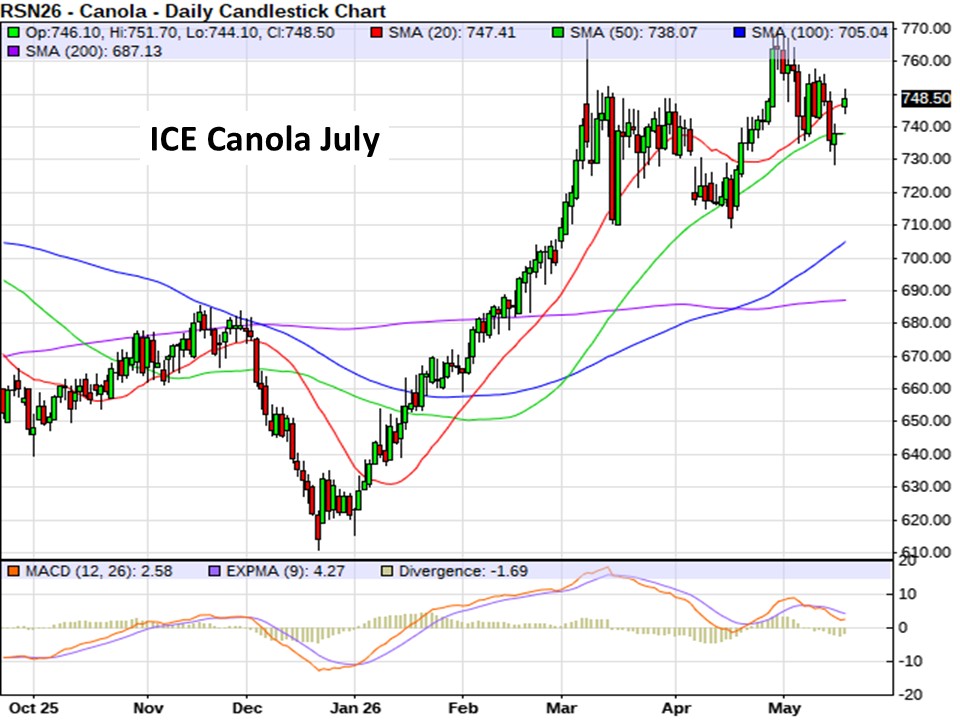
For today… canola futures are trading $6 to $10/tonne higher this morning, playing catch up broader global oilseed and by-product markets which rallied Monday while the Canadian market was closed for holiday. Nearby July canola futures are leading this morning with a gap up $10.90 gain to $749.00/tonne. That s helped narrowly the July contract s overall $14.90/t decline last week. With a quick recovery Friday following the close below support at the 20 and 50-day moving averages late last week, and the gap up today, the technical damage may be neutralized for now.
Canola gapped higher when overnight trading began Monday evening after missing out on extremely strong gains seen in other ag markets on Monday. Headline algorithms and spec funds taketh away and they giveth back in very volatile moves sometimes, proving again why avoiding the urge to be influenced by the day-to-day noise is important while focusing on the big picture. The surge Monday in the US soy complex, and US ag markets generally, was in response to the details of China’s commitments to purchase US ag products, something that the Trump administration had tried to reassure markets had been done last week. But talk could prove cheap…the market now wants to see actual sales.
Crude oil futures once again pushing contract highs are helping support the vegoil markets and oilseeds, with energy markets running out of patience, along with petroleum reserves.
With Friday’s ICE canola crush margin still $385.90/t compared to 328.59 a month ago and $102.88/t a year ago, another significant leg higher for futures prices would certainly seem reasonable.
Stay informed with our daily market videos. Each video quickly covers key futures moves, price trends, and market signals that matter to Canadian farmers. Get clear, timely insights in just a few minutes. Bookmark https://www.producer.com/markets-futures-prices/videos
To access the latest futures prices, go to https://www.producer.com/markets-futures-prices/
Source: producer.com