
AM Market Report – May 26, 2026
From the editors: It has been our pleasure to produce this markets content for you. As we wrap up our reports this week, we want to thank you for your readership and loyalty. If you have questions about other markets products or would like to subscribe to additional services, please contact customerservice@farmmedia.com. Our Farmer Services Team will be glad to help.
GOOD MORNING…HERE IS YOUR MORNING MARKET NEWS
OVERNIGHT GRAIN TRADE
ICE canola futures are bouncing $9/tonne higher to start this morning, regaining more than half of what was lost on Monday.
Chicago soybean futures are posting 2 to 6 cents/bu declines this morning. US markets were closed yesterday for the American Memorial Day holiday long weekend. Soymeal and soyoil futures are also weaker.
CBOT corn futures are leaking 2 to 3 cents lower this morning.
US wheat markets are mixed to mostly lower…Minnie spring wheat futures are up a penny on the front-month July contract but 1 to 4 cents on the deferreds. HRW is fractionally to cents lower, while SRW wheat dipping mostly 3 to 5 cents lower.
Losses in the crude oil market are helping pressure US grain markets to start this US holiday-shortened trading week. Growing weather in the US Corn Belt also leans price-bearish for corn and beans, amid no threatening conditions at present.
Latest on US-Iran war
– US and Iran clash near Hormuz even as both tout peace talks progress
– Trump says Iran talks proceeding nicely as peace deal appears closer
– Trump pushes Saudis to recognize Israel as part of Iran deal
– European gas prices drops as US signals progress toward deal with Iran
– Rubio sees good news coming on Hormuz as Iran talks continue
US and Iranian forces clashed near the Strait of Hormuz overnight, highlighting the ongoing tension between the two sides even as they tout progress toward an interim peace deal. The US military said it conducted strikes in southern Iran, targeting missile-launch sites and boats attempting to lay mines, while the Islamic Revolutionary Guard Corps said it fired at an F-35 fighter jet and several drones.
Meantime, US President Donald Trump said negotiations with Iran over an interim deal to extend their ceasefire and reopen the Strait of Hormuz were proceeding nicely. An Iranian delegation traveled to Doha for consultations with senior Qatari officials on the negotiations, including discussions on the release of frozen Iranian funds. The US and Iran still need to finalize key details, including whether ships transiting the Hormuz Strait will be allowed free passage and how quickly billions of dollars of Iranian funds will be unfrozen.
In Other News
– Russian wheat export prices rise again… Rising global prices, the strengthening of the rouble against the US dollar and subdued sales by farmers continued to drive up export prices for Russian wheat last week. The price of Russian wheat with 12.5% protein content for free-on-board delivery in June to early July was US $245/tonne at the end of last week, up $5 from the previous week, said the IKAR consultancy. The price of new crop wheat which is due to hit the market in July was up $2 at $242/tonne, they said. IKAR estimates Russia’s May wheat exports at between 3.0 and 3.3 MMT.
SovEcon consultancy put prices for Russian wheat with 12.5% protein at between $242 and $244/tonne compared to between $240 and $242 last week. Russian prices continue to rise, supported by limited domestic supply and an exceptionally strong rouble, SovEcon’s head Andrey Sizov said. “Farmers are delaying sales in anticipation of higher prices. Some say they are ready to carry stocks into the new season,” he said. At the same time, the risk of a Turkish import wheat ban, in view of good prospects for its own crop, is becoming a key bearish factor for Black Sea wheat. Turkey in the past limited wheat imports during periods of high local supply.
SovEcon has revised its estimate for May wheat exports upwards by 0.1 MMT compared with last week, to 2.8 MMT.
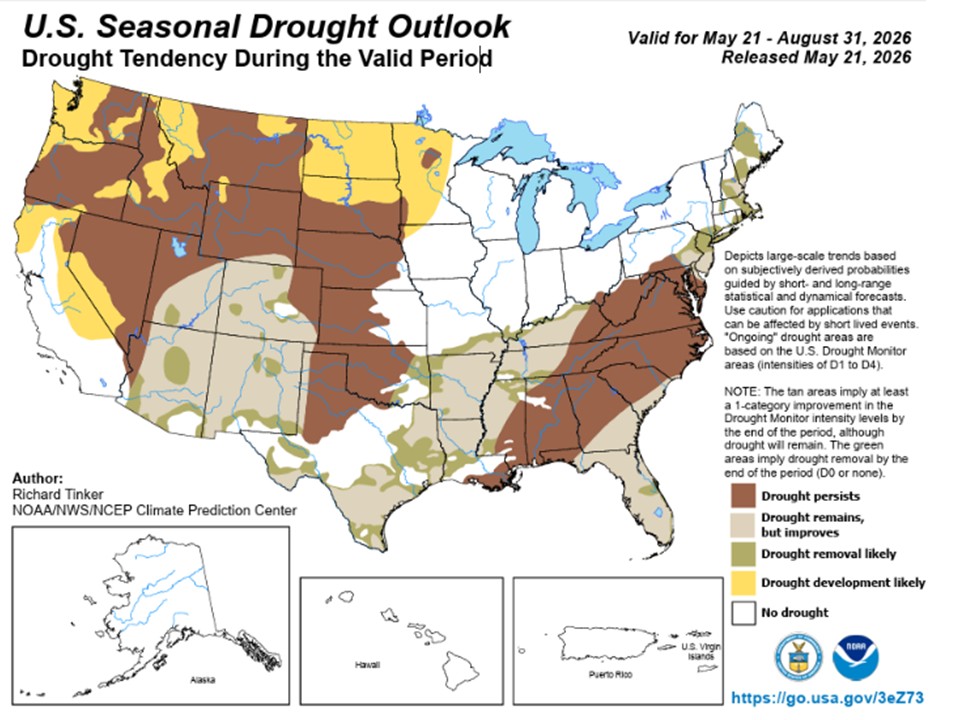
– Summer drought expected to bypass US Midwest; Impact Plains… Drought is expected to largely spare the US Midwest this summer, even as much of the rest of the United States remains plagued by dryness. The latest seasonal drought outlook from the US Climate Prediction Center projects no drought development in the heart of the Midwest through the end of August. The outlook is generally favourable for the core US Corn Belt, where much of the country s corn and soybean production is concentrated.
However, forecasters warned that drought could still develop across portions of the northwestern Corn Belt. The official outlook favours subnormal precipitation over parts of Iowa, Minnesota, and western Wisconsin, and drought is expected to persist where it exists, expanding northeastward to cover a large part of Minnesota and a small portion of Iowa by the end of August.
On the other hand, the past few weeks to months have been wetter than normal across most of the Great Lakes, so it is unlikely that even somewhat below normal summer precipitation would push the region into drought, the outlook said.
Outside the Midwest, the drought outlook becomes considerably more concerning for major wheat-growing regions across the US Plains. Forecasters project drought persistence and expansion for parts of Kansas, through much of Nebraska and into the Dakotas, areas critical for hard red winter wheat and spring wheat production.
Much of the western United States is also forecast to remain dry through the summer, although some drought relief is possible in parts of the Southwest and Four Corners region if seasonal monsoon activity strengthens later in the season, the seasonal drought outlook said.
As of May 19, more than 62% of the continental US was being impacted by some form of drought, including about 45% in severe to exceptional drought.
– With a new Fed chief in place, bond traders foresee US rate hikes… As Kevin Warsh takes the helm at the US Federal Reserve from Jerome Powell, bond investors are betting he ll prioritize the central bank s inflation-fighting credibility over President Donald Trump s push for lower interest rates. With the Iran war unleashing the biggest inflation surge since 2023, traders are pricing in that the Fed is virtually certain to start raising rates by December. That s a sharp reversal from just three months ago, when markets were betting there were deeper cuts ahead, said a Bloomberg report on Monday. The shift reflects the impact of turmoil in the Middle East, the resilient US economy and an AI-investment boom pushing the stock market higher, all of which have fueled concerns that inflation could remain stuck above the Fed s 2% target for some time, said the report.
However, Kevin Hassett, President Trump s chief economic adviser at the White House, signaled he s confident that an eventual drop in oil prices will create space for the Federal Reserve to lower US interest rates. The White House expects energy prices to drop once there s a deal with Iran, Hassett said on Fox News Sunday Morning Futures. But that might take some time…even after the current war with Iran is concluded.
– China eases its monetary policy… China let the interest rate on a one-year policy loan to banks decline to a record low, a sign Beijing is stepping up efforts to support an economy that s losing momentum. Some banks borrowed from the People s Bank of China s one-year medium-term lending facility at rates as low as 1.45% in May, down from 1.5% in April. The decline in borrowing costs comes as China s economy shows signs of faltering after a strong first quarter, with growth slowing across the board in April.
Outside Markets
The Dow Jones Industrial Average finished Friday up 294.04 points to settle at 50,579.70, while the S&P 500 gained 27.75 points to 7,473.47. US markets were closed Monday for holiday. Canada s S&P/TSX stock index rallied 360 points on Monday to a new all-time high 34,831.
Global stock markets are mixed this morning as expectations for an imminent end to the Middle East conflict waned after the US launched fresh attacks on Iran. Wall Street futures are in positive territory as trading resumes after markets were closed yesterday for a holiday…Dow up 182 points. TSX futures are pointed lower after Canada s main stock index closed at a fresh record high yesterday. European stock markets are mixed this morning, while Asian markets were lower overnight.
I m a bit skeptical…We keep being told there s a deal that s near, but what does the deal look like? That s what s really important. When s the Strait of Hormuz going to open…There s a lot we don t know, said Joseph Capurso, a strategist at Commonwealth Bank of Australia.
The June US Dollar Index is down 0.111 at 99.075. The Canadian dollar was slightly weaker against its US counterpart…currently quoted at 72.44 US cents.
July crude oil futures are down $3.77 at US $92.83/barrel. Oil futures are strangely lower after reports this morning of the US military s strikes in Iran…adding to uncertainty on whether a deal will be imminently reached to end the war and open up shipping flows through the Strait of Hormuz.
While differences between the parties have narrowed, any eventual peace deal would likely lead only to a gradual reopening, meaning the current tight supply outlook could take months to normalize, said Ole Hansen at Saxo Bank.
Grain Markets
Chicago soybean futures are trading 2 to 6 cents/bu weaker coming out the US Memorial Day long weekend, with the nearby contracts leading the way lower. Crude oil is the primary pressure factor, trending lower from Friday, as the US and Iran were reportedly inching closer to a deal over the weekend, though hostilities have ramped up again today. Bean futures held higher into Friday s close, as contracts were steady to 2 cents in the green. July bean futures were up 19 cents last week.
Soymeal futures are losing $1 to $2/ton this morning after finishing as much as $3.50/ton higher on Friday, though July meal still lost $2.40 overall last the week. Soyoil futures are a modest 2 to 18 points lower this morning after ending Friday 8 to 37 points in the green, with July bean oil was up 10 points last week.
Commitment of Traders data from Friday showed spec funds trimming back their net long position by 7,011 contracts in CBOT soybean futures as of last Tuesday, taking it to 207,804 contracts.
Today’s delayed weekly USDA Crop Progress Report is expected to show a rapid pace of US crop planting and emergence.
Chicago corn futures are down 2 to 3 cents/bu this morning. Here too, weaker crude oil is the primary pressure factor. The corn market closed the Friday session with contracts 1 to 2 cents higher, with July corn up 7.5 cents last week.
A couple private export sale announcements were reported on Friday morning, with 493,700 tonnes to Mexico and 110,000 tonnes to unknown destinations.
The weekly CFTC update from Friday showed managed money trimming back their net long by 6,129 contracts for the week ended May 19. That took their net long position in corn futures to 293,354 contracts.
Large corn reserves in the US, forthcoming increases in South American supplies, and drought-reducing forecasts have all contributed to greater hesitancy among corn bulls, who had already built a historically large net-long position by early May and now face a seasonal tendency toward lower prices through the summer.
US wheat markets are also weaker this morning… Minnie spring wheat futures are up a penny on the front month July contract but down 1 to 4 cents in the deferreds. HRW is fractionally to 4 cents lower, while SRW is mostly 3 to 5 cents lower. All ag markets, including wheat, are feeling price pressure from crude oil losses early on Tuesday morning.
On Friday, the US wheat complex pulled off midday lows, but still closed with losses across the three markets…spring wheat was fractionally to 6 cents in the red on Friday, with the nearby July contract slipping 4.25 cents for the week. Managed money was busy cutting back to their net long position in US wheat futures for the week ended May 19.
A South Korean flour mill tendered for 100,000 tonnes of wheat from the US and Canada, with the tender due on Wednesday.
CANADIAN GRAIN MARKET
ICE canola futures sustained heavy losses on Monday amid a downdraft in crude oil. Oil prices fell sharply following reports over the weekend the US and Iran had come to an agreement in principle to end the war, with the deal also expected to reopen the Strait of Hormuz. But final approval of the accord remains uncertain, and details lacking, but US and Brent crude futures fell on the news anyway, with both markets now back below $100/barrel.
European rapeseed was also lower yesterday, while Malaysian palm oil was little changed. The US soy complex did not trade on Monday due to the American Memorial Day holiday.
July canola lost $14 on Monday to close at $736.20/tonne, and November was down $13.80 at $746.60.
For today… canola futures are trading $9/tonne higher this morning, running contrary to a weaker US soy complex. Canola got ahead of US markets that were closed yesterday for holiday and fell hard Monday on crude oil weakness. Benchmark July canola futures are up $9.60 this morning to $745.80/tone after dropping $14 on Monday. The 20-day moving average is still above at $749 and the 50-day just below at $739. The winter/spring bullish trend remains largely intact…but as stated here yesterday, seasonal highs for ag commodity markets (including canola) may have already been made this month.
Ag markets generally, including our canola, are heavily influenced by war events in the Persian Gulf. The White House keeps saying a US deal with Iran is imminent (knocks crude oil pricing lower), but there remains little (if any) evidence an actual deal to end the war is at hand. Remains a real market wildcard issue. After dropping with crude oil yesterday, canola futures are rebounding up this morning on reports of the most intense round of attacks seen since the ceasefire began eight weeks ago. Negotiations remain stuck on the same key points as has been the case for two months now.
It’s worth noting that price quotes may be confusing because all of Monday’s electronic trading in US non-ag markets were for Tuesday’s trade date. US grain and oilseed markets are down this morning. Malaysian palm oil futures were only marginally higher last night, but still trending lower the past couple of weeks. EU rapeseed futures are higher this morning.
Meanwhile, increased optimism regarding Western Canada crop seeding progress this week (and the resulting pressure on price) may be quickly replaced by emerging concerns over a hot/dry outlook hurting germination and stressing early crop development, especially the further south and east you go on the Prairies.
Stay informed with our daily market videos. Each video quickly covers key futures moves, price trends, and market signals that matter to Canadian farmers. Get clear, timely insights in just a few minutes. Bookmark https://www.producer.com/markets-futures-prices/videos
To access the latest futures prices, go to https://www.producer.com/markets-futures-prices/
Source: producer.com