
As ag tech advances, one innovation flies above the rest
Technological advancement in agriculture is nothing new.
The industry has seen amazing progress since the Prairies were first settled, and the technology train keeps on chugging.
We’ve written previously in this space about the potential of autonomous equipment and that while it may seem far-fetched to totally remove humans from the farming equation, it’s still something that needs to be watched.
Manufacturers continue to incorporate the technology into their equipment, a trend that is probably here to stay.
Then there’s artificial intelligence and the potential it holds for agriculture, not only in the research lab but also in the field.
At a recent agri-tech conference in San Francisco, those at the leading edge of AI talked about how the technology could soon be used not just to offer advice but also to act on it.
AI is already being used for things such as identifying weeds, and potential applications continue to multiply.
However, the technology still seems daunting to many.
While it’s easy to see how AI can be used in a corporate setting to speed up product development, its role on the farm is murkier.
In a business with so many variables, whether it be weather, field variability or farmer risk tolerance, is there a place for AI tools to move from making recommendations to actually getting the job done?
There were no clear-cut answers at the San Francisco conference, but it was apparent that a significant shift in how AI can be used in farming could very well be on its way.
Again, like autonomous farm equipment, imagining the full potential of AI in agriculture may seem very much like science fiction to most farmers, but the writing seems to be clearly on the wall.
There is one new technological advancement that can no longer be thought of as science fiction.
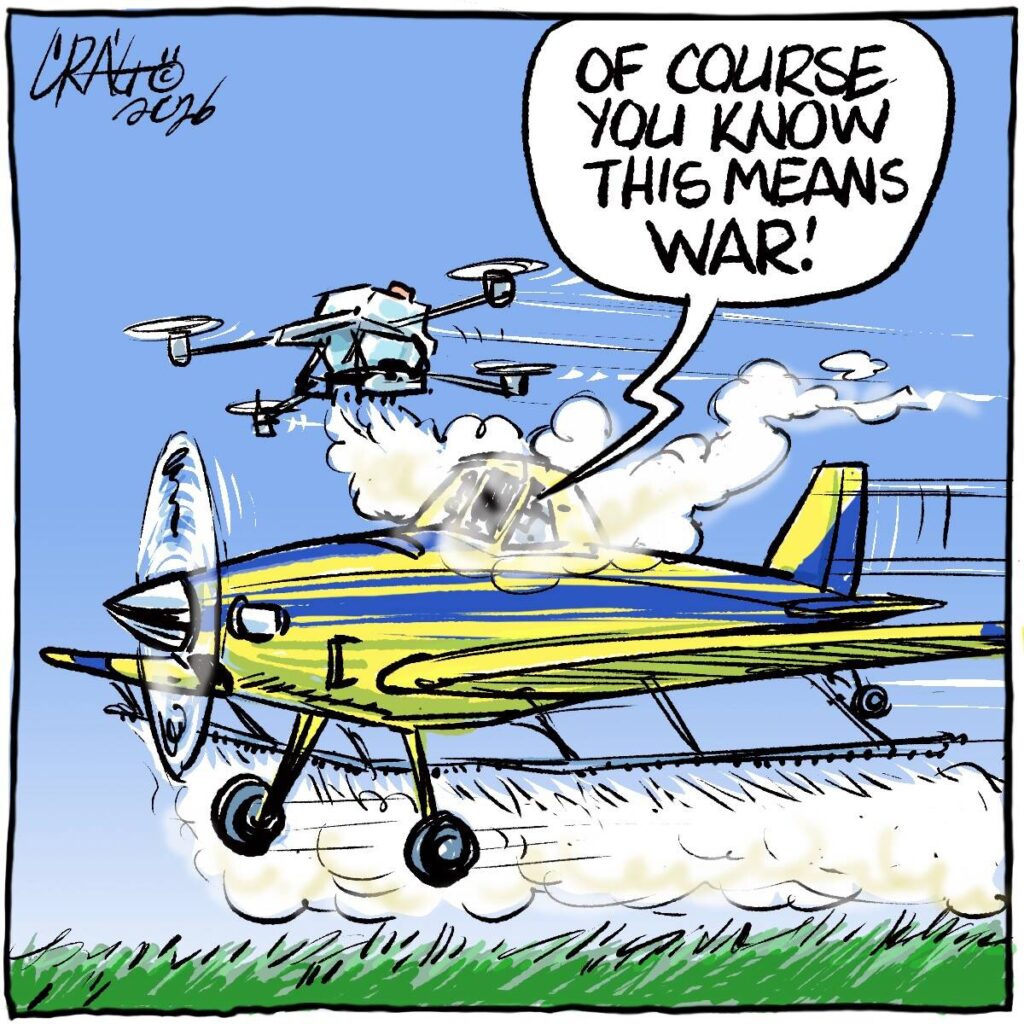
As we have reported and editorialized in the past, the use of drones in agriculture is very much upon us.
Much of the recent discussion about drones has focused on using them to spray crops and the growing pressure on the federal government to give the practice the green light.
After years of review — and not to mention impatience among farmers — the Pesticide Regulatory Directorate (formerly known as the Pest Management Regulatory Agency) recently proposed new regulations for drone spraying that would treat it the same as spraying from airplanes.
From the sentiment noticed at a recent conference organized by the Canadian Agriculture Drone Association, the move couldn’t come fast enough.
Many of those at the conference can’t wait to start spraying their crops by drone.
Indeed, anecdotal evidence would seem to indicate that many are already doing so.
A walk through farm shows such as Ag in Motion in recent years finds that the equipment and technology sector is certainly well established and ready to furnish farmers with the tools they need to embrace drone spraying.
Not everyone agrees.
Tom Wolf, a well-known spraying expert, was at the conference to spread his familiar message that spraying by drone is not the same as spraying by airplane and is likely to cause problems.
Indeed, Wolf must have felt a little like Daniel in the lion’s den at the conference, but his message should not be dismissed out of hand.
However, while Ottawa has yet to release its final decision, it really does feel like the door is starting to open to drone spraying and is unlikely to close.
Of course, there is much more to agricultural drones than spraying.
In Nova Scotia, farmers are using them to apply fertilizer to cranberry crops.
Closer to home, cattle producers are using them to check livestock, waterers, fences and gates.
Along with other technology, such as satellite imagery, drones can also be used to identify where cattle prefer to graze.
The point is that while the full potential of autonomous farm equipment and AI tools is quickly coming into focus, much work must still be done before they are fully used on Prairie farms.
Drones, on the other hand, are already here, ready to fly and worth a closer look.
Source: producer.com