

CALVING 2026: Farm care tips for premature calves
Calving time often brings an array of well-known issues, including scours, breech births and implications from the weather.
Another issue, though less talked about, is calves born prematurely.
However, there are ways to manage premature calves to give them the best chance of success.
“I think it’s almost everything we would say for a normal calf, but more so,” Chris Clark, an associate professor at the University of Saskatchwan’s Western College of Veterinary Medicine, says of potential issues for premature calves.
WHY IT MATTERS: Premature calves are a realty for cow-calf operations, but there are things the farmer can do to give those preemies the best possible chance.
What causes premature births?
Sometimes, babies are just born prematurely, without any certain reason.
Many people can relate to this — your child comes much earlier than expected, everything is a mad rush and suddenly you are spending weeks in the neonatal intensive care unit while your child receives the care they need.
For calves, there isn’t the life-saving technology that is available for human children. If a calf is born too prematurely, there is little that can be done.
The time when it is less concerning is if the calf is born two weeks premature or less. Anything earlier is cause for concern regarding the development of the calf, especially for its lungs because they are the last thing to develop.
“When we’re talking about managing the premature calf, it’s quite a narrow window in the grand scheme of things because if they’re born too early, nothing’s going to save them,” Clark says.
Although premature calves can often happen randomly, or without a specific reason, there are some things that can cause prematurity, according to Clark.
This includes abdominal trauma and fetal stress.
Abdominal trauma can be caused by the animal being kicked by others, which is more common during moving and feeding.
Fetal stress can be caused by placental problems or disease.
“If the fetus becomes stressed, you start to see hormones going into the circulation that sort of accelerate maturation and can lead to an early parturition,” Clark says.
What to do
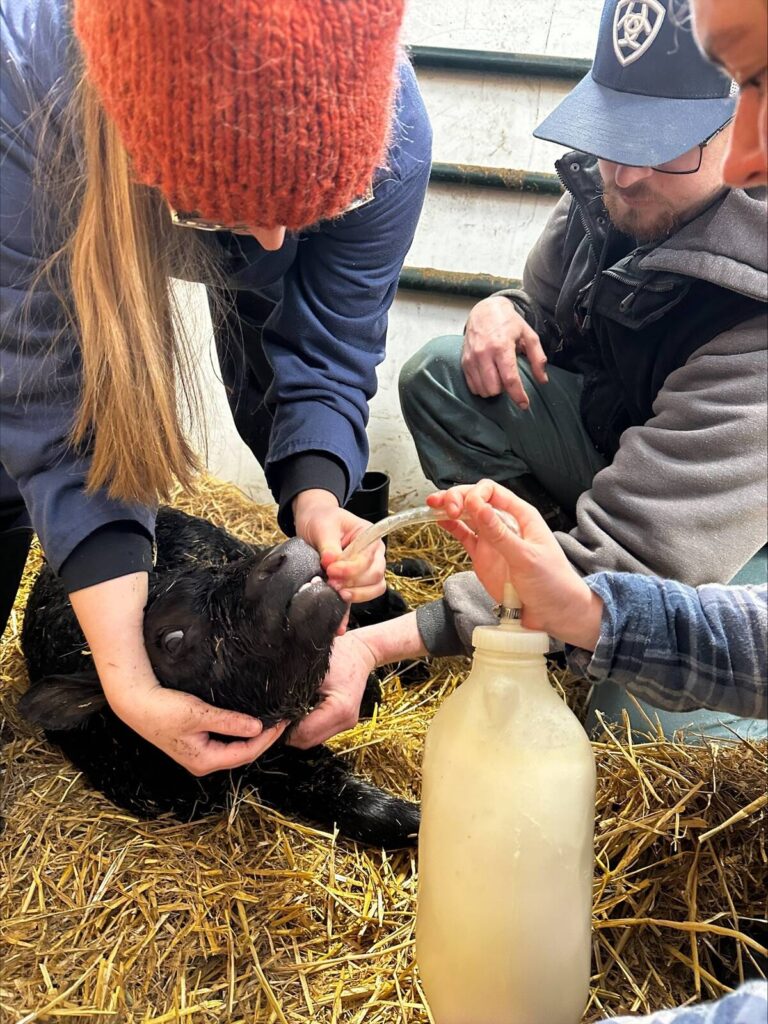
If a premature calf hits the ground, the first thing Clark recommends is to get colostrum into it.
Premature calves are often very small compared to a normal calf, which means they will get colder quicker and have a harder time getting onto their feet.
Colostrum will help the calf get the nutrients and essential antibodies it needs.
“We could have had a conversation just about the significance of colostrum and newborn calves, but when you’re talking about these premature neonates, even more so,” Clark says.
READ (LOTS) MORE: Your western Canadian reading list for calving season and cow-calf care
Premature calves may need to be fed many times before they are able to stand.
Clark says he likes to try to keep the calf with the mother because the mother can help keep it warm and help it to stand and suck.
“The mother is the ultimate life support system. And if we can get this calf over this hump, get it standing and get it nursing, then the mother’s got her job to do, to look after it.”
Care timelines
The length of time the calf will have to undergo intensive care is often a case-by-case situation, but Clark says generally producers will want to continue until the calf can stand on its own, follow its mother around and suck independently.
“You’ve got to accept that it’s going to take them a little longer. Rather than just tubing them with colostrum, you may be tubing them with milk for several days.”
He recommends using an esophageal tube because it is too challenging to get a weak calf to suck from a bottle.
However, if the calf has a poor suck reflex, even an esophageal tube will be challenging because the calf will have a hard time swallowing.
In that case, Clark recommends calling the vet.
“It’s when you realize you’re not going to be able to get a stomach tube into it, and the calf is getting really depressed and flat and unable to lift its head, I think those are the ones that will benefit from having a veterinarian take a look at it.”
Choose your calving season
Something Clark thinks is a benefit not just to the health of calves but also to the industry is the move some producers are making to calve in May and June rather than March and April.
He says he now sees only a fraction of the calves he used to in the WCVM clinic.
“The clinic was wall-to-wall sick calves, but it’s been really interesting over the last 30 years with the move to calving out in May and June, and I think it’s a new generation of producers who educated themselves much more. So, it’s fascinating to me how few calves we see now.”
Clark said he isn’t saying that calving later in the year prevents the birth of premature calves, but he does think it’s beneficial, and those benefits translate into the health of the herd.
Photo:
Janelle
“I think cattle calving at pasture with space where you’ve got the grass starting to grow, and you’ve got that great natural food source for them, and the ability to feed out at pasture rather than feeding in corral pens, is all a benefit,” Clark says.
“It’s a testament to the work done by very great veterinarians who were here before me, and the hard work of the producers who have really made significant changes to calf health problems.”
He feels seeing fewer premature calves or sick calves in the clinic could be attributed to how these situations are being dealt with on the farm.
“I don’t know whether that’s just because producers have got better at handling them themselves, or whether it’s just that the shift in calving really means that the problem has, to some extent, looked after itself. I do think the producers have generally got much more comfortable looking after these calves.”
Other than that, Clark says he doesn’t think there are any tangible management practices that can prevent premature births. A positive is that once a premature calf comes through those first few hours or days of its life, there are often no long-term implications.
In that respect, calves are just like humans who are born prematurely.
Source: producer.com