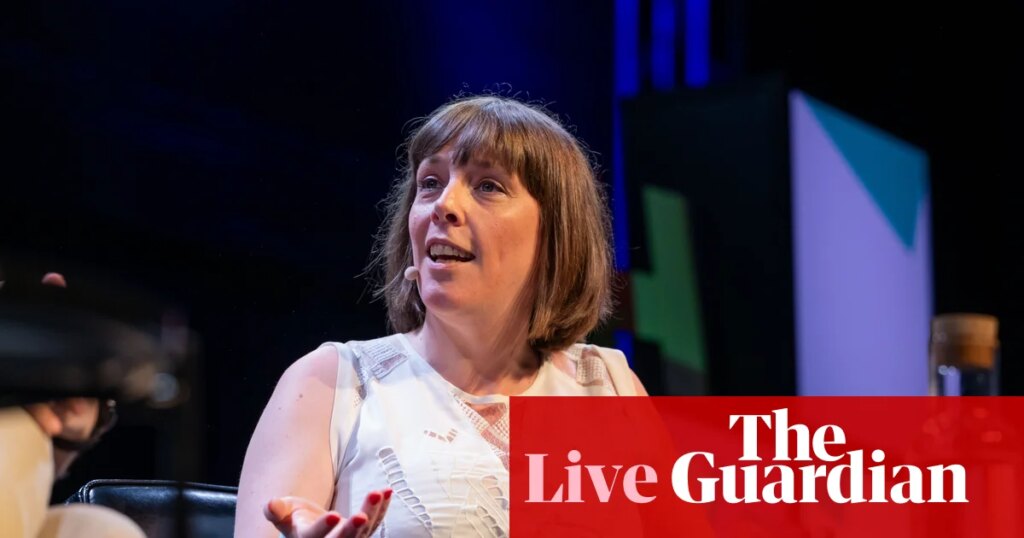
Child phone nudity law could largely end online child sexual abuse, in UK and globally, if widely adopted, Jess Phillips claims
Jess Phillips, the former safeguarding minister, told the World at One that she believed that Google and Apple, the two companies that control the operating systems on almost all smartphones that are sold, could very quickly install the software that would stop them being used by children to take naked pictures.
But she said, having worked on this issue for about 18 months (see 12.19pm), she had heard “every single corner-cutting excuse, work-around in the book from tech companies and those who seek to represent them” and so she expected further foot-dragging.
She said she would like to contribute to drafting the legislation to force them to act if they do not do so voluntarily.
She went on to say she would only believe the ban was actually happening when “a child picks up their phone, tries to take a naked image of themselves because they’ve been groomed to do it, and they won’t be able to do it”.
But, if the ban does come into force, it could be tranformational, she said.
Referring to figures showing that 91% of online child sexual abuse reports refer to self-generated content, she said she expected online abuse rates to “plummet” under this plan.
She explained:
We have the opportunity here in a matter of months to basically eliminate child sexual abuse [online] in the UK.
And what is more is that, I cannot see a way that if we do this – when we do this, I should say – in the UK that phone manufacturers and countries around the world are going to say, ‘I’ll tell you what, we’ll import the phones that are good for paedohiles.’
So I don’t think we’ll just get rid of 91% of child abuse. I think we have the potential in what we’re going to do – and this is what I fought so hard for it – to end online child sex abuse, to cut child sex abuse around the world so dramatically.
The latest edition of the Guardian’s Politics Weekly UK is out. It features Pippa Crerar and Kiran Stacey talking about Keir Starmer’s announcement today about restrictions on mobile phone technology for children, and whether this is to do with Starmer searching for a legacy.
At the end of the debate Robert Kenyon, the Reform UK candidate, asked Andy Burnham why he did not stand to be Makerfield MP at the 2024 election. Was the constituency at the bottom of his priority list then?
No, said Burnham. He said that he had been serving the area for 25 years, as MP for Leigh (the neighbouring constituency), and then as mayor for Greater Manchester.
In the BBC debate they are now talking about crime.
Andy Burnham said Greater Manchester police force was failing for a long time. He said he had appointed a new chief constable, Stephen Watson, who he said was “the outstanding police leader in this country”. He said Watson has doubled the number of people being arrested.
Michael Winstanley, the Conservative candidate, said that Burnham was also mayor when the Greater Manchester was failing.
Burnham calls for more use of detention for migrants facing deportation in byelection debate
Back in the BBC debate, the second question was about immigration.
Robert Kenyon, the Reform UK candidate, said that while he did not mind people coming to the UK legally, “if you’re going to come here illegally, then you need to be deported ultimately, because it’s costing the taxpayer billions”.
Andy Burnham said for him this was an issue of control.
It’s this thing about control, isn’t it? It feels like the country isn’t functioning properly, running things properly, in the small boats issue. And people want it to be dealt with.
Burnham said the government needed to “go further” in tackling small boats crossing. He said he agreed with the Conservative candidate, Michael Winstanley, about the case for greater use of detention for people facing deporation. He said:
I think we need to make greater use of detention so that people who’ve got no basis for a claim are not actually admitted into the country [and] dealt with quickly.
Actually returns are up under this government. The people who are returned to their country of origin. So the issue has to be dealt with. It is something that just has to be gripped and gripped properly, because it is about trust in politics. And it is one of those things that is fraying trust to a degree.
Picking up on a point made by Kenyon, who complained about the large number of asylum seekers being housed in HMOs (houses in multiple occupation), Burnham said he had long argued that “it’s not right that the Home Office just goes to the areas where housing is lower cost, and overly uses those areas, when it comes to asylum dispersal”.
He went on:
I have argued strongly, repeatedly as mayor of Greater Manchester, that all areas of the country should play a role. It’s not right, that the Home Office just comes to the some of the more deprived parts of the country. That is a massive change that is needed.
Andy Burnham in BBC debate Photograph: BBC
Zack Polanski tells bakers’ union that very cheap food in supermarkets suggests workers being exploited
Shoppers should not be able to buy vegetables for 7p because it is a sign of exploitation in the system, Zack Polanski said today.
Speaking at the baker’s union conference, Polanski called for tougher regulation of supermarkets and claimed the food system was in crisis.
Polanski said:
We do need to talk about supermarket regulation. It cannot go on as it is.
I was thinking of a friend of mine the other day – who I’m not judging for this, I understand, but they were really excited that they were buying vegetables for 7p in one of the supermarkets.
That is not a sign of a healthy system … someone is being exploited somewhere and if you are paying 7p for vegetables then something is not right.
Yes, there’s a cost-of-living crisis. Yes, governments and local councils need to do everything they can to keep food prices down and make sure that people can afford to eat and, in the same breath, we need to make sure that we’re paying our workers properly and that people have proper dignity and working conditions.
And one of the most obvious places where that exploitation is happening is in the supermarket, where a largely unregulated sector, or a sector that has not been regulated enough, has been exploiting both the workers in the supermarkets and the farmers and agricultural workers and, yes, sometimes the people who are suffering from the cost-of-living crisis too.
The Bakers, Food and Allied Workers’ union (BFAWU) represents workers in the food sector.
Burnham says he wants ‘essential services back under public control’ in BBC Manchester Makerfield byelection debate
BBC Radio Manchester is holding a Makerfield byelection debate. You can listen to it here. BBC News are also showing it too.
There are 14 candidates in the election. Only five of them are taking part: Andy Burnham (Lab), Robert Kenyon (Reform UK), Michael Winstanley (Con), Jake Austin (Lib Dem) and Sarah Wakefield (Green).
The first question was about the cost of living. Burnham was invited to explain what his plan was, and he said that as Greater Manchester mayor he had imposed a £2 cap on bus fares. And he said within a couple of years he would bring all the rail stations in the Makerfield constituency into the ambit of the Greater Manchester Bee network, which he said would cut rail costs.
But he said he wanted to see stronger control of other public services, like water. He went on:
In the water industry, we’ve got a situation where the private interest predominates over the public interest. Exactly like buses in Greater Manchester when I came in as mayor in 2017.
And it’s a situation where the shareholders never lose and the public never wins.
I believe strongly that we need to put these essential services back under public control. Water, energy, housing – getting rents down.
BBC Manchester’s Makerfield byelection debate Photograph: BBC
Catherine Atkinson, the victims minister, was also on Radio 4’s the World at One today. Like Jess Phillips (see 1.59pm), she also said the new nude images requirement for phone providers – to be imposed by law, if they don’t comply voluntarily – could be a game changer in the battle against online child sexual abuse.
She explained:
I think it’s a really significant pillar. There’s no point in asking a young girl, a child, to send a photograph if they cannot take one, they cannot share it and they can’t even see it. This will be such a significant change.
DfE opens call for evidence on when children should get first smartphone
The Department for Education has opened a “call for evidence” as part of an inquiry that will lead to the production of advice about when children should be given their first smartphone, and how they should manage their screen use generally. It will be led by Dame Rachel de Souza, the children’s commissioner for England, and Prof Russell Viner. De Souza and Viner recently produced guidance on screen time for under-5s.
In an interview this morning, de Souza said that she would like to see children under the age of 18 protected from harmful social media platforms. (See 9.16am.)
New polling published today shows that 86% support the government’s screen use guidance for under-fives, while 82% say it is already helping families build healthier habits for young children.
The need for support is clear. While 96% of parents believe their child benefits from being online, fewer than three in ten think the benefits outweigh the risks when it comes to social media, messaging and video-sharing platforms.
The call for evidence will also seek views on screen use in schools, recognising that children’s digital lives span both home and education. Evidence gathered will help inform the new guidance as well as wider work to ensure technology used in classrooms supports learning, improves outcomes and protects children from harm.
There is information about how to respond to the call for evidence here.
Child phone nudity law could largely end online child sexual abuse, in UK and globally, if widely adopted, Jess Phillips claims
Jess Phillips, the former safeguarding minister, told the World at One that she believed that Google and Apple, the two companies that control the operating systems on almost all smartphones that are sold, could very quickly install the software that would stop them being used by children to take naked pictures.
But she said, having worked on this issue for about 18 months (see 12.19pm), she had heard “every single corner-cutting excuse, work-around in the book from tech companies and those who seek to represent them” and so she expected further foot-dragging.
She said she would like to contribute to drafting the legislation to force them to act if they do not do so voluntarily.
She went on to say she would only believe the ban was actually happening when “a child picks up their phone, tries to take a naked image of themselves because they’ve been groomed to do it, and they won’t be able to do it”.
But, if the ban does come into force, it could be tranformational, she said.
Referring to figures showing that 91% of online child sexual abuse reports refer to self-generated content, she said she expected online abuse rates to “plummet” under this plan.
She explained:
We have the opportunity here in a matter of months to basically eliminate child sexual abuse [online] in the UK.
And what is more is that, I cannot see a way that if we do this – when we do this, I should say – in the UK that phone manufacturers and countries around the world are going to say, ‘I’ll tell you what, we’ll import the phones that are good for paedohiles.’
So I don’t think we’ll just get rid of 91% of child abuse. I think we have the potential in what we’re going to do – and this is what I fought so hard for it – to end online child sex abuse, to cut child sex abuse around the world so dramatically.
There will be three urgent questions in the Commons this afternoon. Here is the list, with rough timings.
After 3.30pm: A science minister will respond to a UQ from the Lib Dems’ Munira Wilson about the child phone sexual images ban proposed today.
Around 4.15pm: An environment minister will respond to a UQ from Labour’s Clive Lewis “on systemic failures across the water sector”.
Around 5pm: A Foreign Office minister will respond to a UQ from Jeremy Corbyn about “the deteriorating humanitarian situation in Cuba, following the US naval and financial blockade of the island”.
Badenoch declines to take sides in Vance/Lammy dispute, saying US and UK should stop criticising each other in public
Kemi Badenoch has said that British politicians and their US counterparts should stop criticising each other publicly.
Asked by the Press Association about JD Vance, the US vice president, claiming that the murder of Henry Nowak was due to the UK government’s immigration policies (or the elite’s “politics of self-hatred”, as he put it), and David Lammy, the deputy PM, subsequently telling Vance he was wrong, Badenoch decided she could not side with either of them.
Instead Badenoch said:
David Lammy has the right to say what he thinks about this issue, but I do think that there is a problem, especially with social media, of so many politicians commenting about what’s happening in other countries.
David Lammy and others made very vocal criticisms about the death of George Floyd, that is the justification that Americans are now using.
I think we just need to stop all of this, this endless war of words publicly.
People should be dignified when talking to foreign counterparts. Let’s keep the negative feedback with our allies in private, otherwise we’re just helping countries like Iran and Russia who want to see us at loggerheads.
Badenoch has not always followed her own advice. Earlier this year, as she was trying to distance herself from her initial support for Trump’s war against Iran, she said the US president’s criticisms of Keir Starmer were “childish”. She also said Trump should have to clear up the “mess” his war had left.
Kemi Badenoch with Stuart Machin, the M&S CEO, visting a store in Victoria, London, this morning. Photograph: Carl Court/Getty Images
The NAHT union for school leaders has welcomed the ultimatum to tech companies to stop children being able to use mobile phones to take naked images. Sarah Hannafin, the union’s head of policy, said:
NAHT is clear that the ability to send or receive nude images or videos should absolutely be age restricted to safeguard children and young people.
The impact of sharing such content can also spill over into the classroom and playground, affecting children’s happiness and wellbeing.
Where tech firms do not act, it is only right that ministers compel them to do so, and we hope this move will be followed by further action to ensure all devices and online platforms are safe for children following the government’s recent consultation.
This website uses tracking tools, including cookies. We use these technologies for a variety of reasons, including to recognize new and past website users, to customize your experience, perform analytics and deliver personalized advertising on our sites, apps and newsletters and across the Internet based on your interests. You agree to our Privacy Policyand Terms of Accessby clicking I agree.
This website uses cookies to improve your experience while you navigate through the website. Out of these, the cookies that are categorized as necessary are stored on your browser as they are essential for the working of basic functionalities of the website. We also use third-party cookies that help us analyze and understand how you use this website. These cookies will be stored in your browser only with your consent. You also have the option to opt-out of these cookies. But opting out of some of these cookies may affect your browsing experience.
Necessary cookies are absolutely essential for the website to function properly. This category only includes cookies that ensures basic functionalities and security features of the website. These cookies do not store any personal information.
Any cookies that may not be particularly necessary for the website to function and is used specifically to collect user personal data via analytics, ads, other embedded contents are termed as non-necessary cookies. It is mandatory to procure user consent prior to running these cookies on your website.