
Could dugout water quality testing be done at home?
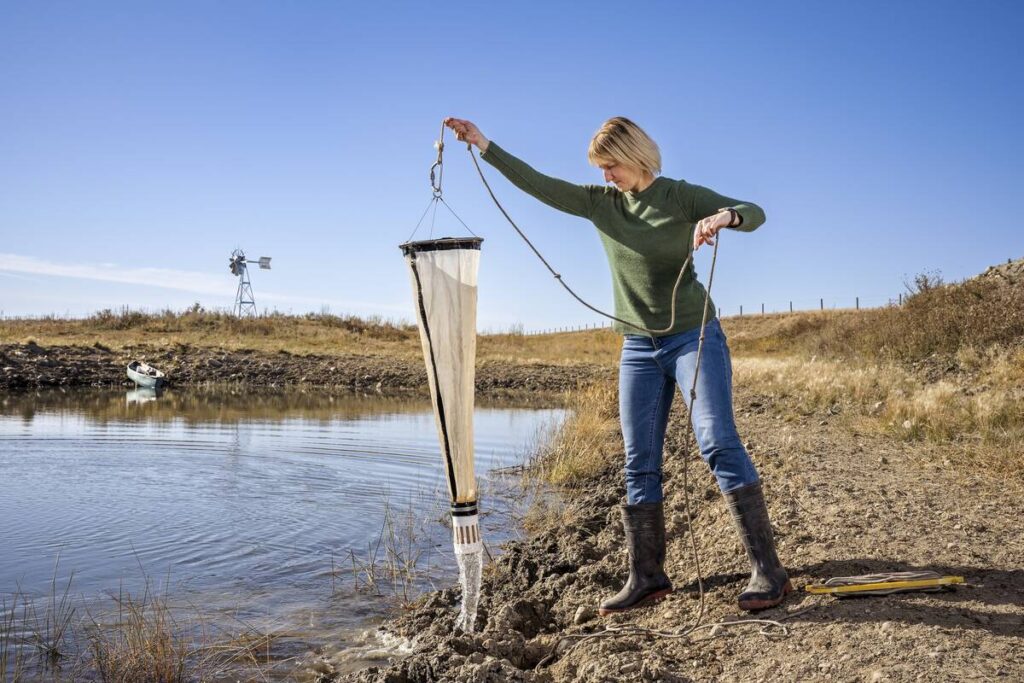
Kerri Finlay and her research team are working on ways to help farmers test their own water.
Finlay, a professor at the University of Regina and director of the Institute of Environmental Change and Society, specializes in water quality, greenhouse gasses and climate impacts on water.
“The team is working on a variety of different things, mostly focused on water quality,” she said.
“We’re interested in algal blooms, blue-green algae and algal toxins,” she said.
The research team includes undergraduate and graduate students, extension specialists and landowners.
Finlay’s lab is known as the Finlay Aquatic Sciences Team. Members are looking at how water bodies interact with climate change and studying how water bodies respond to changes in temperature and changes in precipitation. They’re also investigating how water bodies release and absorb greenhouse gasses.
“In the last decade, maybe longer, we’ve also been really interested in what we call community-based water monitoring, or just citizen science for water quality monitoring,” said Finlay.
Read Also

“This started because a lot of people were worried about water quality in Saskatchewan and the Prairies. What we found is we’re good at going out and collecting samples, but it takes us quite a bit of time,” she said.
This became apparent when people in the province’s Cypress Hills region wanted to know more about their water quality.
“I sent students out and they drove for four hours, and then it took them 20 minutes to take a sample and then drive four hours back to the lab, only to say, ‘yep, you’ve got algae.’ ”
“We’ve been doing a lot of work trying to figure out what we can actually learn when people are collecting water quality data versus what happens when we do it in the lab,” she said.
Finlay said the team is testing any type of water source, but dugouts have been a main area of interest.
Cow Kits
Cow Kits, which are water tests that can easily be used by farmers, were designed through a partnership with Water Rangers, an Ontario-based company that developed testing for recreational water used for swimming, boating and at the cottage.
Water Rangers was also focussd on citizen science. A current program involves 70 volunteers who test the water at their cottages.
The Cow Kits, which were showcased at Canadian Western Agribition in Regina, have been used on dugouts since 2017. They are modified Water Rangers kits that focus on issues that local farmers have with water quality for their cattle.
The team is now using Cow Kits on rivers and wetlands.
“We realized that a lot of these tools could be applied specifically to landowners, to producers that might have concerns for the water quality in their dugouts,” she said.
The research team had been investigating salts in the water, as well as blue-green algae blooms.
“We were using the kits and training the landowners in how to sample the water for it. And ultimately, we really wanted to know if we could get these tests to be accurate enough to be able to say, ‘yes, this water is safe or not safe for your cattle to drink.’ ”
It’s slightly different from what happens on lakes, because people can still boat on lakes when there are algae blooms, said Finlay.
“It’s different when you’re going to use it to water cattle. We spent a couple of years testing the different things that we were measuring and learned a bunch of stuff along the way,” she said.
Trouble with testing
The researchers can test for factors such as pH accurately, but this isn’t of particular interest to farmers.
Living algae blooms are hard to test and are only accurate for one day.
Farmers don’t have a lot of time to spend sampling their water just to get information that is interesting for academics in the city, said Finlay. Some of the other tests were not reliable.
In the end, the research team settled on a connectivity metre, which measures the salinity of the water. Salinity is a huge concern in Saskatchewan.
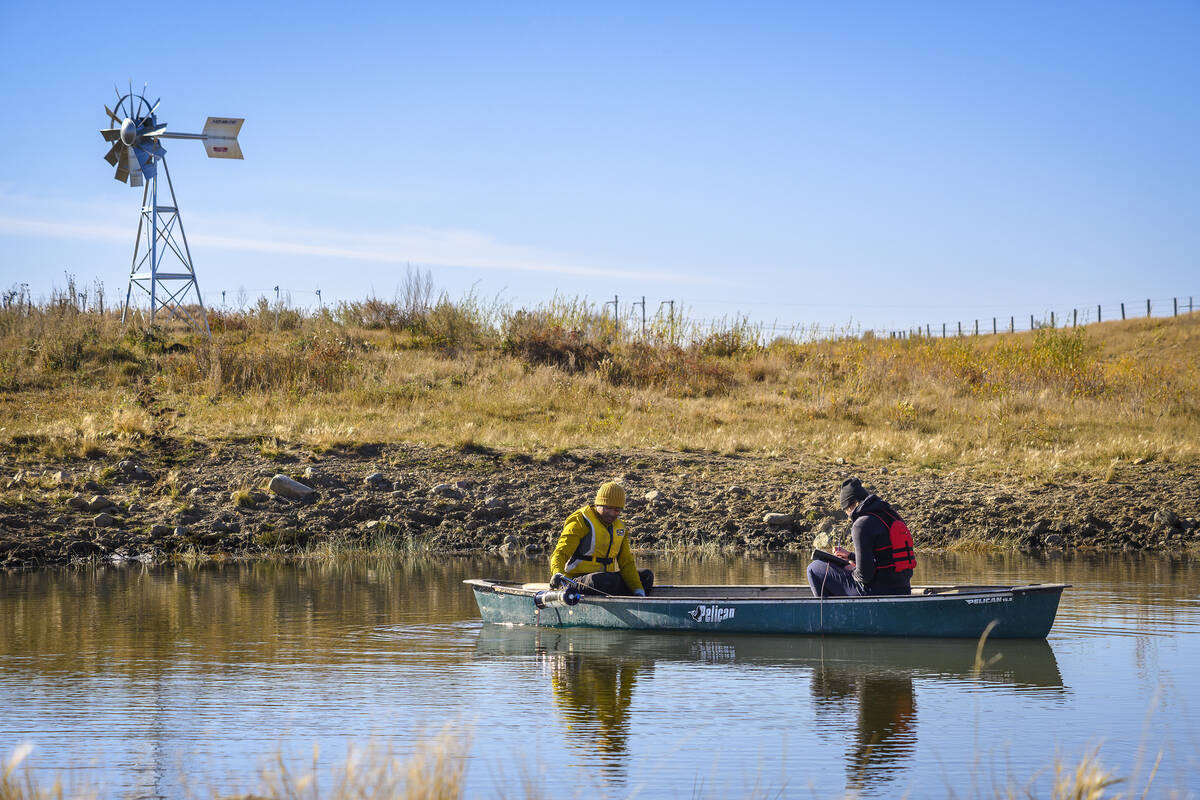
Photo:
University
“We realized that those handheld connectivity metres do a good job. They’re quite accurate in terms of how they measure faults in the water,” she said.
The team wanted to produce something landowners could use to test directly for themselves. They created a package with a connectivity metre, a reacher stick that allows producers to get a water sample offshore and an instructional manual of how to interpret the results.
Finlay said it took about two years to develop the Cow Kits..
The team is currently working with extension specialists at Saskatchewan Agriculture. These extension specialists have been working with producers who can benefit from the Cow Kits.
“We are starting to focus on this blue-green algae a bit more as well. It’s a bigger challenge and there are a lot of questions related to it,” she said.
“There’s a potential to detect the genes that are making the toxin, which would give you, like a two week heads up, which would be pretty cool,” she said.
“In theory, this shouldn’t be too expensive, but that’s definitely in the development stage.”
This year, the researchers will be conducting tests to see how algae blooms can be remediated.
“We’re going to try some hydrogen peroxide this summer and see how effective that is,” she said.
Source: producer.com