

Farms face flooding in northeastern Saskatchewan
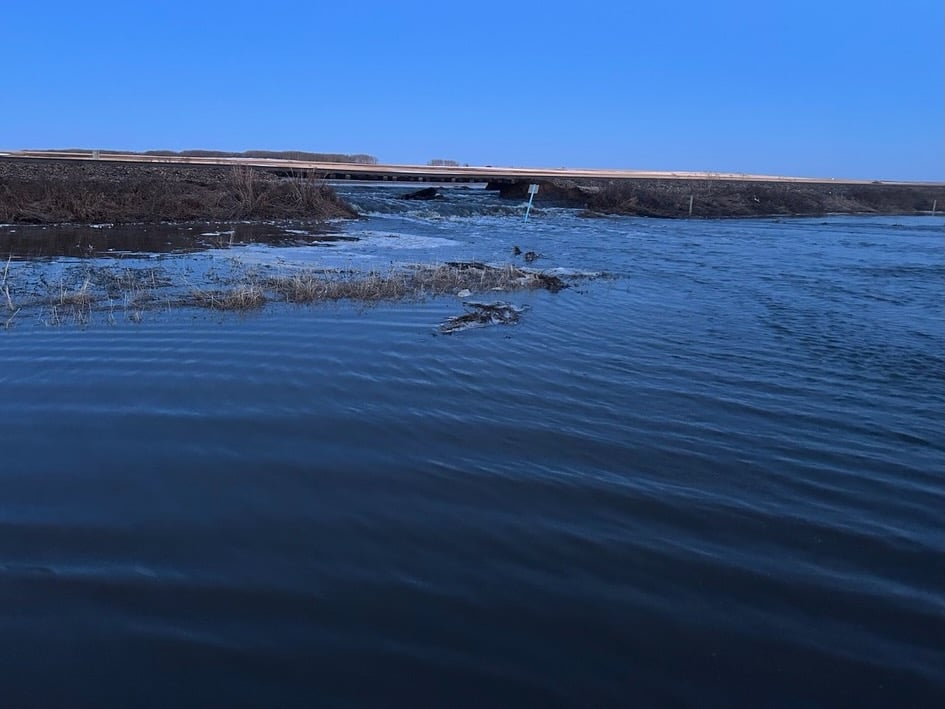
SASKATOON — Dale Boyd thought spring thaw was going well in northeastern Saskatchewan until temperatures soared on Saturday.
The bulk of the snow was gone, at least in the fields. Water was flowing through culverts, and the bridges and rail tracks were in good shape.
“The consensus was that we were quite lucky,” said the owner of B4 Seeds.
Read Also
Canadian wheat faces tougher fight for markets
As global competition tightens, Canada’s wheat sector is leaning on customer support, training, and market diversification to protect sales for farmers.
And then temperatures climbed as high as 14 C on May 2, melting the remaining snow that was trapped in the trees, and the water started flowing.
By Saturday night it had crested the grid road that usually protects Boyd’s farmyard, located five kilometres southwest of Melfort.
Straw from a nearby field plugged culverts that had been open for two weeks.
Boyd’s last line of defense was a Canadian National Railway rail line that acts as a berm and forces water 500 to 600 metres south of his farmyard.
“It actually got to the stage where the steel on the tracks was all that was holding the water back,” he said.
Eventually the water broke through that final barrier, taking out up to 18 metres of rail track in the process. The flood waters came dangerously close to entering Boyd’s farmyard, but rerouted south around the farm at the last minute.
WHY IT MATTERS: Northeastern Saskatchewan is a big canola growing region of the province.
Farms located north and west of Melfort did not fare as well, and neither did the local infrastructure.
“Bridges and culverts and roads are closed all over the place,” he said.
Leah Clark, executive director of irrigation and economic development with Saskatchewan’s Water Security Agency, said there has been well above normal runoff in the east-central and northeastern regions of the province.
Inflows into the Carrot River range from a one-in-25-year event near Smoky Burn to a one-in-200-year event near Armley.
The Quill Lakes basin is experiencing at least a one-in-50-year flow event due to the rapid melting, she told reporters attending a recent webinar.
Derek Squair, president of Exceed Grain Marketing, said large portions of northeastern Saskatchewan are affected.
“That’s big canola area,” he said.
The crop insurance deadline for canola is around June 10 in that region of the province, which could become an issue if seeding is seriously delayed.
“The swing in canola acres could be massive,” he said.
Boyd said some farmers in the area believe they won’t start seeding until June 1. Others think they will be in the fields by May 15.
He isn’t overly concerned just yet, but he will be keenly watching weather forecasts between now and mid-June.
“The biggest thing is we can’t handle any more moisture,” he said.
A single rain event of any magnitude will set seeding back four or five days.
“We almost need to have next to nothing for May rain.”
Boyd acknowledged that message is probably hard to hear for farmers on the west side of the province who are in desperate need of moisture.
“We’d love to spread it out, that’s for sure,” he said.
He doesn’t think many farmers will be changing their seeding plans until after May 25. A lot of wheat gets sowed in the last half of May with good success these days.
And a lot of canola goes in the ground during the first 10 days of June. Farmers are not as concerned about fall frosts as they used to be.
If anything, he thinks canola could take some acres away from wheat.
Farmers in the region are not going to be panicking at this early stage of the game.
“Up here we’ve got pretty thick skin to bad weather in the spring,” he said.
However, there will likely be some acres unseeded this year as growers avoid waterlogged potholes and filled sloughs.
Boyd is also concerned about getting crop inputs such as fertilizer and seed delivered to farms due to damaged roads, bridges and culverts.
Hauling equipment to the fields is also going to be an issue, especially for growers north of Melfort.
“There are guys that have three ways out of their yard and all three roads are washed out,” he said.
Grain transportation could also be affected, although he was shocked how fast Canadian National Railway repaired the flood-damaged track near his farm.
However, he doubts CN will be pulling 150-car trains anytime soon, and whatever they will be hauling will be moving at vastly reduced speeds.

Source: producer.com