
Mustard holds its own in diversified rotations: Prairie research
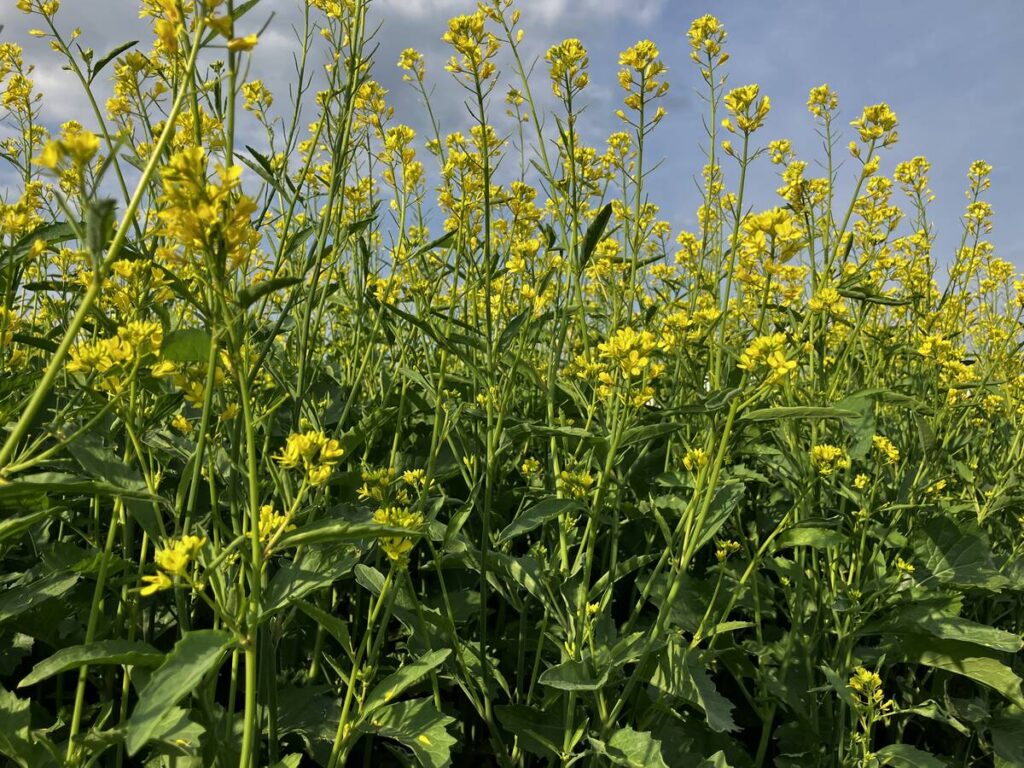
Farmers looking to shake up their crop rotations may have more flexibility than they think.
New Prairie research suggests that replacing canola with minor oilseeds such as mustard can maintain profitability, even in lower-input systems.
The findings come from a multi-year study examining diversified cropping systems across locations in Alberta and Saskatchewan. It is part of a broader research effort, with findings from the same trials analyzed across studies examining economics, agronomy and soil impacts.
Diversifying rotations can help farmers manage input costs without giving up profitability.
Researchers working on the economic study compared more conventional wheat-canola-pulse rotations with alternatives that substituted canola with minor oilseed crops, including industrial, oriental and yellow mustard, camelina and flax. Mustard-based rotations were among the strongest performers in the study.
Across sites, those alternative systems performed similarly to conventional rotations when it came to overall productivity and returns. The results were based on commodity prices averaged over 12 years to reduce the influence of short-term market swings.
The findings suggest profitability in these systems is driven less by chasing high crop prices and more by managing input costs, particularly nitrogen.
Read Also
What mustard brings to the mix
Nitrogen savings from pulse crops were a key part of the economics, but mustard’s lower input needs and drought tolerance may also have helped.
Mohammad Khakbazan, an agricultural economist with Agriculture and Agri-food Canada (AAFC) and lead author on the economics study, said systems that included mustard performed similarly to, or better than, more conventional rotations.
While the economics show mustard can compete in those systems, the agronomic reasons are less straightforward. What is clear is that mustard did not drag the rotation down and, from an agronomic perspective, the crop appears to hold its own.
Mervin St. Luce, a research scientist with AAFC at Swift Current, Sask., and lead author on the agronomic study published from the same trial data, said rotations that included minor oilseeds such as mustard showed no significant difference in overall productivity or nitrogen use efficiency compared to those that included canola.
Dry years shaped results
In terms of yield, the mustards were sometimes less productive than canola, but they were usually in the ballpark.
St. Luce said the study was carried out over a fairly dry period (2018–22), and canola yields were lower than expected. Mustard is generally considered more tolerant of drought than canola, which may have helped stabilize performance in those years.
“Would the results be the same if we had better growing conditions? Maybe not,” St. Luce said.
“Maybe canola would have done much better.”
Nitrogen use is a big piece of the agronomic puzzle.
St. Luce said mustard is generally considered less nitrogen-demanding than canola, which is one of the most nitrogen-intensive crops in Prairie rotations.
This difference may help explain some of the lower fertilizer use observed in rotations that included mustard, although the study did not isolate nitrogen requirements by crop until the final two years.
During the first three years of the trial, nitrogen rates were applied uniformly across crops, but later phases shifted to soil test-based applications to better reflect how farmers manage fertility in practice.
St. Luce said the results show differences in nitrogen use between systems, but the data does not yet fully explain what is driving those differences. He suggested lower-than-average canola yields may be part of the explanation.
Researchers are continuing to examine how different crops affect nitrogen cycling in the soil, including how crop residues break down and release nutrients over time.
Even without a clear mechanism, the broader takeaway is straightforward: in dry Prairie conditions like those seen during the study, rotations that include crops such as mustard can perform as well as more familiar systems.
On-the-ground realities
For farmers, however, adopting those systems is about on-the-ground realities.
Darren Bond, a farm business management specialist with Manitoba Agriculture, said decisions to switch crops often come down to practical considerations.
Market access may be the biggest hurdle.
Specialty crops such as mustard are often grown into smaller, less transparent markets, and may require contracts or established relationships with buyers before seeding.
Without that, Bond said, growers risk ending up with a crop that is difficult to sell.
“You might be sitting on this crop for a few years before you can sell it,” he said.
Beyond that, farmers need to consider whether the crop fits on their farm. They need to factor in things such as herbicide carryover or rotation restrictions from previous seasons.
Input availability is another factor.
While mustard may require less fertilizer than canola, growers still need to ensure they can source seed, crop protection products and other inputs, particularly in a tighter supply environment.
The point, said Bond, is that even when research shows alternative crops can compete on profitability, farmers have to work through the practical details before changing rotations.
“We need to do this homework,” he said.
Source: producer.com