

NEXAT could trigger a revolution in agriculture equipment
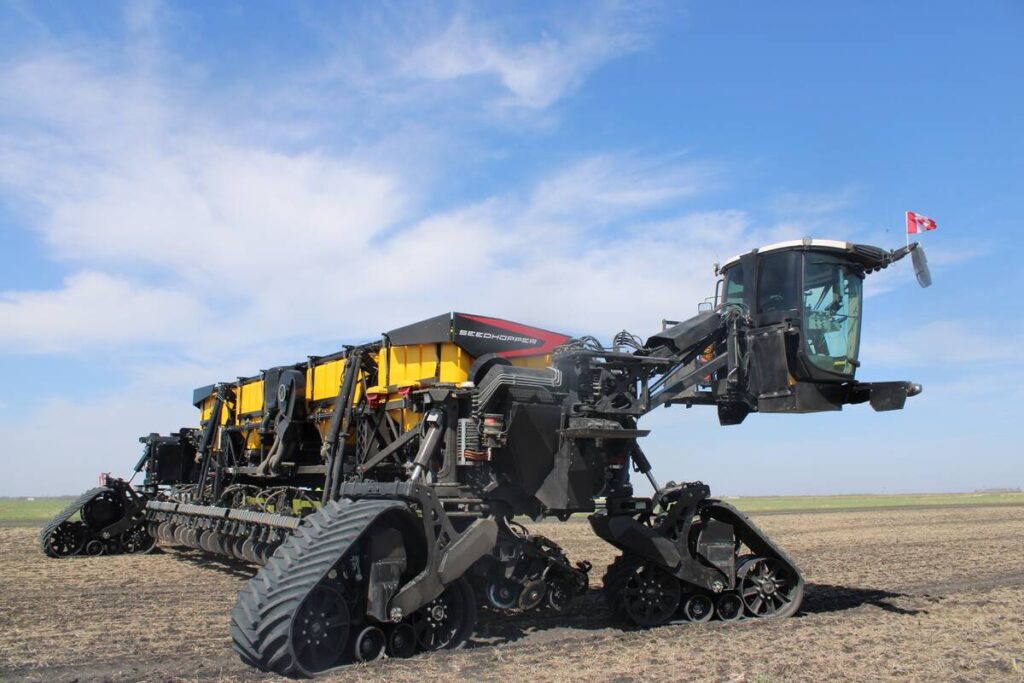
If you’ve never heard of NEXAT, you will over the next year.
It’s a revolutionary approach to farm equipment that seems to tick all the boxes for modern grain farming.
NEXAT is a German company’s innovation that received a lot of attention at Agritechnica in Hanover, Germany, last fall. Before that, it was featured sporadically in Canadian farm media.
Read Also
U.S. citizen petition poses new threat to wheat production
Sure, movements pop up from time to time calling gluten a poison, but it’s fair to say grain farmers haven’t faced the same activist backlash experienced by livestock producers.
The first major publicity foray in Canada was a small booth and a presentation by Lucas Lang, the company’s country manager for Canada, at Canada’s Farm Show in Regina March 18.
You can follow all our coverage of Canada’s Farm Show here.
Much more publicity and interest will be generated when one of the huge carrier units is featured at Ag in Motion near Langham in July.
Canada is one of the few countries chosen for development and introduction of NEXAT. Due to American tariffs, Canada was chosen over the United States.
Three units were running last summer at a farm north of Moose Jaw. A fourth unit is on its way.
In a nutshell, NEXAT is a large carrier unit that runs across the field on the same track for each field operation.
Two 550 horsepower diesel engines power electric drives. In 10 to 20 minutes, the carrier can be switched from a seeder to a fertilizer spreader, sprayer, cultivator or combine.
NEXAT specially designed a huge-capacity, unique combine for the carrier. On implements from seeders to sprayers to combine headers, it’s working with other companies.
For the Canadian market, NEXAT is working with Saskatchewan seed drill manufacturer K-Hart.
As for scale, the carrier unit is about 45 feet wide. The sprayer covers 220 feet and the seeder can be 90 feet with an on-board 900-bushel seed and fertilizer tank.
The combine has significantly more capacity than anything on the market with two straw choppers and a 908-bushel tank that unloads at 18 bu. per second.
Check out the NEXAT system on its website for much more information on specifications.
Beyond size, the innovation seems to answer all the concerns producers may have about this approach.
Cost is always a big question, and while commercialization is just beginning, the goal is to have the system 10 to 15 per cent lower cost than what is needed for conventional equipment.
One big unit carries all the attachments. You’re not buying diesel engines and drive systems for a tractor, sprayer and combine.
NEXAT uses controlled traffic farming.
Only a small percentage of the land ends up with tire tracks, meaning less compaction and more fuel efficiency.
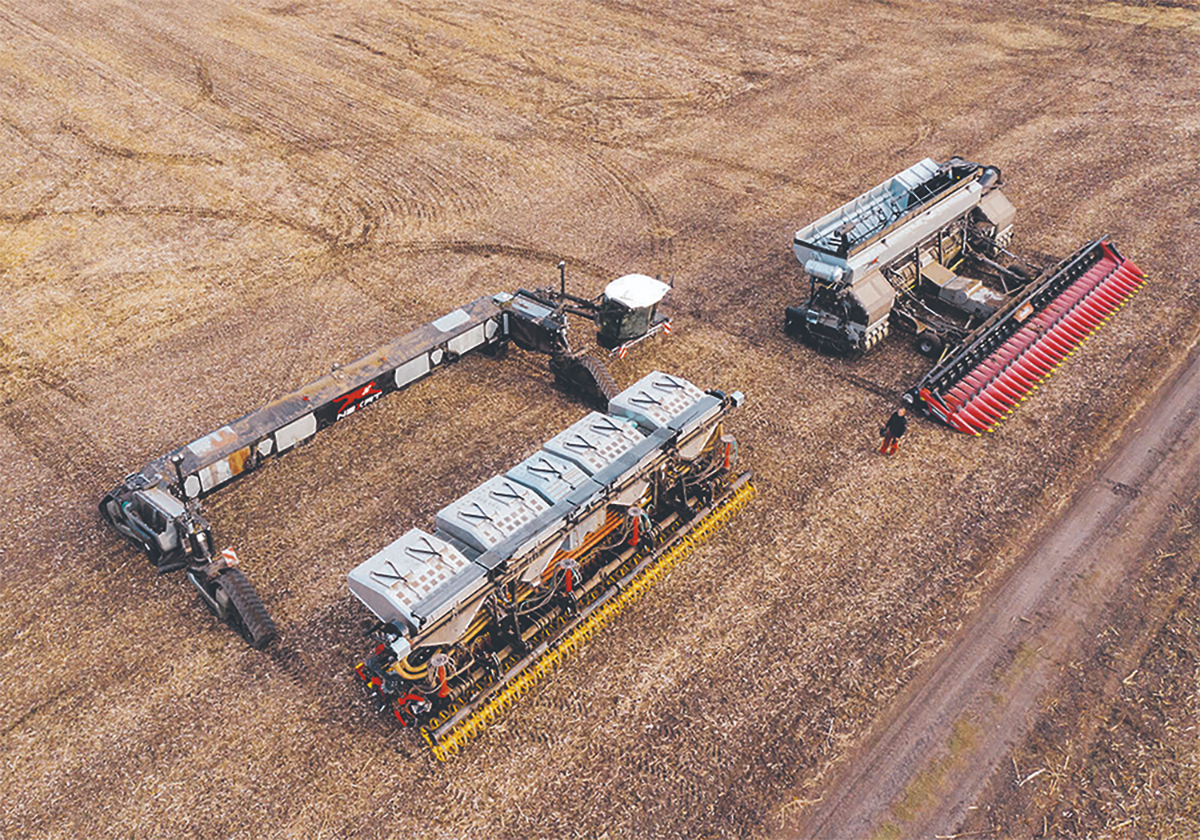
The combine requires both diesel engines, but many operations can be accomplished with just one of the engines. These sustainability advantages resonate with consumers.
While there is a cab for an operator, everything is set up for GPS control. The unit quickly converts from field use to transportation mode.
It’ll be interesting to see how quickly NEXAT catches on.
Personally, I have a hard time imagining it on some of the very hilly land farmed on the Canadian Prairies. I also wonder about its use on smaller fields.
However, farms continue to get larger, and good help isn’t always easy to find. If NEXAT can fulfill its potential, the future of farm equipment could look very different in a few years time.
Oftentimes, revolutionary approaches do not reach their potential. Many fizzle entirely.
I’m unlikely to ever farm with one, but I’d bet on NEXAT being the next big change in large acreage field crop production.

Source: producer.com