

Rural municipality of Shellbrook lifts evacuation order
UPDATED: Monday June 1, 2026 – 1830 CST – The RM of Shellbrook has rescinded its evacuation order. As of 1645 CST June 1 residents of the RM are being allowed to return to their homes.
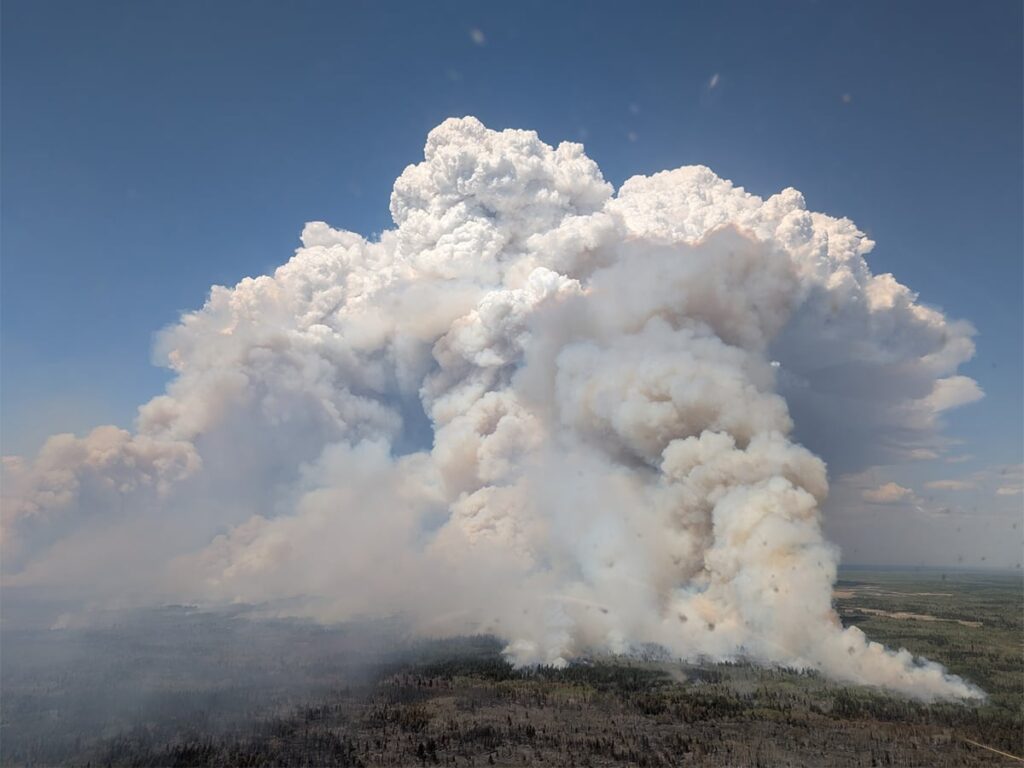
REGINA — Rural residents near Shellbrook, Sask. remained out of their homes June 1 as the Lobstick fire continued to burn out of control.
However, Saskatchewan Public Safety Agency officials said the situation had improved since about 130 people were ordered out of their homes the evening of May 29.
The fire grew slightly from 19,000 hectares, or 47,000 acres, over the weekend held in part by rain showers and increasing relative humidity and fire fighting efforts.
North of Hudson Bay, the Cayford fire forced residents of Red Earth Cree Nation and Shoal Lake Cree Nation to evacuate. Premier Scott Moe said more than 1,000 people were being housed in major centres because of smoke and access issues from the 11,500-hectare (28,400 acres) blaze.
The Red Cross is supporting those communities.
Read Also
Many parts of Saskatchewan are in extreme fire risk as of June 1, including areas of the southern grain belt.
The SPSA said some horses and cattle had been evacuated near the Lobstick fire, which started May 26 near Duck Lake and jumped the North Saskatchewan River to threaten the Shellbrook area.
A chicken coop, a shed and an unoccupied trailer were destroyed but no homes have been lost and there were no reports of livestock lost either. In the fall of 2017 nearly 800 cattle were killed or euthanized after a grass fire swept through southwest Saskatchewan.
Moe, who is from Shellbrook, said he expected some fencelines were burned and that gel coating had protected some farm yards.
“Just knowing the area, one of those old buildings that was lost … it was quite a heroic effort locally, and again by the SPSA, that the rest of the buildings, the home, the shop, the rest of the buildings in what’s a pretty isolated yard in a very forested area, were not lost as well,” he said.
He said a number of containment measures had been taken on the eastern flank of the fire to protect communities such as Holbein, Crutwell and along the river into Prince Albert.
“We wanted to prevent this fire ever having an opportunity to take a run, as it has ample fuel alongside the river as it heads into Prince Albert and we all know the communities and the acreages that are in that space,” he said.
He thanked all the firefighters, municipal officials and volunteers involved in the effort.
“I think we’re in a stronger position today than maybe we were four days ago when it comes to the Lobstick fire. We have some more work to do with respect to the Cayford fire,” Moe said.
Those two are the only fires burning out of control among the 10 active wildfires. Four were contained, three were under ongoing assessment and crews were protecting values in another.
Fire bans continue in the region as well as in various parts of the province including the southern grainbelt. There are 58 bans implemented by rural municipalities, 29 urban bans and four in provincial parks.
The response to the Lobstick fire involves aircraft using both water and fire gel. Dozer guards were constructed to protect a power transmission line.

Holbein, a hamlet about 11 kilometres northeast of the fire, is surrounded by irrigation lines feeding perimeter sprinkler heads, according to the SPSA. A fire guard was built on the southwest corner of the community.
Shellbrook Fire and Rescue are extinguishing jump fires that were contained and Buckland Fire and Rescue is on standby to assist.
Bryan Chartrand, executive director of land operations at the SPSA, said the fire risk is still high even with rain on Saturday and in the forecast.
“It’s looking favourable for us, but it all depends on whether or not that precipitation actually does occur,” he said.
Backup plans are in place should the fire become a bigger concern. Water bombers helped steer the fire head toward a lake in order to get dozers and personnel into the area. Chartrand said the fire has not jumped the lake.
Chartrand said the Cayford fire started in an old burn, the Bell Fire of 2021, and much of the fuel has already been burned. He said this fire will run into natural barriers and is limited as to where it can go. That will give crews time to get resources in place. The main effect is likely to be smoke.
Some rural municipalities want more coordination between municipal and provincial jurisdictions so that an RM fire ban would also apply to the Nisbet Forest. Moe said responsibility for the provincial forest will remain with the province but agreed there is an opportunity to talk.
He said provincial fire bans are broader than those in RMs.
“We understand some of the frustrations and I would be certainly open to always doing better when it comes to the communication between rural municipalities and the SPSA,” he said.
Meanwhile, the opposition NDP called for the release on an MNP report into the government’s handling of wildfires last year. A year ago more than 200 homes at Denare Beach were destroyed by fire.
Moe said the government would release the report as soon as possible. MNP had asked for an extension to March 31 to review more documents.
“If there’s recommendations that come from that report we’ll certainly intend to move on those sooner rather than later,” he said.
Source: producer.com