
What could US-Iran peace deal mean for UK household costs? | Household bills
Around the world, markets reacted with relief this week to news that Donald Trump had signed a draft peace deal with Iran that promised to reopen flows of oil and gas from the Gulf to global buyers.
There are already signs the truce could unravel, with Friday’s peace talks in Switzerland abruptly called off, but for now markets seem persuaded that commercial vessel traffic through the key waterway can start returning to normal.
The international oil price has slumped to below $80 a barrel, from highs above $126 a barrel in the heat of the crisis when Iran’s de facto blockade on the vital strait of Hormuz trade route upended global energy markets.
Europe’s gas prices have fallen, too, from more than €61 per megawatt-hour in the first month of the war to between €40 to €42/MWh this week.
Falling pump prices
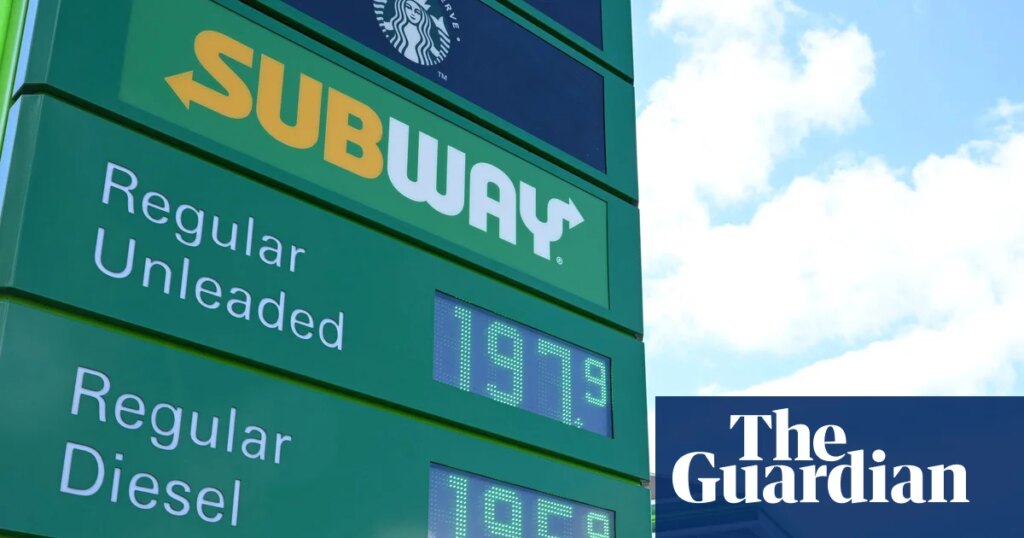
Fuel prices have already begun to tumble at forecourts across the UK. The price of a litre of petrol is down by 4.6p, from 159.7p on 28 May to 155.1p this week, according to the AA motoring group. Diesel is down 9.3p from 184.4p a litre to 175.1p in the same period, the group added, crediting the government’s price comparison scheme launched in February.
“We have been surprised at the speed of the reductions and concluded that this is the influence of Fuel Finder: retailers seeing how much rivals are cutting their prices and, knowing that drivers can see the same information, having to respond,” says the AA’s Luke Bosdet.
The group cautioned that although the wholesale cost of petrol had fallen by 10p a litre from the highs early in the Iran war, disruption to Gulf supply chains was expected to keep pump prices relatively high for a while.
Even with the recent falls, road fuel is still very expensive by historical standards, Bosdet added. Before the Covid-19 pandemic, the Ukraine crisis and the Iran war, the highest price British motorists had paid was 142.5p a litre.
Rising energy bills
Global markets may have begun falling but households in England, Scotland and Wales are still bracing for the steepest summer rise in energy rates in four years.
Months of soaring market prices means that under the government’s energy price cap, the price of gas and electricity will climb by 13% for the July to September period to the equivalent of £1,862 for a typical household’s yearly gas and electricity use. That is up from a level equating to £1,641 a year in the April to June quarter.
The good news is that the higher rate will take effect during warmer, brighter months when households will be able to reduce their overall energy use without too much effort. But what about when things start to get colder?
Recent declines in wholesale gas costs mean the price cap from October to the end of the year is likely to be lower. The energy regulator for Great Britain, Ofgem, bases its calculations on the average market price over a set window. The July cap was based on costs between 18 February and 18 May when the Middle East conflict was at its height, while the final price cap of the year will be based on 19 May to 18 August trading.
So while bills will continue to be higher than pre-crisis levels, the amount charged for each unit of energy during the winter is likely to fall.
Grocery bills
There is good news for household food bills, too, according to the boss of Tesco.
Ken Murphy, the chief executive of Britain’s biggest retailer, said this week that he did not expect grocery inflation to reach as high as the 9% levels suggested by some industry bodies in the early days of the Iran war – especially because petrol pump prices were “falling as we speak”.
Although consumer confidence was low because of fears that the conflict would push up prices, this had not translated into significant changes in shopping behaviour, he added.
Falling mortgages
The war has caused the kind of upheaval in the mortgage market last seen in the aftermath of Liz Truss’s disastrous 2022 mini-budget. Before the fighting started, economists were anticipating two cuts to interest rates this year but those hopes were soon replaced with predictions of rate increases amid fears the high oil price would stoke inflation.
Things have not changed overnight but if you are a first-time buyer or looking to remortgage the picture is improving.
Lorna Hopes, a mortgage specialist at the financial advisers Smith & Pinching, says: “Mortgage swap rates, which determine how mortgage lenders price their fixed rate loans, now suggest there will be no more than one base rate rise in the second half of 2026. Just a few weeks ago, they were predicting at least two. This is great progress for mortgage customers.”
The Bank of England kept the base rate on hold on Thursday at 3.75% and market bets shifted this week to suggest a rise is more likely in November than September.
In recent days big high street names including Nationwide and Barclays have cut their mortgage rates but rates remain higher than prewar levels. In February you could get a two-year fix at 3.69%. Today the best deal is closer to 4.49%. On a typical £200,000 mortgage over 25 years this increase has added £89 to monthly payments.
Nicholas Mendes, a mortgage technical adviser at the broker John Charcol, says: “Borrowers are still paying more than they were in February, and it’s a meaningful gap, even with the cuts that have come through lately.”
The ceasefire combined with the latest data showing UK inflation unchanged at 2.8% in May has pulled swap rates down, and lenders are starting to follow, Mendes says. “The worst of the war premium has gone. But the market is climbing down from a shock here, not heading back to where it started.”
What can households do?
If your mortgage deal is coming to an end “don’t sit and wait for February’s rates to come back”, is Mendes’s advice. “They won’t, at least not quickly. Lock in something competitive now, keep it under review, and let your broker chase a better one before you complete.”
Another option is to hop on to a tracker – where the rate you pay moves up or down in line with the Bank of England base rate. Many lenders do not impose early repayment fees on tracker deals, and, with some, there is no product fee either, so you could take one out as a “holding position” and see how things pan out.
Locking in a lower energy price could also help to save money, especially if market prices do not fall as quickly or as far as hoped. There are still some fixed energy deals on the market, and the group-buying company Switch Together believes households could save £200 a year on energy bills by using its scheme.
George Frost, the UK boss of Switch Together, says: “If I laid £200 in crisp banknotes in front of you and said you can take it or leave it, what would you do? By not switching, you are turning your back and could be leaving that £200 on the table. In some cases, households could secure a fixed deal below the cap, including through collective schemes where suppliers compete to offer lower tariffs, but too many are not exploring their options or assume there is little they can do.”
However, more and more British homes are looking to save money by generating their own power. During the Iran war households have turned in record numbers to green home energy upgrades such as solar panels, EV chargers and heat pumps to try to keep costs down even as global oil and gas prices soar.
Last year a record 269,000 solar installations were completed in the UK, up more than a third year on year and equivalent to a new rooftop solar installation every two minutes. Bosses of some of the biggest retailers held talks with the government this week about starting to sell plug-in solar devices so renters and those in flats without roof access can generate electricity.
Source: theguardian.com