
Government recognizes work is needed to meet challenges ahead
The federal government seems to be getting serious about nation building.
Actions since last year’s election point toward a renewed recognition that the country needs to do something to prepare its economic infrastructure for the challenges ahead.
One example is the Major Projects Office, which has been given its first list of national initiatives to kick-start the Canadian economy.
The agriculture industry made its position loud and clear that at least some of its priority projects needed to be on that list.
The Port of Vancouver received particular attention from the sector because of the important role it plays in moving agricultural exports overseas.
Alas, the industry failed to convince the government, and its priorities were pretty much left off the final list.
Most of the projects focus on energy and mining, although a container port at Montreal did make the list, which is something, we suppose.
However, the industry will have to continue its lobbying efforts if and when another list of priority infrastructure projects is put together to make sure agriculture is not forgotten.
Read Also
Then there’s the recently announced Trade Diversification Corridor Fund, which has been promised an investment of $5 billion into trade enabling infrastructure.
Eligible investments include ports, railways, inland terminals, airports and highways, and the agriculture sector is going to have to make sure that the projects, when they are selected, make sense for farmers and industry.
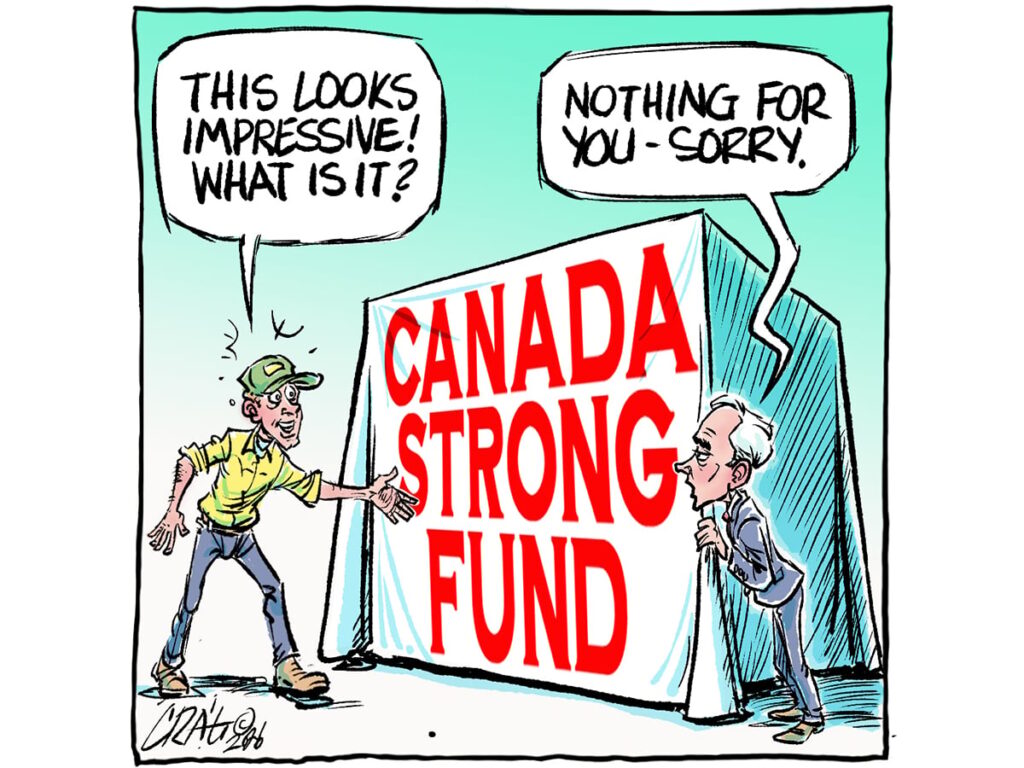
The most recent initiative that will need agriculture’s attention is the federal government’s first sovereign wealth fund.
The Canada Strong Fund is intended to act as an investment vehicle for the major national projects in which the government is interested.
While the term “sovereign wealth fund” is being used in discussions about this initiative, that is not completely accurate.
Most sovereign wealth funds around the world are used by countries to squirrel away extra money and then invest it with an eye toward earning a return on that investment.
Many of the more well-known funds were set up by oil-producing countries, such as Kuwait, Norway and Saudi Arabia.
In fact, the Saudis’ Public Investment Fund, through its Saudi Agricultural and Livestock Investment Company, is the majority owner of G3 Canada, along with Bunge.
The Canada Strong Fund isn’t actually Canada’s first sovereign wealth fund.
Alberta set up the Alberta Heritage Savings Trust Fund in 1976 to reinvest a portion of the province’s resource revenue.
It never accumulated the amounts that were initially anticipated, largely because of government’s willingness to pull out money to fund short-term political goals.
This should be a cautionary tale for Ottawa as it goes ahead with its Canada Strong Fund.
There is also a big difference between what the federal government is planning and how most other sovereign wealth funds are managed.
Most are funded with surpluses, but Canada doesn’t have surpluses.
The national deficit keeps growing, partly because of the government’s renewed focus on increasing investment in the country’s economic infrastructure.
Few details are yet available about how the Canada Strong Fund will work, but we do know the government plans to put in $25 billion initially over three years, which isn’t going to help the country’s deficit.
However, prime minister Mark Carney says there will also be an opportunity for foreign investors and regular Canadians to invest in the fund.
The government has said the fund will be used to focus on areas such as advanced manufacturing, energy and mining.
There is no mention of agriculture, similar to the Major Projects Office’s initial priority list.
It’s going to be up to farmers, their organizations and the agriculture industry in general to push hard on the levers of power to ensure that their sector is not neglected by this new effort to build economic infrastructure in Canada.
Source: producer.com