
AM Market Report – March 25, 2026
GOOD MORNING…HERE IS YOUR MORNING MARKET NEWS
OVERNIGHT GRAIN TRADE
ICE canola futures are trading under pressure to start this morning…down $7 to $8/tonne…retreating with weaker vegetable oil and energy markets.
Chicago soybean futures posting 3 cent/bu gains this morning, with soymeal edging ever so modestly higher, but soyoil slightly weakening.
CBOT corn futures are down 2 cents this morning.
US wheat markets are lower…spring wheat future are losing 3 to 5 cents, HRW down mostly 2 cents, while SRW wheat is leading with 4 to 7 cent losses.
Read Also
AM Market Report – March 24, 2026
GOOD MORNING…HERE IS YOUR MORNING MARKET NEWS OVERNIGHT GRAIN TRADE Cereal grain futures edged higher in overnight trade, but oilseeds…
Grain traders are tracking price movements in the crude oil market, which is trading sharply lower today.
Latest on the war in Iran…
– Iran received a 15-point peace proposal drafted by the US. The proposal covers sanctions relief, civilian nuclear cooperation, a rollback of Iran s nuclear program, missile limits and access for shipping through the Strait of Hormuz. U.S. awaits Iran s response. Trump says Iran wants to make a deal.
– Tehran has been signaling little willingness to compromise, at least in public, saying the US is negotiating with itself.
– US is set to deploy 2,000 troops to the Middle East, adding to about 5,000 soldiers expected to start arriving in the region in the coming days.
– Iran has kept up attacks on Arab Gulf states and Israel overnight but no reports of casualties.
– Global stocks bounce, crude oil falls on Trump s peace push.
Markets are reacting to reports of attempts to negotiate a ceasefire despite every indication that it is simply a distraction meant to influence markets and buy time to get US military assets in place for the next escalation. The two sides couldn’t be further apart in their reported demands with both sides confident that they are winning the war.
In Other News
– Global food production at stake… The Financial Times reports 25% of the world s traded oil passes through the Strait of Hormuz, which has obviously garnered much attention in recent weeks. However, it also carries the fertilizer components that underpin roughly half of the world s food supply.
Gulf states account for 49% of the globally traded urea and 30% of ammonia…perishable contributors to the nitrogen cycle that makes high-yield agriculture possible. Halting that supply chain ultimately changes soil chemistry and planting decisions over the months that follow.
Before the first US-Israeli air strikes in Iran, the global food system was already running on reduced redundancy due to the lingering conflict between Russia and Ukraine…which makes up roughly a quarter of global wheat trade. Some 400 million people across the Middle East and east Africa have been absorbing that supply shock for three years. The Hormuz closure isn t breaking a healthy system; it is breaking one that was already compromised.
– Iran war won’t alter upcoming US biofuel blending plan… The administration of US President Donald Trump will release its 2026-27 US biofuel blending volumes obligations this week, according to two sources familiar with the matter. The rule will not differ materially from volumes proposed by the US Environmental Protection Agency prior to the onset of the Iran war, the sources said.
The EPA submitted its Renewable Volume Obligation proposal to the White House Office of Management and Budget late last month. University of Missouri ag economist Ben Brown says that if the EPA s proposal is finalized as it was presented last summer, it would increase corn and oilseed demand and provide certainty to the markets.
– Prairies led way as national farmland values rise... Canadian farmland values continued to rise in 2025, with the Prairie provinces leading the way and outperforming the national average, Farm Credit Canada s annual Farmland Values Report showed. Even as higher borrowing costs, trade uncertainty and uneven crop returns created challenges for producers, demand for quality land remained strong across much of Western Canada.
According to the report, the average value of Canadian farmland increased 9.3% in 2025. Manitoba posted the largest gain in the country at 12.2%, followed by Alberta at 11.4% and Saskatchewan at 9.4%. Those increases were well ahead of Ontario s 2.2% rise and Quebec s 4.8% gain, while British Columbia recorded a 1.7% decline in average cultivated farmland values.
FCC said a limited supply of land for sale, lower interest rates, strong balance sheets for many producers and healthy livestock returns all helped support the market.
Manitoba saw particularly strong growth in the Parkland and Westman regions. Parkland farmland values jumped 17.7%, while Westman rose 15.1%, reflecting strong competition for available acres. The Central Plains-Pembina Valley region also posted a solid 9.3% gain. By comparison, the Interlake region was more uneven, with northern areas showing flat to slightly lower values after poor crop years, even though the region as a whole still posted an increase of 5.8%.
In Alberta, some of the strongest increases were recorded in the south. Dryland values near expanding irrigation districts climbed 16.4%, supported by scarce supply and competition from both dryland and irrigated operations. Irrigated land in southern Alberta increased 11.3%, while the Northern region gained 10.1% and the Central region rose 9.6%. Alberta s Peace region posted an 8.9% increase, helped by continued buyer interest in lower-priced land and mixed farming opportunities.
Saskatchewan farmland values rose 9.4%, a slower pace than in the previous two years, but still a strong gain. The largest increases were recorded in the North Western and North Eastern regions, both up 12.1%, as well as the East Central region, which rose 12%. The West Central region, by contrast, posted a more modest 4.8% increase. Irrigated land showed some of the sharpest gains in the province, with West Central and South Western irrigated parcels rising 19.2% as drought concerns and limited supply supported values.
– Product of USA label coming to the US meat industry… The Trump administration has launched a national public awareness campaign to promote its voluntary Product of USA labeling standard that took effect January 1. Speaking during a National Agriculture Day ceremony Tuesday, Ag Secretary Brooke Rollins said the guidance supports transparency, consumer trust, and American producers. More countries want our beef, she said. But on the flip side it s about doing right by our consumers in this country by clearing up all confusion about what Made in the USA actually means.
Rollins says the voluntary label ensures producers who invest in a fully American supply chain can compete fairly. No short cuts, no exceptions, and no confusion, Rollins said. No more foreign beef being deceptively passed off as America s best. It ends today.
US Senator John Hoeven of North Dakota says a Product of USA label gives consumers confidence. They want to know those animals started and ended right here in the United States, Hoeven said, because we truly do have the best beef in the world. Hmmm…
Rollins says the label is reserved exclusively for meat, poultry, and egg products from animals that were born, raised, harvested, and processed in the United States.
Outside Markets
The Dow Jones Industrial Average finished 84.41 points lower on Tuesday at 46,124.06, while the S&P 500 was down 24.63 points at 6,556.37. Canada s TSX composite index rose 58 points to 31,941 points.
Early Wednesday, the June Dow Jones Futures are up 430 points. European and Asian stock markets are also higher. Canada s TSX futures are following sentiment higher.
Global stock markets are gaining ground on reports the US is seeking a month-long ceasefire in its war on Iran, raising hopes for a breakthrough that could help restore oil ?exports from the Gulf.
The market is trading the headlines at the moment, said Kerry Craig, global market strategist at J.P. Morgan Asset Management in Melbourne. So there s a positive tone. The difficulty is now…there are still unknowns about where this actually goes from here and whether there s anything material in terms of a ceasefire.
The June US Dollar Index is down 0.082 at 99.160. The Canadian dollar weakened against its US counterpart…currently quoted at 72.71 US cents.
May crude oil futures are falling $4.67 lower to US $87.68/barrel. Oil prices plunged after reports the United States had sent Iran a 15-point proposal ?aimed at ending the war in the Middle East, raising prospects of a ceasefire (maybe) that could ease supply disruptions in the region.
Expectations of a ceasefire have risen slightly and profit-taking is leading the market, said Hiroyuki Kikukawa, chief strategist of Nissan Securities Investment, a unit of Nissan Securities. But the outlook remains uncertain as to whether negotiations will succeed, limiting selling.
The global energy crisis is deepening as emergency measures by governments worldwide have fallen short of plugging the huge shortfall in oil and gas supply caused by the US-Israeli war on Iran. Costs for energy, fertilizers and petrochemicals have soared as the world is losing as much as 20 million barrels of oil per day from Middle East producers due to Iran’s effective closure of the shipping chokepoint of the Strait of Hormuz.
Countries across Asia are weighing up work-from-home policies and stimulus measures enforced during the COVID pandemic, as they scramble to respond to global fuel shortages triggered by the Iran war. Asia is at the frontline of the fuel crisis, buying more than 80% of the crude that transits the Strait of Hormuz, which has been almost totally blocked by Iran since the war broke out on February 28.
Grain Markets
Chicago soybean future are showing 3 cent/bu gains this morning. Bean futures were pressured Tuesday, closing down 2 to 8 cents across the board. Soymeal futures are up around $1/ton this morning after finishing down $2 to $4/ton yesterday. Still a potential bear flag formation taking shape of the price charts.
The soybean market may have turned its focus away from the volatile energy market to some degree…and toward the idea of a drawn-out war with Iran that could delay a US trade meeting with China even further. Plenty of uncertainty now about when face-to-face, high-level trade talks with China will happen. The meeting between US President Trump and Chinese President Xi now might not occur until May or even June, further tightening the window for significant US old crop bean purchases by China. Also…China and Brazil have reportedly reached an agreement over phytosanitary issues that had slowed down shipments for much of this month.
Traders are also monitoring harvest in Brazil and crop development conditions in Argentina.
Soyoil futures are slipping 3 to 20 points lower right now after rising 15 to 45 points on Tuesday…ebbing and flowing with the tide in crude oil pricing. Crude oil is down this morning, as reports surfaced of a potential US-generated 1-month ceasefire proposal on offer to Iran. But the Iranians have reportedly rejected the negotiations.
The US EPA is expected to release the RVO number…mandated US biofuel production targets…for this year later this week, adding some support back into the bean oil market. There has been plenty of market chatter the EPA will announce market-friendly US biofuel mandate quotas. They better.
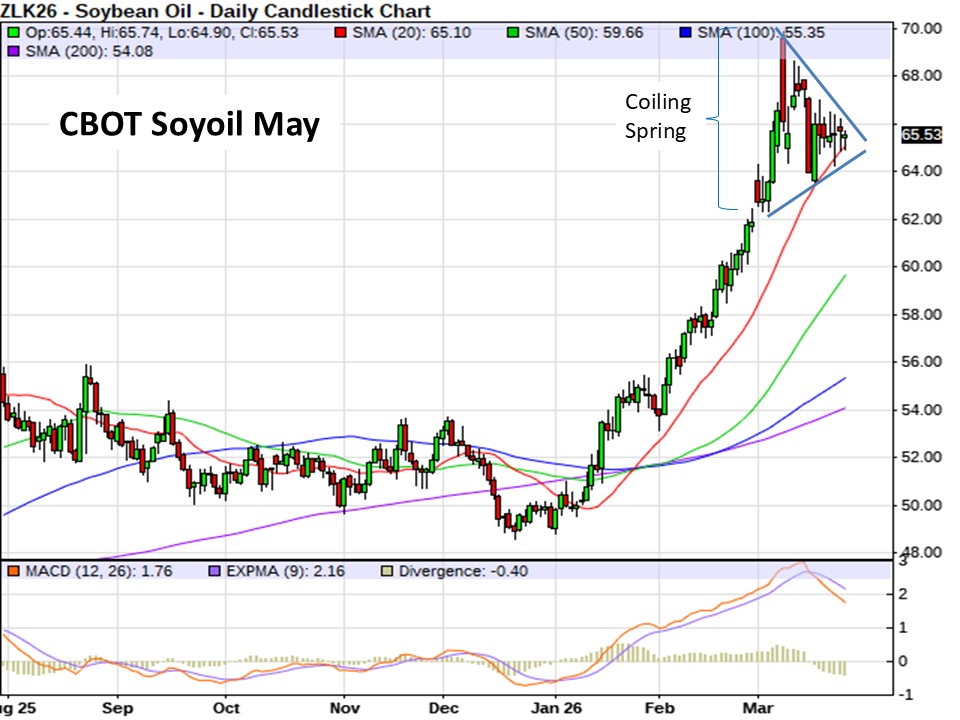
Bean oil futures are maintaining chart support above its 20-day moving average. Note there is a symmetrical triangle or coiling pattern to recent price action…prices trading in narrowing ranges forming short-term uptrend and downtrend lines. Unfortunately, doesn t offer a signal to which way we go next…but a breakout one way or the other is coming.
Chicago corn futures are trading 2 cents/bu lower this morning. The corn market saw gains of 2 to 3 cents in most contracts on Tuesday, with some deferred contracts steady to fractionally higher. Corn is being influenced with the bouncing ball of Persian Gulf war developments and the corresponding swings in the energy markets. The Trump regime has reportedly offered a 1-month ceasefire on the Middle East conflict. Iran has reportedly rejected the negotiations.
The next major ag-specific fundamental factor will be next week’s USDA Planting Intentions Report and Quarterly Stocks Report (Mar 31). Traders are also watching near-term rain chances in South America and conditions in the US ahead of widespread planting, while getting ready for next week s USDA numbers.
US wheat markets are weaker this morning… Minnie spring wheat futures are slipping 3 to 5 cents lower, HRW down mostly 2 cents and SRW wheat 4 to 7 cents lower. The US wheat complex was higher across its three markets on Tuesday…spring wheat finishing yesterday 3 to 4 cents higher.
The next week looks on the drier side for much of the US Plains HRW country, which is not beneficial to already backsliding crop ratings. A few spots in SRW country are looking at a wetter pattern in parts of the eastern Corn Belt.
Globally, the trade s watching winter wheat emerge in Europe, Russia, and Ukraine, while keeping an eye on things ahead of the next round of wheat planting, soon to get underway for spring wheat in the Northern Hemisphere and winter wheat in the Southern Hemisphere.
CANADIAN GRAIN MARKET
ICE canola futures ended higher on Tuesday, recovering part of the previous day s decline on firmer crude oil and broader vegetable oil strength.
The Iran war remained a key backdrop, with renewed concern over Middle East energy supplies helping push Brent crude back above $100/barrel earlier in the day, a supportive factor for biofuel-linked oilseeds such as canola. US crude was trading above $91/barrel on Tuesday.
Canola also took spillover support from gains in Chicago soyoil and European rapeseed, although the advance stayed relatively modest as traders remained wary of the conflict s day-to-day volatility. Losses in the Canadian dollar were supportive for canola as well.
May canola ended yesterday up $4.80 at $723.90/tonne, and November was $3.70 higher at $730.20.
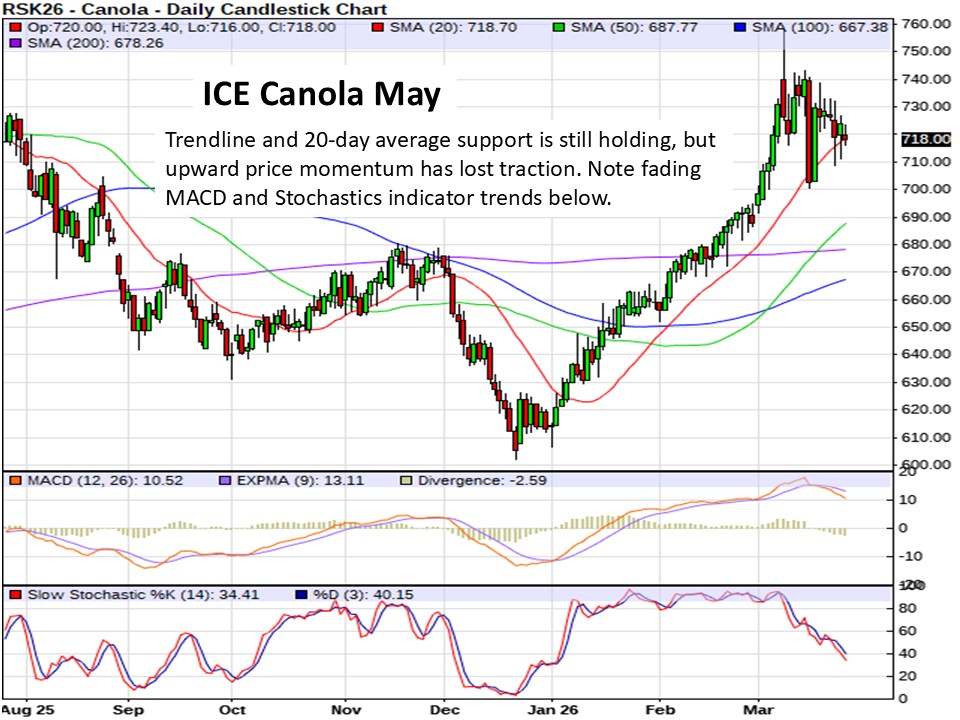
For today… canola futures are weighted down this morning…losing $7 to $8/tonne right now. Nearby May canola futures are $7.50 lower at $716.40/tonne…still holding underlying chart support lines, but momentum is fading. So good news on US biofuel policy, lifting US soyoil, and in turn our canola would be welcomed by market bulls. EPA Administrator Lee Zeldin is scheduled to announce final US biofuel blending mandates…potentially today, if not, by the end of the week.
But so far this morning, canola is lower with weaker soy/palm oil and energy markets. European rapeseed is also lower, extending its correction lower.
On the feed grains… MarketsFarm report Adam Peleshaty writes that feed grain prices should continue to move upwards this spring, irrespective of rising fuel prices, according to a Lethbridge-based trader. Jim Beusekom, president of Market Place Commodities, said feed barley was trading at $305 to $310/tonne in Lethbridge, with feed wheat at a similar range. US corn landed into the same area was trading at $295 to $305. He said feed barley and wheat, which were trading at $270/tonne at the start of the month, largely followed the upward price movement for US corn futures.
Beusekom added that consistent demand and a successful export program for feed barley will continue to support prices over the next six weeks.
We would expect spring and summer will be a competitive marketplace to purchase from farmers because they ve been successful in selling their crops so far and they aren t carrying as much as originally forecasted, Beusekom said. A lot of the market direction on barley is definitely still being set by corn and secondly by the exporters.
Although the war in Iran and the halting of traffic on the Strait of Hormuz have affected energy prices nationwide, Beusekom said it hasn t affected grain prices yet, but freight rates could change if fuel costs stay elevated. The question of who will take care of those costs is still up in the air.
There are a lot of input costs that are creeping higher. How do you know if they are factored into those prices? It s hard to tell, he added. For example, on grain that s (shipped) for export, does the seller pay for it or does the buyer pay for it? For the grain we re importing, it s basically the same thing.
As for upcoming spring conditions, Beusekom said parts of southern Alberta and southern Saskatchewan are leaning towards drought , but they are still subject to change. It does seem Western Canada is leaning on the dry side, but I want to caution everyone, rain and a snowstorm could alleviate drought concerns, he said.
Stay informed with our daily market videos. Each video quickly covers key futures moves, price trends, and market signals that matter to Canadian farmers. Get clear, timely insights in just a few minutes. Bookmark https://www.producer.com/markets-futures-prices/videos
To access the latest futures prices, go to https://www.producer.com/markets-futures-prices/

Source: producer.com