
AM Market Report – May 13, 2026
GOOD MORNING…HERE IS YOUR MORNING MARKET NEWS
OVERNIGHT GRAIN TRADE
ICE canola futures are taking a rally pause this morning…trading $3 to $5/tonne lower.
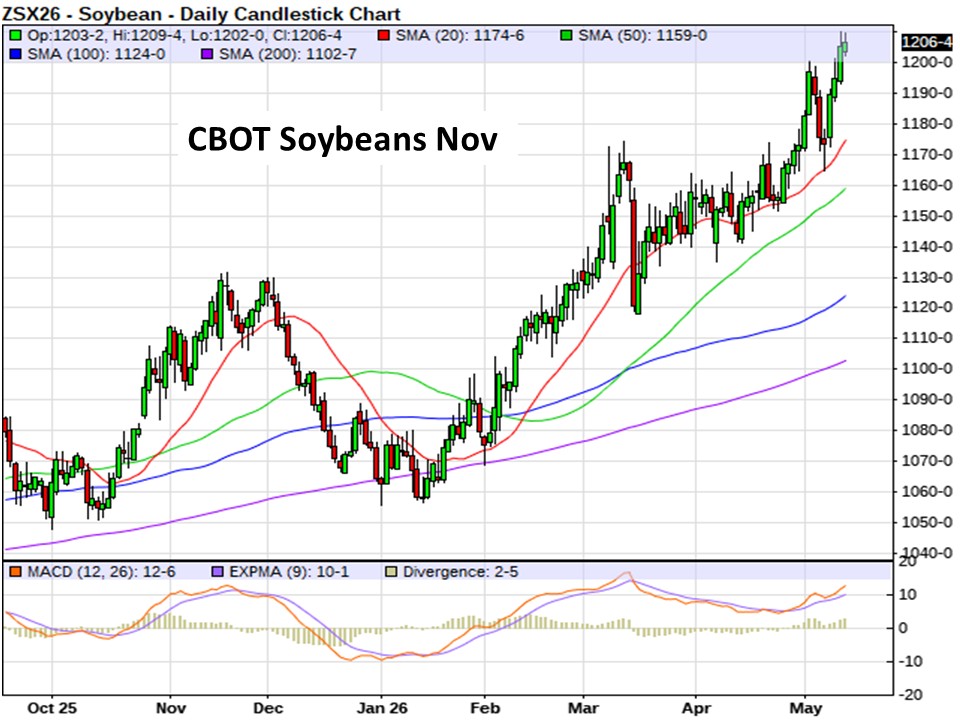
Chicago soybean futures are up 1 to 2 cents/bu after posting solid 13 cent gains yesterday. New crop bean futures hit a new high close for 2026, with a record trend yield needed to reach 2026 production expectations. Separately, this week’s optimism of the US-China trade summit has traders buying until they hear anything that tells them not to. The market will move to trade the headline news from the trade summit in China (more in separate news items below).
US wheat markets are mixed after surging higher on Tuesday… Minnie spring wheat futures are currently showing 3 to 5 cent gains, HRW up 1 to 9 cents, but SRW wheat is down 3 to 5 cents.
The USDA on Tuesday delivered a quite bullish report for US wheat futures. It estimated the US 2026 wheat crop at its lowest in 54 years. That sent winter wheat futures as much as limit up for the session (45 cents/bu), with spring wheat futures charging up 37 cents…all gapping up to new highs for the winter/spring uptrend. The rally on Tuesday grabbed the attention of the general investing marketplace, with traders and investors wondering if the grains are going to be the next precious metals markets, regarding major bull moves.
CBOT corn futures are flat to fractionally higher this morning. Wheat’s rally carried corn 4 cents higher yesterday, despite the USDA data being neutral to bearish for corn. The US House of Representatives is expected to vote on US nationwide, year-round E15 sales.
USDA Report Summary
USDA dumped a lot of data yesterday, but the key numbers included the smallest projected US winter wheat crop in more than a half century, with the winter wheat crop coming in 154 million bu below the average trade guess. That dropped the projected 2026-27 new crop US wheat ending stocks estimate to 762 million bu, down from 935 million this year. New crop US soybean stocks also came in below trade expectations for the new marketing year at 310 million bu. Global corn stocks for the new year fall to 277.54 MMT, down from the average trade guess of 289.53 MMT, and down nearly 20 MMT from the current year. These new crop numbers now become the filter through which all future news events are interpreted.
For grain and oilseed futures, the question is whether the shift in wheat supply and rising inflation concerns offer enough fuel for further gains given that speculative funds have already piled into the long side of ag markets seeking an inflation play.
Latest on US-Iran war…
– Trump says Iran needs to make a good peace deal or face devastation
– WTI crude oil holds near $102 with Mideast impasse, world inventories drop
US President Donald Trump repeated his military threats against Iran ahead of a visit to China, saying Iran will either make a good deal with the US or face devastation. A ceasefire between the US and Iran has lasted over a month but is fragile, with Trump describing it as being on massive life support and Tehran continuing to resist US demands. The closure of the Strait of Hormuz is deepening the impact on the energy market, with the International Energy Agency saying oil inventories are falling at a record pace and will continue to drop for months.
In Other News
– Trade, Taiwan and Tehran… Predictability has never been a hallmark of US President Trump s foreign visits, and his arrival in Beijing today will likely be no exception, according to a Globe and Mail report. In this case, Trump s war in Iran…which has triggered the most severe oil supply shock in history, raised fears of a global recession, cost US $29+ billion to date and delayed this visit once already…continues to drag on. The mood is tense.
The stakes: High! Combined, the United States and China represent more than 40% of the world s economic activity, but last year, an escalating series of tit-for-tat tariffs nearly cut off trade between the two countries altogether. Trump and China s President Xi Jinping agreed to a temporary truce last October, with the hope of signing a more comprehensive trade deal during this week s visit.
The expectations: Low! The Trump administration has been so consumed by the Iran war and its fallout that little advance work seems to have gone into the summit. US Treasury Secretary Scott Bessent had one sit-down with Chinese officials in Paris two months ago…and nothing since. That doesn t really seem promising in terms of delivering a robust set of outcomes for this meeting, observed Jonathan Czin, a former CIA expert on China now based at the Brookings Institution.
The entourage: Big, regardless! Beyond Bessent, trade czar Jamieson Greer, Secretary of State Marco Rubio, Defence Secretary Pete Hegseth (a last-minute add), Trump s son Eric and, for some reason, Eric s wife/Fox News host Lara Trump, the US delegation includes more than a dozen Big Tech leaders. Among them: outgoing Apple chief executive Tim Cook, newish Meta president Dina Powell McCormick and Elon Musk, evidently back in Trump s good books.
The agenda: Honestly, who knows? Trade, Tehran and Taiwan are meant to be the biggies, but it s not as though Trump is a stickler for any sort of script.
On trade, there are a few easy wins up for grabs. The US could ease its curbs on China s semiconductor exports and chip-making equipment. Beijing could agree to resume selling rare earths and critical minerals to US companies, and buy more American ag products and Boeing airplanes.
The White House has signalled it wants Xi s help ending the war in Iran. Last week, Bessent told Fox News that China should step up with some diplomacy to get the Iranians to open the Strait of Hormuz. As Tehran s largest trading partner and the top buyer of its oil, Beijing does have influence, and since its own economy relies heavily on exports, China would rather avoid a global recession that reduces demand for its goods. But Xi s in no hurry to get involved in the Middle East: China s oil reserves and electric vehicles have helped it weather the energy shock.
Perhaps a different US position on Taiwan would persuade him. China claims the self-ruled island as its territory, and Trump could agree to change the official US policy from not supporting Taiwan s formal independence to opposing it instead. But Czin doesn t think Beijing will expend too much energy getting Trump to make that rhetorical shift. Either the distinction will be lost on him, frankly, or he ll wake up the next morning and Truth Social out the exact opposite.
The takeaway: To borrow a favoured Trump expression, China has the cards here. More than any other government, China has called Trump s bluff, matching him tariff-for-tariff last year and getting him to unwind the trade war that he started. Now Trump s heading to Beijing with a far weaker hand, after launching an actual war that has hurt China economically, but not as much as most countries…including the US.
– US EIA concedes Middle East supply disruptions are far worse than prior estimates… The US Energy Information Administration on Tuesday revised its earlier forecasts to reflect a much bigger and lengthier hit to global oil supplies from the Iran war than it previously projected, highlighting the uncertainty that has roiled broader energy markets since the conflict began three months ago. Energy analysts have found it difficult to predict the length and depth of disruptions to oil markets from the war in the Middle East, especially as US President Trump has issued contradictory statements claiming one day that the war could end within weeks, but then threatening to fight until he sends Tehran back to the “stone ages.”
– China s ag ministry: less soybean imports this year… China, the world s top soybean importer, expects purchases to slump in the coming season as its hog herd declines, heightening competition for market share just as the US seeks to ramp up sales. The country s purchases in this season that started in October are seen dropping 7.6% from the prior year to 95.5 MMT, the agriculture ministry said in its monthly China Agricultural Supply and Demand Estimates report on Tuesday and as reported by Bloomberg. That would be at least a second straight annual decline in a market global farmers have historically counted on for steady growth. Consumption in 2026-27 will also fall by about 6%.
China s forecast bucks an estimate from USDA s global crop report, issued the same day, which pegged China s soybean imports to climb to 114 MMT. Quite a forecast discrepancy. Soybeans, as well as other crops including corn, are expected to be featured in talks as President Trump meets his Chinese counterpart Xi Jinping meet in China this week.
– Oil World sees EU rapeseed output rise, Canadian canola fall in 2026/27…Rapeseed production in the European Union will rise to 20.97 MMT in 2026/27 from 20.52 MMT in 2025/26, while imports will drop to 6.50 MMT, from 6.90 MMT this season, German analyst firm Oil World said on Tuesday. In a presentation, Oil World’s David Mielke told the GrainCom conference in Geneva that the firm projected the Canadian canola output in 2026 at 21.40 MMT, down from 21.80 MMT in 2025. Canadian canola exports would fall to 7.60 MMT in 2026/27 from 8.30 MMT this season. Global biodiesel output would rise to 67.10 MMT, against 61.30 in 2025, with EU output at 15.30 MMT against 14.90 MMT.
– Russian wheat export prices steady… Russian wheat export prices were little changed last week amid subdued trading, with analysts noting a seasonal decline in importers demand and negative margins for exporters against the backdrop of a strong rouble. The price of Russian wheat with 12.5% protein content for free-on-board delivery in June was US $239/tonne at the end of last week, up $0.50 from the previous week, said the IKAR consultancy.
IKAR has revised its estimate for May Russian wheat exports upwards to 2.5 2.8 MMT, compared with no more than 2.5 MMT a week earlier. IKAR last week cut its 2025/26 wheat export forecast to around 44.5 MMT from 46.0 MMT previously.
SovEcon consultancy expects prices for Russian wheat with 12.5% protein content at between $239 and $241/tonne, the same as a week ago. According to SovEcon s data for the second half of last week, prices for wheat with 12.5% protein content were at $238 $241 per ton FOB, compared with $239 $241 a week earlier. The agency forecasts Russian wheat exports in May at 3.0 MMT.
“Importers are becoming cautious again and appear to be waiting for lower prices after active booking in the previous month amid the start of the war in the Middle East,” Andrei Sizov, head of SovEcon, noted.
– World rice output set to decline for first time in 11 years… Global rice production is set to decline for the first time in a decade, tightening supplies of one of the world s major food staples, says a Bloomberg report. Output in the coming 2026-27 season is seen at about 538 MMT, the first decrease in 11 years, the USDA said in a global crop report on Tuesday. The largest declines are seen in India, Myanmar and the US, where the harvest is seen falling 15% from last year as farmers plant less. Combined with record consumption and trade, that will curb global stockpiles.
The fall comes as a spike in fertilizer and energy costs…driven by the war in Iran…are disrupting operations for farmers in Asia. Some growers are considering skipping plantings of the new crop, which is known for being fertilizer-intensive grain.
– Fertilizer costs reaching tipping point… Surging fertilizer prices are beginning to reshape global grain production, as farmers from Argentina to Europe cut nutrient use, switch into less input-intensive crops or scale back planting altogether, raising certain risks for wheat, corn and barley output in the 2026 season, and possibly beyond. The global fertilizer market is no stranger to supply disruptions and price swings, but the war between the United States and Iran has sent shockwaves through supply chains on a scale rarely seen in recent years. By disrupting trade flows through the Strait of Hormuz, a key artery for exports of urea, ammonia and sulfur, the conflict triggered a price spike that reverberated quickly across importing markets.
According to the European Commission, urea prices have jumped 55% since the conflict began in late February. In Argentina, benchmark urea prices surged to around US $1,000/tonne from $500 before the crisis, and even in countries rich in fertilizer supply, farmers warned inputs had become unaffordable.
While the latest crisis is exceptional in scale, the global fertilizer market has been under significant strain for years. The latest escalation in the Middle East fits into a broader pattern of recurrent stress tests for the fertilizer market rather than representing an entirely new type of disruption, said Doriana Milenkova, senior analyst with Rabobank. Over the past six years, the sector has repeatedly absorbed shocks…from pandemic-era logistics bottlenecks and energy price spikes to the Russia-Ukraine war…demonstrating a degree of resilience, Milenkova said.
Yet judging by farmers reactions, this episode appears especially severe. During the peak of the 2022 disruption, global nitrogen fertilizer consumption fell by only 1.7%, and by less than 7% in Europe, where the impact was most acute, Milenkova noted.
Now, farmers across Europe are warning that they may not only scale back fertilizer use, but in some cases leave fields idle altogether.
For the first time in the last 20 years, even before the start of sowing, it is clear that production costs exceed potential revenues, even with optimistic yield forecasts, warned Juris Lazdi , head of Zemnieku Saeima, a Latvian farmers organization. Lazdi? said the impact of the crisis may soon be visible to the naked eye, as the number of abandoned agricultural fields in Eastern Europe could triple this year.
Even before the current conflict, the succession of shocks already had left fertilizer prices structurally elevated, making the latest surge particularly painful for growers, Milenkova said. As a result, farmers complaints now are being heard even in countries where fertilizer is produced in abundance.
– Mosaic s phosphate cuts another blow to Prairie farmers… The announcement that Mosaic Co. is curtailing its phosphate fertilizer production is another blow for farmers, says an analyst. It makes a bad situation worse, said Josh Linville, vice-president of fertilizer with StoneX. The phosphate market is in really bad shape.
Further supply reductions mean there is likely more crop input pain on the horizon. As ridiculous as it sounds, we may have already seen the lowest priced phosphate for 2026 barring substantial changes in the global market, said Linville. There may not be a price correction until the fall. I hope I m wrong. I want nothing more than to be wrong, but it may not happen, he said.
Prairie farmers are big users of phosphate fertilizer. Canada does not produce phosphate fertilizer, so farmers are 100% reliant on imports from the United States. Canada imported an average of 1.46 MMT of monoammonium phosphate and 92,027 tonnes of diammonium phosphate annually through 2018-23.
Mosaic said the conflict in the Persian Gulf has exacerbated an already stretched global fertilizer market. Mosaic will be watching to see when sulfur flows return to normal in the Strait of Hormuz. Roughly 20% of global phosphate and half of seaborne sulfur volumes originate in the Middle East. When combined with the product that comes out of the Black Sea, nearly half of all phosphate materials have been impacted by the conflicts in Ukraine and Iran.
China has banned phosphate exports through August, and Mosaic s competitors have significantly curtailed production due to sulfur availability problems. To put it bluntly, there is not going to be enough phosphate to meet global demand.
– Cash Advance Program off to record-breaking start… Farmers facing rising input costs are turning in record numbers to the federal Cash Advance Program. The program provides working capital without forcing producers to sell their grain or livestock early. According to the Canadian Canola Growers Association (CCGA), demand has been especially strong as producers face higher costs for seed, fuel, and fertilizer.
One of the biggest drivers of interest this year is the increase in interest?free funding. Farmers with canola can now access up to $500,000 interest?free, while producers of all other commodities qualify for up to $250,000 interest?free. The remaining balance is available at prime minus a quarter percent.
The program allows farmers to use the money for any farm?related expense. He says many producers are using advances to cover spring seeding costs or to support livestock operations until animals are ready for market. More than 50 commodities are eligible under the program, including major grains and oilseeds, pulse and specialty crops, cattle, bison, sheep, goats, hogs, and honey.
The federal Advance Payments Program is off to a record?breaking start this year, with more than 4,500 advances already issued to farmers across Western Canada, totaling nearly $900 million.
Outside Markets
The Dow Jones Industrial Average pushed up 56.09 points on Tuesday to settle at 49,760.56, while the S&P 500 ended down 11.88 points at 7,400.96. Canada s S&P/TSX composite stock index gained 152 points to close yesterday at 34,291…nearing its all-time high posted at the start of March.
Global stock markets are mixed to weaker this morning after a ?shaky truce held between Washington and Tehran despite a deadlock in peace talks. Wall Street futures are mixed this morning, with the Dow 151 points weaker, the S&P 500 slightly higher, and the Nasdaq higher on revived AI optimism. TSX futures are lower this morning after Canada s main stock index posted a three-week high yesterday.
Breaking news… US wholesale prices in April rose the most in three years, signaling more troublesome inflation as pipeline costs intensify. The US producer price index rose a seasonally adjusted 1.4% for the month, much higher than the 0.5% Dow Jones consensus forecast and the upwardly revised 0.7% March increase, the US Bureau of Labor Statistics reported Wednesday. This was the largest monthly gain since March 2022.
On an annual basis, the index was up 6%, the biggest increase since December 2022.
Excluding food and energy, core PPI accelerated 1%, compared to the 0.4% estimate. Excluding food, energy and trade services, PPI rose 0.6 %.
Energy was at the root of the unexpectedly high gain in producer prices, as it was for a surge in consumer prices that the BLS reported Tuesday. For PPI, some three-quarters of the gain in goods prices stemmed from a 7.8% jump in final demand energy, the BLS said. More than 40% of that was traced to a 15.6% surge in gasoline, during a month when prices at the pump soared well past $4 a gallon as pressures from the Iran war hit the broader energy complex.?
The June US Dollar Index is up 0.265 at 98.445. The Canadian dollar was little changed against its US counterpart…currently quoted at 73.00 US cents.
June crude oil futures are down $0.26 at US $102.44/barrel, though all other contracts are slightly weaker. Oil prices are steady to easing slightly this morning as investors await developments from the fragile Middle East ceasefire ?and braced for the high-stakes summit in Beijing between US President Trump and his Chinese counterpart, Xi Jinping.
Concerns over supply disruptions and uncertainty surrounding the Middle East are keeping oil ?prices well supported, even as traders struggle to establish a clear direction, said Priyanka Sachdeva, senior market analyst at Phillip Nova. The market remains highly reactive to every update from the region, meaning sharp swings are likely to persist.
Grain Markets
Chicago soybean futures are trading 1 to 2 cents/bu higher this morning. Bean futures were in rally mode on Tuesday, with contracts up 10 to 13 cents/bu at the close. Soymeal futures are around $2/ton higher this morning after advancing $1 to $5/ton yesterday. Soyoil futures are narrowly mixed this morning after gaining 85 to 162 points on Tuesday.
US President Trump landed in Beijing this morning as he is expected to meet with China s President Xi over the next couple days, with trade likely at the top of the lists for topics of conversation. It remains to be seen just how much interest Beijing has in old crop US soybeans, but new crop might be a part of a potential deal.
USDA s supply/demand report on Tuesday showed old crop US soybean carryout projection down 10 million bu from last month to 340 million bu. That came from a 10 million bu cut to exports and 20 million bu increase to crush. New crop data was also published, with US ending stock at 310 million bu, well below the 366 million bu trade estimate due to stronger usage across the board, with new biofuel plants coming online. The initial US soybean production outlook for 2026 was seen at 4.435 billion bu (4.262 a year ago), with yield average seen at 53 bu/acre.
Starting to look as though there really is little cushion for any soybean production issues in the US this year given the tightening 2026-27 ending stocks projection at 310 million bu, leaving the market on edge and November soybean futures setting contract highs.
South American production was left unchanged this month. Old crop ending stocks for the world was up just 0.34 MMT to 125.13 MMT. The initial projection for 2026/27 was at 124.78 MMT.
Stateside, the trade is monitoring planting weather, which looks generally favorable in much of the region.
Chicago corn futures are steady to almost a penny weaker this morning. The corn market rose 4 to 5 cents/bu on Tuesday. A limit-up rally in winter wheat futures was supportive.
Yesterday s USDA report saw a 15 million bu increase to the US corn ending stocks projection to 2.142 billion bu, via a 15 million bu cut to ethanol. The first look at USDA s new crop 2026/27 US balance sheet showed US corn ending stocks at 1.957 billion bu, slightly above the average trade estimate. The 2026 US corn production number was tallied at 15.995 billion bu, with average yield seen at 183 bu/acre.
Brazil corn production was raised 3 MMT by USDA to 135 MMT, with Argentina up 7 MMT to 59 MMT. World corn ending stocks were up 2.14 MMT to 296.95 MMT for old crop. New crop carryout was pegged at 277.54 MMT.
Planting conditions continue to generally look favorable in much of the US Corn Belt.
US wheat markets are mixed Wednesday morning… Minnie spring wheat futures are 3 to 5 cents higher, HRW up 1 to 9 cents, but SRW wheat is down 3 to 5 cents. The US wheat complex was in impressive rally mode on Tuesday, hitting limit-up (45 cents/bu) in a few HRW/SRW contracts, while spring wheat charged 17 to 37 cents higher to close out yesterday.
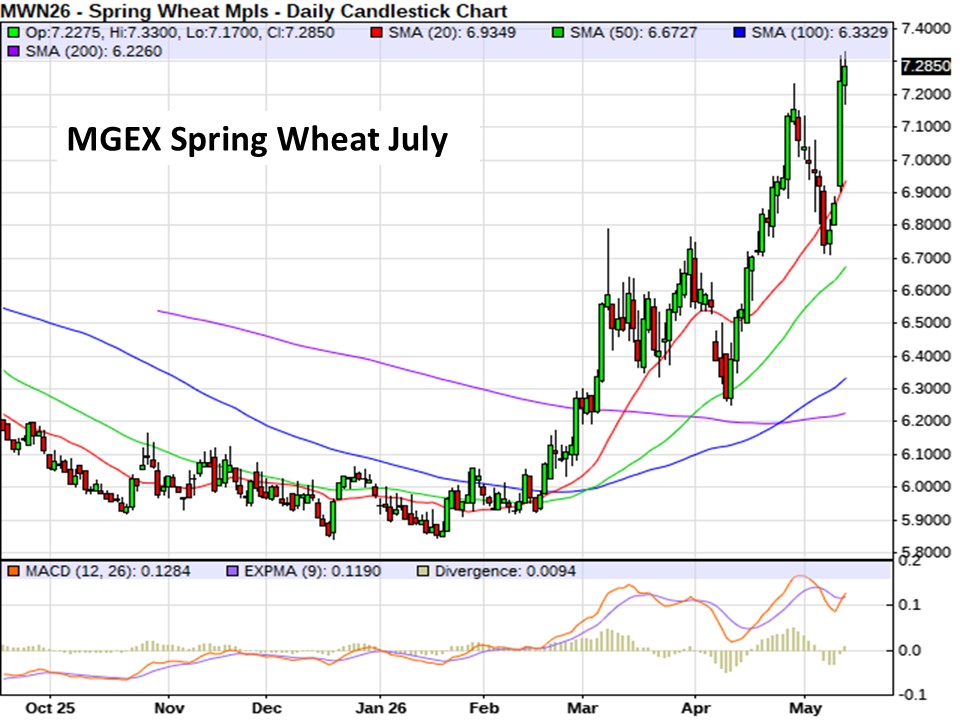
The USDA report from Tuesday showed US winter wheat production at only 1.048 billion bu, which was well below estimates of 1.211 billion. HRW production was seen at 514.8 million bu, with SRW at 300.9 million bu and white winter at 231.8 million bu. All wheat production was 1.561 billion bu, 186 million bu below the average estimate. If realized, it would be the lowest US wheat output since 1972, largely due to drought issues in the Plains impacting the hard red winter crop and leading to increased acreage abandonment..
USDA s supply/demand report forecast old crop US wheat stocks at 935 million bu, which was down 3 million bu from the April total. The story though was on new crop…seen by USDA at only 762 million bu, compared to estimates of 845 million bu, mainly on the lower US production. World stocks were 279.21 MMT on old crop, down 3.91 MMT from the April total. Ending stocks for 2026/27 were pegged at 275.04 MMT in the initial estimate.
The first day of the Kansas Wheat Quality Tour showed an average yield of 38.3 bu/acre, the lowest Day 1 total for the tour since 2023.
CANADIAN GRAIN MARKET
ICE canola futures pushed higher on Tuesday, supported by a stronger crude oil market, firmer CBOT soybean/soyoil values, and a softer Canadian dollar that improved export competitiveness. The rebound reflects improving sentiment across the vegetable oil complex, where biofuel demand continues to support prices despite uneven performance in palm oil. Strong domestic crush margins are also keeping oilseed processors active, providing a steady floor to the market.
Beyond the daily move, canola is increasingly tied to global oilseed dynamics. Traders are weighing Canada s production outlook against European rapeseed prospects and tightening vegetable oil supplies tied to energy markets. The softer Canadian dollar adds another layer of support, helping offset broader macro uncertainty.
July canola futures gained $10.80 yesterday to settle at $754.20/tonne, while new crop November also firmed $12.10 to $763.90.
For today… canola futures are trading $3 to $5/tonne lower to start this morning…lowest of the overnight session…following yesterday s solid gains. July canola futures are down $5.00 at $749.20/tonne, though the bullish price trend overall remains intact.
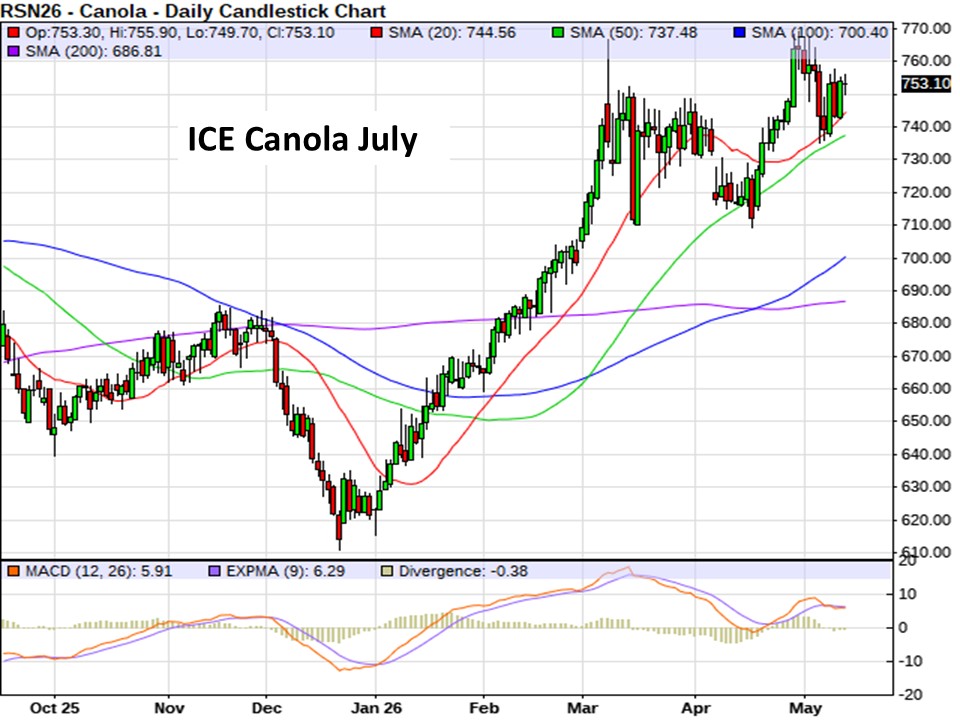
Looking ahead, the market s ability to sustain gains will depend on whether strength in crude oil and biofuel demand persists, while early-season weather across the Prairies begins to shape yield expectations.
So far this morning…CBOT soybeans are slightly higher, while soyoil is narrowly mixed. EU rapeseed are up slightly, but Malaysian palm oil continues to leak lower and hovering near their lowest level in nearly a month.
Stay informed with our daily market videos. Each video quickly covers key futures moves, price trends, and market signals that matter to Canadian farmers. Get clear, timely insights in just a few minutes. Bookmark https://www.producer.com/markets-futures-prices/videos
To access the latest futures prices, go to https://www.producer.com/markets-futures-prices/
Source: producer.com