
Bayer and BP commit to camelina
WINNIPEG — Bayer wants farmers to grow more camelina, an oilseed crop that resembles canola.
On May 6, Bayer and BP announced what they’re calling a “strategic alliance” to increase production of camelina in North America and around the globe. That camelina will be processed into biofuel such as renewable diesel and aviation fuel.
The strategic alliance should give farmers in southern Saskatchewan and other parts of North America more certainty that there’s a stable market for camelina in future years.
“We are utilizing our industry leading breeding program to enhance the crop and its untapped potential globally to help meet the needs of this growing market (for biofuels),” said Frank Terhorst, head of strategy and sustainability at Bayer Crop Science.
“We see this as a win for our customers and their farms, as it creates potential new revenue streams, but also a win for the renewable fuels market.”
Bayer and BP estimate that the market for biodiesel, renewable diesel and sustainable aviation fuel (SAF) markets will triple by 2040, reaching 40 billion gallons. BP is a global energy company with annual revenues of nearly US$200 billion.
Read Also
Camelina is an ideal feedstock for biofuel production because it can be grown in drier climates and lighter soils, such as the brown soil zone of the Prairies.
Bayer has already launched the Newgold brand, a line of oilseed crops, which includes a spring and winter camelina.
Bayer is hoping that farmers in Montana, southern Saskatchewan and Alberta will plant camelina on marginal or under-utilized land, or between crops.

Photo:
Marilyna/iStock/Getty Images
“Camelina is winter hardy, offering pod shatter resistance and drought tolerant characteristics allowing it to be grown on idle or fallow land … allowing farmers to avoid potential competition with food production,” Bayer says in a May 6 press release.
In 2025, Antoine Bernet, country division head with Bayer Crop Science in Canada, said Canadian farmers have a huge opportunity to supply the growing demand for biofuels.
To meet that demand, Bernet estimated the world may need an additional 120 million acres of oilseed crops.
To help producers, so they can grow the necessary feedstocks, Bayer began working on a portfolio of oilseed crops, now known as Newgold.
That project accelerated in January 2025, when Bayer acquired the seed and IP assets of Smart Earth Camelina from Saskatoon.
For years, Smart Earth contracted camelina production in Western Canada and sold camelina oil into the horse, pet and fish food markets.
However, the company struggled to convince producers to grow camelina, with acreage rarely topping 10,000 acres on the Prairies.
With Bayer and BP now backing camelina, farmers might have more confidence in the crop.
Camelina is more tolerant of drought and dry growing conditions, so growers struggling with canola and poor canola yields in southwestern Saskatchewan may be willing to give it a try.
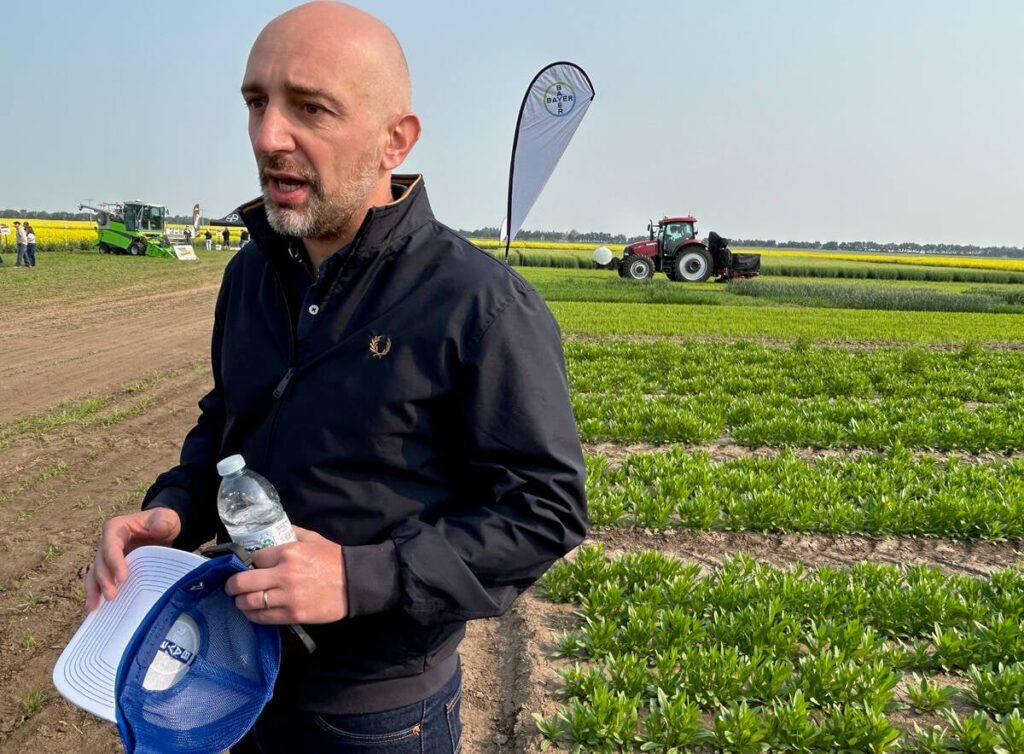
“This (geography) is exactly the opportunity,” Bernet said, while standing next to a camelina plot at the Bayer research centre near Saskatoon in 2025.
“These crops (camelina) can produce a high level of yield per acre, with a very low carbon intensity.”
Source: producer.com