
Canadian drone fliers can learn from the mistakes of U.S. operators
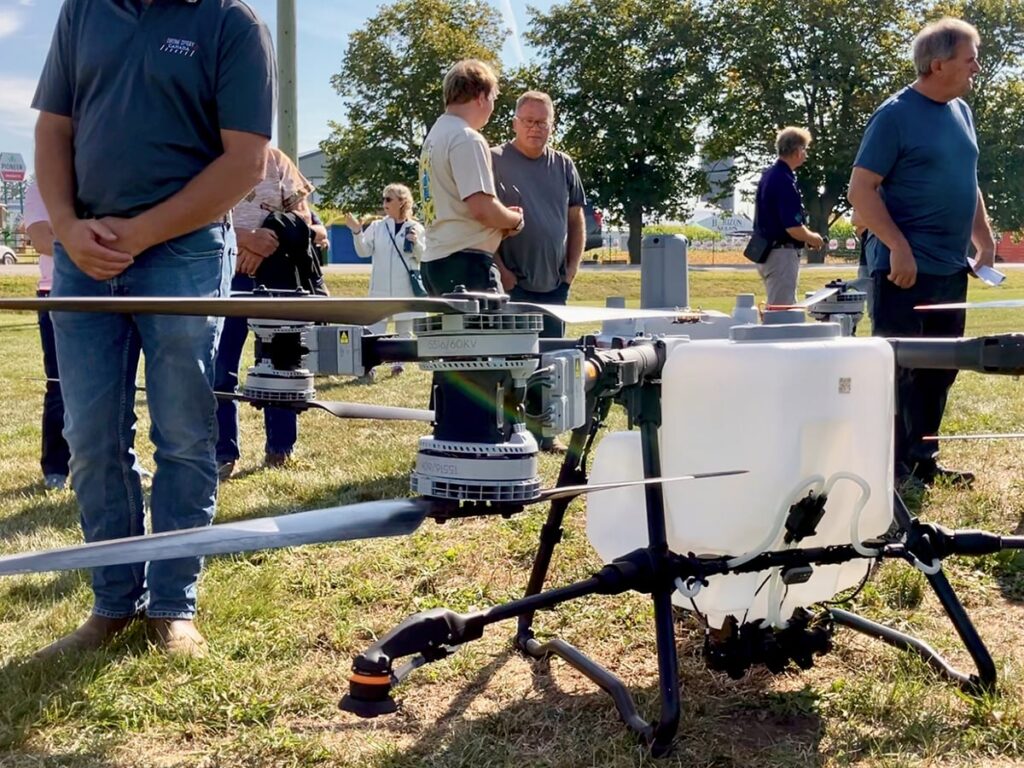
Glacier FarmMedia – This time last year, weed and disease control via drone was looking down a long, uncertain, hurdle-filled road to legality. Today, assuming proposed Health Canada rule changes go through, Canadian farmers can already see a time when they can add drone spraying to their farm management tool box.
That technology will come with a learning curve for farmers, though.
Lack of access to drone spraying has previously sparked frustration among Canadian farmers, particularly since their competitors in the U.S. can turn to the technology. Some spray experts, however, argue that spraying via drone is not the same as spraying via plane, and that caution is warranted.
Canadian regulatory bodies have spent years arguing that existing aerial application labels aren’t good enough for drone spraying. Crop protection products needed drone-specific approvals on their labels.
Spray drones drew crowds at field days and farm shows, but those caught spraying unapproved products with them faced fines up to $10,000.
The list of approved products was glacially slow to grow, despite field trials meant to feed the PMRA’s (now the Pesticides Regulatory Directorate) need for qualifying data.
Recently though, federal rule makers made what Prairie spraying expert Tom Wolf called “the biggest U-turn I have seen in my career that PMRA has made.”
Read Also

Health Canada proposed to allow drone application for any product already approved for other aerial use.
The move was welcomed by the technology’s champions and farmers who had been eagerly waiting for rules to change — many of whom have argued that not being able to use drones hit at competitiveness.
Others, Wolf included, argued that the split between drones and crop planes was scientifically sound. In another spring 2026 article from The Western Producer, Corteva field modernization scientist Kevin Falk worried the unfamiliar technology might lead to application missteps, which might then be blamed on the product rather than the means of application. The companies themselves might hold back on greenlighting drone application of their product.
Avoiding spray mistakes
Agribusiness wants to nip those kinds of mistakes at the bud.
Josh Crimmins, sales engineer for Raven Industries and one of the speakers during an April sprayer clinic at AgWest in Elie, Man., said drone spraying is a growing trend in the U.S., but so are questions regarding its efficacy.
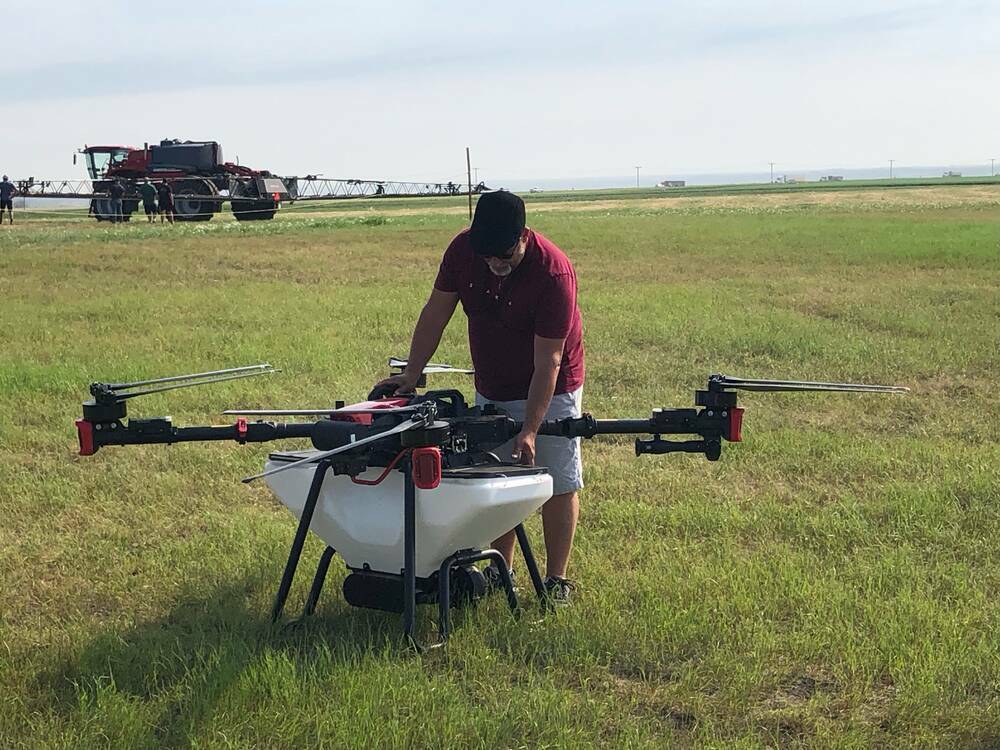
Photo:
File
In 2025, for example, Iowa corn growers were dealing with a particularly bad year for southern rust.
“We were hit extremely bad,” said Crimmins, “If you didn’t put fungicide on your corn, it was like a 40-bushel hit to the field.”
The farm he was working with at the time used both a conventional sprayer and drone in the rush to get acres protected. The drone’s performance was far from perfect.
“Without a shadow of doubt, you could tell where the drone missed a spot,” he said. “There was a 10-acre piece behind a tree line that it couldn’t do its path plan.”
Where the drone missed, yield monitors showed a 40-bushel difference.
The mistake of stretching spray
Crimmins felt the problem arose from the drone operators not being properly prepared.
“They were kind of extending what they should be doing,” said Crimmins. “They were trying to do more acres than what they were supposed to.”
Since the disease was so devastating, Crimmins said he could easily see where the drone had applied fungicide and where it had not.
Crimmins’ agronomist saw similar situations with other growers. Corn crops with ground-applied fungicide in the area performed better against the rust.
Avoiding misses
Such mistakes could give local farmers invaluable insight, should drone spraying get the Canadian green light.
Warren Genick is chief technology officer with Green Aero Tech. The Manitoba company specializes in spray drone and aerial mapping services.
While Genick is not aware of the specifics of Crimmins’ story, he’s aware of where things can go amiss if drone operators are pushing the envelope or are inexperienced.
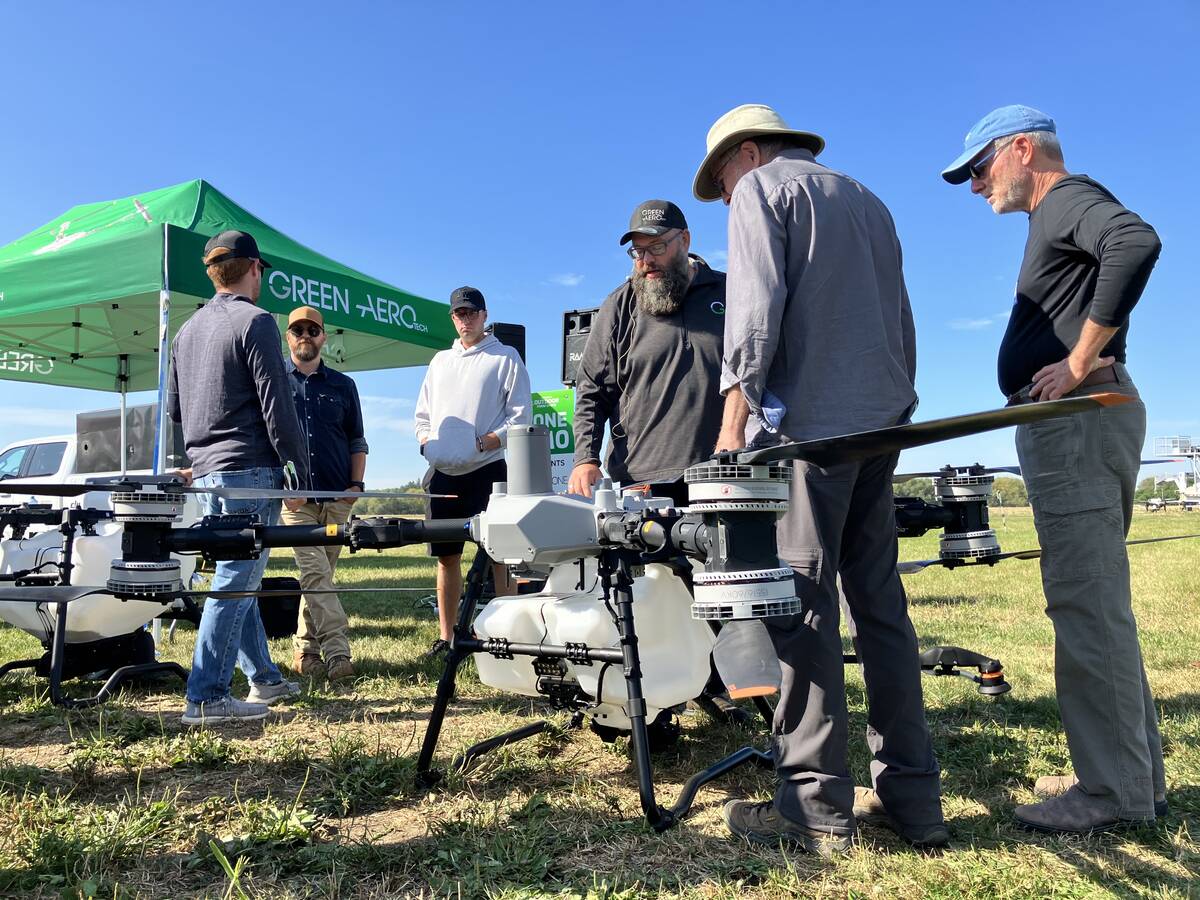
Photo:
Greg Berg
“The reality of spray drones is they’re flying a lot higher off the ground than a boom sprayer,” said Genick.
Ground sprayers typically have the spray boom 30 to 50 centimetres above the canopy. A drone may fly as high as three to six metres above the crop.
Light winds might therefore cause more interference and make for higher spray drift risk.
In those conditions, Genick recommends flying in such a way as to get the fungicide spray well underneath the canopy.
“That might be flying a little bit lower and slower to open it up,” said Genick, “versus flying fast and high and just sprinkling it on top.”
But flying low can come with its own risks, such as a higher likelihood of an operator hitting the crop. Flying low can also cause crop lodging due to the high air pressure from rotor blades, which clock in at 800 to 1,300 r.p.m. when in flight.
Ground versus air
The application hardware of ground and drone sprayers is also different by design.
Whereas ground sprayers use a high-pressure nozzle system to deliver product, drone sprayers use a rotary atomizer, similar to what is used by aircraft applicators.
This means that the atomization speed can be changed in real time in ranges, for example, from 50 to 500 microns.
At those extremes, Genick said one in-field study showed a drone sprayer may be “mangling that droplet more than it’s actually properly atomizing it.”
Genick added that these details are part of the training his company provides.
“Our recommendation to users is to use maybe more inside the range,” said Genick, “maybe only going up as high as 400 microns or that kind of thing, and just being a little more realistic with it.”
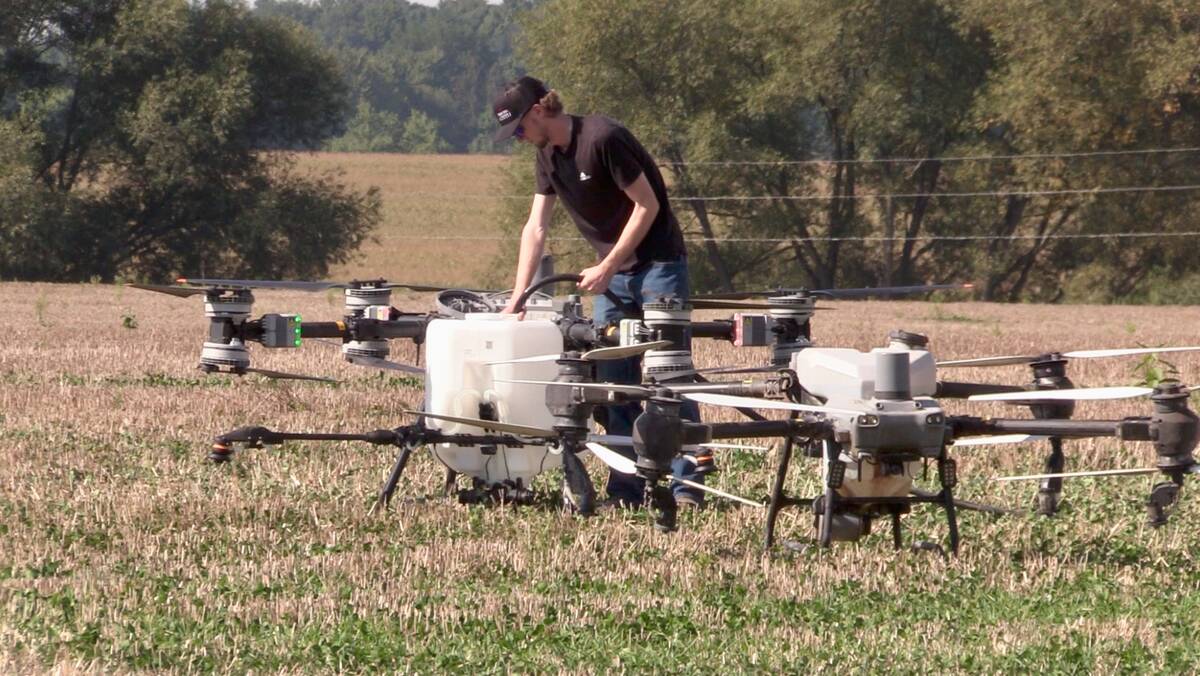
Photo:
Greg Berg
Genick added that the latest spray drone in its fleet, the DJI Agras T100, recently had its nozzles redesigned.
“The bigger the droplet you can have, the less chance for it to drift away on these little, tiny particles that are out of your control,” he said.
Map it out
While drones can be manually operated for specific tasks, Genick says a far better option is to map out your field’s boundaries and obstacles.
This is often done using a smaller, more agile drone. This can fly for longer periods of time and can cover more acres.
Once your field has been mapped, that information can be fed into a drone’s autopilot system to follow a specific flight line.
The drone can then tap into positioning systems such as GPS or RTK, reducing human error.
“For all 6,000 of those flights that I’ve done, I know the computer can do it far better than I can, and far more efficiently,” he said.
That means the farmer will “not have to worry as much about overlaps and gaps and getting too close to things.”
It could take as little as 10 minutes or more than an hour to properly map out a field plan. Either way, Genick said, it’s time well spent.
“Where it’s going to really bite you is if you just show up at a field and tap out four points on the screen and say, ‘go do it,’ ” he said. “That’s not going to end well, or it is not going to be efficient.”
Flying tips
Genick also has the following general words of wisdom for hopeful future drone spraying pilots:
- Keep a close eye on the weather. Spraying with a drone often requires more time in the field, and with that, the potential for sudden weather changes.
- Know how to adjust for changes in wind direction. Winds can quickly change during the course of your spray operation.
- Have good imagery and boundaries of your field so you can fly with more confidence and be more efficient with your spray delivery.
Source: producer.com