
Cropping for profit over production using regenerative agriculture
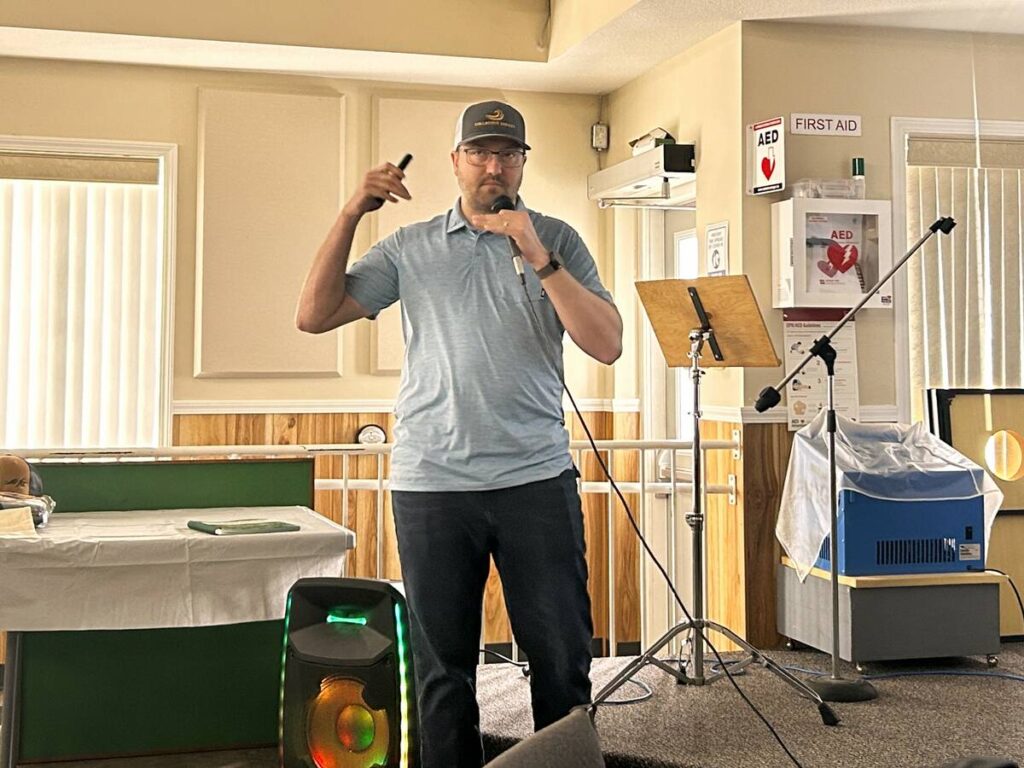
Shifting the outlook from high production goals to increased farm profit has changed the outcomes for Michael Ferguson, co-founder of Collective Impact and a fourth-generation farmer near Melfort, Sask.
Ferguson has been using methods such as cover crops and intercrops while moving away from high fertility inputs since 2019.
He applied more fertility when he took over the farm in 2014, but four years later, he wasn’t seeing much response.
To test his alternative ideas, he created agronomic data maps for a field with marginal land and a creek running through it to identify the land differences.
Crop production margins continue to tighten with higher input costs and low grain prices. Producers have to look at their books and consider all options.
“We kind of took this area out of production because it was always poor, never yielded good,” he said at the recent AgriGather event in Blaine Lake, Sask.
“If you seeded a canola crop, it would come up beautifully, nice and small, but then basically, kind of in July, just run out of steam.”
It was a bit of a mystery whether it was compaction or salinity, so he wanted to farm the area differently.
Read Also

They shifted away from high fertility, updated the drill to variable-rate to use zone maps and pulled the wool over his father’s eyes.
Ferguson is the gofer on the farm, picking up and ordering seed and fertilizer and filling the tanks. In spring 2019, while he was filling with anhydrous and his father visited with the driver, he set things in action.
“I got these maps made, and I stuck it into the monitor. He didn’t know it was going on. And so, then we’re filling up, and he’s talking to the anhydrous guy, about this and about that, and I’m there putting a bag of cover crop seed in our saddle tank.”
It wasn’t until the neighbours started to talk about sunflowers growing in the crop late in the summer that Ferguson fessed up.
The other factor was the rising cost of inputs starting in 2018. When he was in the combine that fall, his mind was racing as he calculated costs and profits per acre.
“I said, ‘I’m not making money. I’m just buying a crop.’”
After two years with a cover crop, he started to see the difference. In 2021, the farm made the most money in the poorest acres of that field because they had cut back on the fertilizer and didn’t spray on those areas. He also saw a more even yield across the field.
And when soil testing, they learned that the cover-cropped field contained an additional two inches of moisture compared to a field 50 metres away with a traditional canola-wheat rotation.
In 2024, Ferguson ran another experiment: full-season cover with the integration of cattle.
He partnered with a local cattle producer and seeded the field to a mix of oats, faba beans and fall triticale with an under-seeded cover crop. Some of it was cut and baled as silage, while other parts were grazed.
The first year was a success and they decided to partner again in 2025, although they did sit down to discuss what went well, what didn’t and each other’s priorities so they could plan better for the next year.
“It was tough to see that grain land taken out,” he said.
“But for me, ultimately, it was, ‘how do I get animal impact on the land? How do I get that nutrient cycling? How do I get diversity? But how do I also generate some revenue to go with it?’ ”
He said he’s already seeing some of the benefits of the animals on the land with increased organic matter, more earthworms and better water infiltration.
With this spring’s warm weather, there is no standing water on his field, even though the neighbouring ones have quite a bit.
Paying the bills
Ferguson’s goal is to be as efficient as possible for each zone of the field, which will require different methods because every piece of dirt is different.
He also said he isn’t just trying to do something new to see how it works, because that’s not a luxury farmers have. It’s about paying the bills.
He gave the example of pea-oat intercrop, which is his “favourite intercrop,” even though people ask why.
“Well, I’m not that smart,” he said.
“But if we get lots of rain, the oats do really good. If it’s dry, the peas do really good. So, no matter the weather, I’m going to get 85 per cent of a crop.”
Peas can drop their bushels significantly with just a few inches of rain, leaving little to nothing for profit. Ferguson said that in their area, crop insurance on peas isn’t great, so this is a better choice for risk management.
Since adopting alternative cropping practices, the farm has found its “sweet spot.” Ferguson’s fertilizer costs in 2025 were the same as in 2020, despite increased costs, and his yields have remained steady.
However, compared to their area averages, his yields are eight per cent behind, although Ferguson doesn’t see it as a negative.
“I have a friend that pays 36 bucks an acre for canola coverage today, and we have the exact same yield,” he said.
“My premium compared to the average is 38 per cent lower than the average for our risk zone. So for me, when I start talking about, how do I make money, I’m saving money there.”
Source: producer.com