
Limagrain prepares for second year of private pulse seed trials
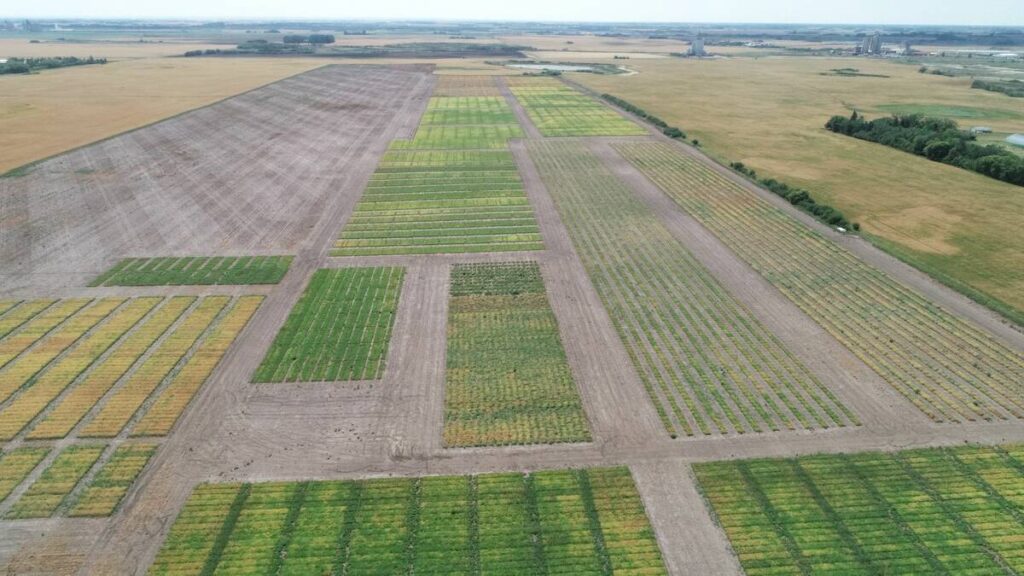
Limagrain Cereals Research Canada got into the pulse breeding business in 2022, and last year it ran its first private registration trial.
The company started with lentils, which will continue for its second year, and the pea registration trial will begin this year.
In 2022, Limagrain and Saskatchewan Pulse Growers entered a partnership to further pulse breeding research and variety development.
Limagrain had already established trial sites from its wheat breeding program, and SPG wanted to diversify development in the space due to the lack of private pulse breeding.
WHY IT MATTERS: It’s hoped this pulse program will tee up new varieties responsive to the needs of Prairie pea and lentil growers.
Sherrilyn Phelps, SPG’s director of research and development, said it was a logical partnership.
“One of the big reasons why it made sense with Limagrain is the fact that their board of directors is farm producers as well,” she said.
“So, they’re very aligned with the need to focus on priorities for growers.”
Since the expansion into pulses, the company has supported and licensed 14 varieties.
Two lentil varieties became available this year as certified seed for producers: CDC 6964 CL, a small green, and CDC 6928 CL, a small red. In the next few years, certified seed for two pea and seven lentil varieties will be distributed across Western Canada.
“Some of the varieties that will be released … are sitting in the top three varieties in Saskatchewan in our regional variety trials,” Phelps said.
Limagrain has 10 internal registration trial sites, an internal disease testing location and another nine trial sites that are run by co-operators in key pea and lentil growing regions across Alberta, Saskatchewan, and Manitoba, where 36 lentil lines and 36 pea lines will be trialled.
“We really looked at our testing network and working to expand where there are the highest numbers of acres and keeping in mind different environments as well,” said Jaenet ter Schure, Limagrain’s pulse breeder.
“We’ve got a lot of hours to drive in summer.”
Phelps said a pulse breeding program on the Prairies gives producers a competitive advantage. Once the seed is available, the improved traits and yields will have been proven and tested for Prairie use, and there’s also the benefit of quicker access to the genetics.
Additionally, the diversity of locations provides a lot of data on environmental effects and offers the ability to identify where the varieties will perform best.
Development process
Limagrain’s variety development has focused on improvements to yield and stability, disease resistance, agronomics, seed characteristics and quality while aiming to deliver new varieties to farmers as quickly as possible.
The project included establishing a disease testing program, complete with screening protocols and validation for diseases such as root rot complex and anthracnose.
Managing its own registration trials provides Limagrain with flexibility because it allows for an increase in testing capacity and accelerates potentially valuable lines.
SPG said it wasn’t expecting to see huge gains in breeding until the eight to 10-year mark, but it is impressed with the progress seen in the last four years.
Photo:
Greg
“We’ve really been able to see their ability to very quickly increase seed to make sure that new varieties can get in the hands of growers as quickly as possible,” Phelps said.
In plant breeding, the first step is the selection of the parents, followed by the greenhouse cross and then the growouts to eliminate variation until a viable F4 is determined that can be used in the field.
F-numbers are the filial generations of plant crosses — the larger the number the further from the first parent cross they are in line breeding.
The first observation plots use F4s to provide the first look at characteristics such as lodging maturity, flowering and height. From there, the first line selections are made, and an F5 is determined, which is used in the first yield trial.
Typically, two yield trials occur before registration trials, though some have three. At the end of the registration — a two year trial — the line is at an F8.
“You start with hundreds of crosses, and then you go to thousands of observation plots,” ter Schure said.
“Critical selections in the following seasons decrease the number of lines significantly, so that you are only testing 30 to 50 lines in your advanced yield and registration trials.”
Seed deficiencies can hold back helpful advancements
Using speed breeding techniques, the company can increase the number of plant cycles in a year from one to four, which reduces 10 years of work to six.
Using a contra season, in which seed is grown in a warmer climate during the Canadian winter to increase seed count, provides sufficient seed volumes for testing and accelerates the timeline. This year, some varieties were taken to Chile.
With the trials, Limagrain has continued to improve the levels of yield found in check varieties such as CDC Nimble, as well as maintain and increase disease resistance. In lentils, the priority is maintaining and improving resistance to anthracnose and ascochyta blight.
A line of anthracnose resistance levels was identified during the indoor tests but wasn’t continued due to other deficiencies that need further work. However, they have been flagged as potential parents.
Additional disease work continues to reach partial aphanomyces root rot resistance in peas, alongside fusarium root rot.
“We’re working with the Global Institute of Food Security and they’ve been testing thousands of lines in their high-throughput screening facilities,” said ter Schure.
“And then after their selections, you go from thousands of lines to a couple of hundred that might be interesting.”
These hundreds of lines are being tested in field in a root rot nursery ran by Syama Chatterton at Agriculture and Agri-Food Canada.
Source: producer.com