
North Africa’s durum demand expected to falter
SASKATOON — North Africa’s bumper wheat crop will hurt price prospects for Canada’s 2026-27 durum, says an analyst.
The U.S. Department of Agriculture is forecasting a record 12.9 million tonnes of production for Morocco, Algeria and Tunisia combined.
That would be up 61 per cent from last year and 58 per cent above the five-year average.
“Weather during the crop year, for all three countries, has been remarkably favorable,” the USDA’s Foreign Agricultural Service (FAS) said in its World Agricultural Production report.
“Typically, either Morocco or Tunisia suffers from drought while Algeria’s fortunes are split down the middle, with the western or eastern side being moisture sufficient and the other side lacking.”
However, this year the agricultural regions of all three nations have received abundant rainfall, and it has been spread out through all crop stages — from planting, emergence and green-up to flowering.
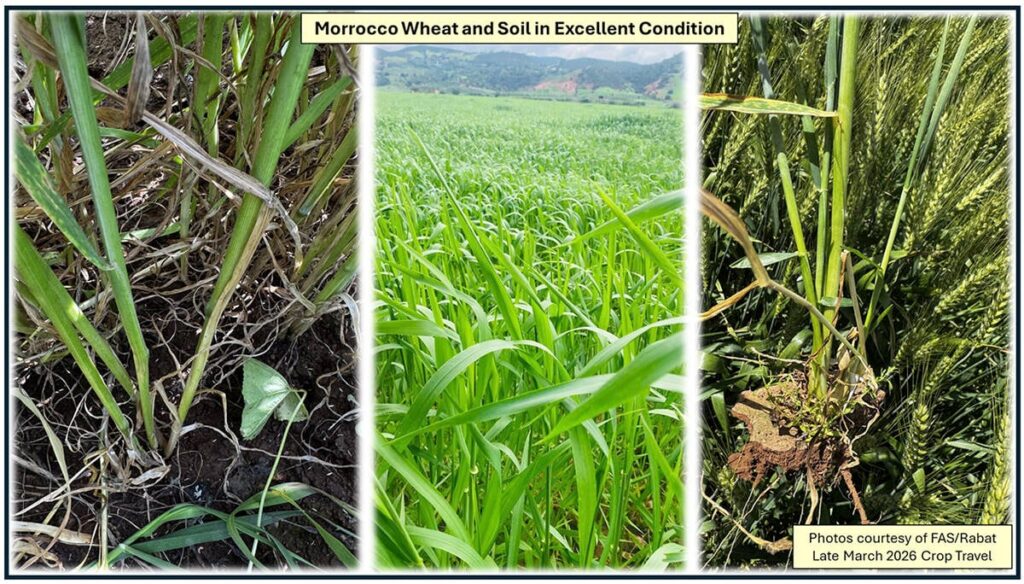
FAS said its bumper forecast is corroborated by satellite-derived normalized difference vegetation index and precipitation maps confirming the “exceptionally favorable conditions” in North Africa and by an FAS crop tour of Morocco in late March 2026.
Read Also

North Africa is Canada’s most important durum buying region.
Algeria was the top market for Canadian durum in the 2021-2025 period, accounting for 24 per cent of exports. Morocco was second at 20 per cent.
As a result, the massive wheat and durum crop in that region of the world doesn’t bode well for demand for Canada’s 2026-27 durum harvest.
“It has to have a major effect, of course,” said Derek Squair, president of Exceed Grain Marketing.
“It’s going to be very bearish for durum prices.”
He said the United States typically buys most of Canada’s top-quality durum, while the No. 2 and No. 3 grades are shipped to North Africa, so it is the lower quality stuff that will be hurt the most.
Morocco is forecast to produce 7.5 million tonnes of wheat, more than double last year’s drought-reduced harvest. It will be the country’s first bumper crop in five years.
Algeria is predicted to produce a record 4.1 million tonnes, up 28 per cent from last year.
Tunisia’s 1.3 million tonnes would be one per cent smaller than last year’s bumper crop.
The USDA report is in line with LeftField Commodity Research’s estimate from a couple of months ago forecasting 5.6 million tonnes of North African durum production, 20 per cent higher than 2025 levels.
The European Commission is also forecasting 4.25 million tonnes of durum production in Turkey, which would be eight per cent above the five-year average.
Canada’s durum crop will likely be smaller than last year, according to LeftField.
The firm is forecasting six million seeded acres, which is below Statistic’s Canada’s estimate of 6.38 million.
Assuming average yields, that would result in 5.89 million tonnes of production, 17 per cent lower than 2025.
“If even more farmers switch out of durum this spring, it could start to tip towards snug supplies, especially with poor quality durum in the carryover,” the firm said in the April edition of the Market Vantage report it produces for Alberta Grains.
Squair said he “100 per cent agrees” with LeftField’s forecast.
He noted that the recent run-up in wheat prices will probably result in some displacement of durum acres in southern Saskatchewan because that crop hasn’t participated in the rally.
“We’re going to be down in durum acres and probably be replaced by wheat acres,” he said.
Squair agrees that production will be down, but carryout from the 2025-26 crop will be substantial. Unfortunately, much of that carryout is the lower quality product that is usually shipped to North Africa.
Source: producer.com