

Urea fertilizer price drops in May as cheaper alternatives found
SASKATOON — Global urea fertilizer prices have fallen in recent weeks as the market searches for an equilibrium, says an analyst.
Prices were up more than 80 per cent in some of the major markets, such as Brazil and Egypt, following the outbreak of hostilities between the United States and Iran in late February.
However, they have come back down a little in recent weeks in response to push-back from major importers such as Brazil, said Harry Minihan, nitrogen editor for Argus Media.
“We’re seeing a preference for other comparatively cheaper nitrogen products,” he said during a recent Argus webinar.
“That’s why the downward pressure is on the international urea markets at the moment as farmers look for cheaper alternatives.”
In Brazil, that product is ammonium sulfate (amsul).
Farmers imported 7.78 million tonnes of amsul in 2025, surpassing urea imports for the first time ever.
That trend is continuing in 2026. Brazil imported 1.75 million tonnes of amsul during the first four months of this year, compared to 1.4 million tonnes of urea.
Read Also

Five years ago, farmers were bringing in twice as much urea as amsul, so that is quite the shift.
Amsul is 21 per cent nitrogen and 24 per cent sulphur, while urea is 46 per cent nitrogen.
Urea is one of the most popular fertilizers used in Western Canada.
Urea prices shot up in response to the conflict in Iran and the closure of the Strait of Hormuz. The Middle East accounts for 35 per cent of the global urea trade.
The price increase was cemented by a massive Indian buying tender on April 15. India Potash Ltd. purchased 2.5 million tons of urea at prices ranging from US$935 to $959 per ton.
“That’s almost $2.5 billion worth of urea bought in a single tender,” said Minihan
“It’s the largest amount on record.”
Strong local demand combined with plunging domestic production led to the huge Indian urea import program.
Indian fertilizer producers were unable to secure their usual supply of liquefied natural gas from the Middle East, which is a key feedstock for manufacturing urea.
India had already imported a record 10.38 million tonnes of urea between April 2025 and March 2026, and the new 2026-27 fertilizer year started off with a bang.
Minihan said the key driver going forward will be the return of Chinese urea exports, which have been under pressure since the end of 2021.
Chinese exports have been highly erratic since then. For instance, almost no Chinese urea was shipped in 2024. The following year they exported nearly five million tonnes of the nutrient.
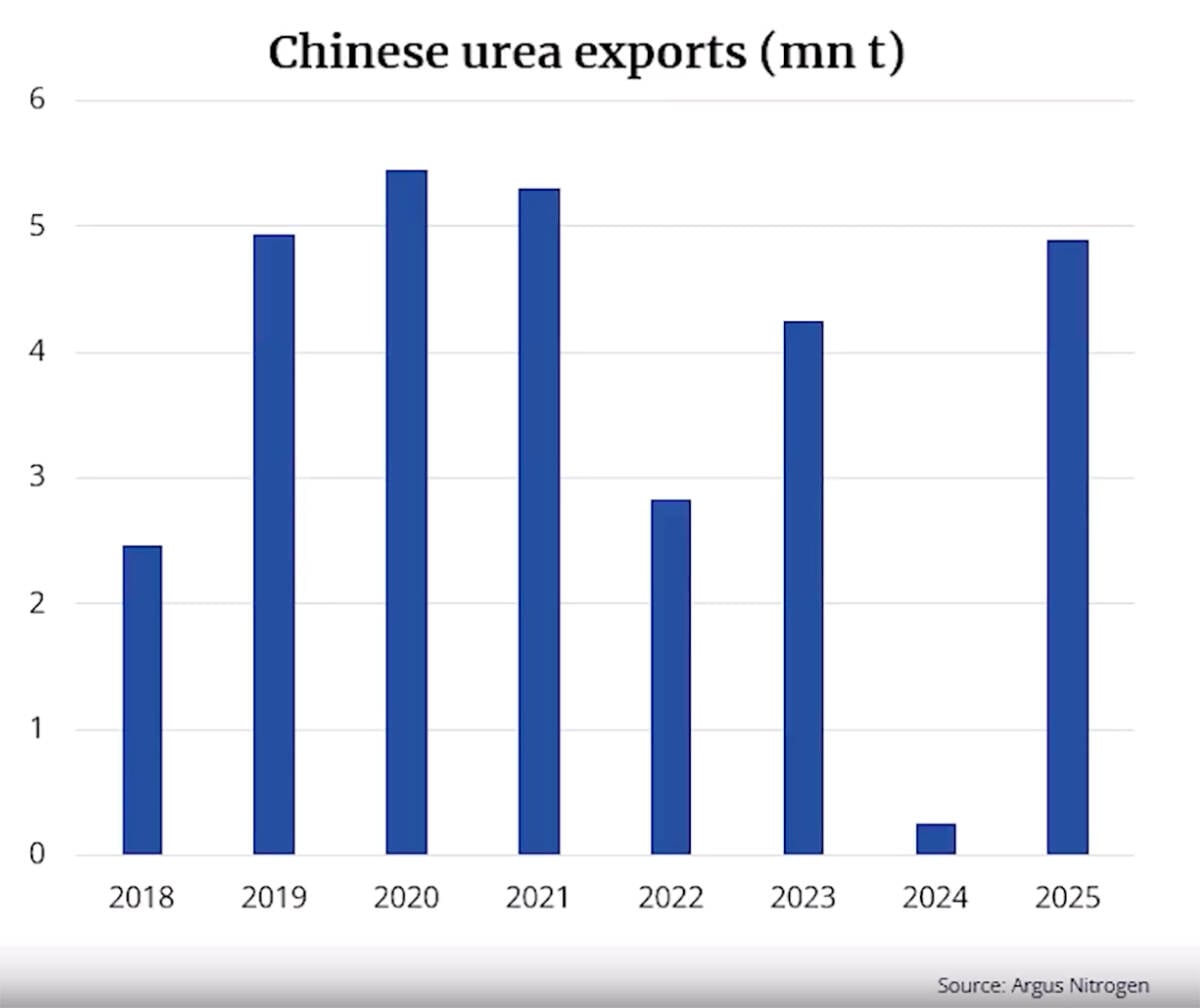
There haven’t been any exports in 2026. Analysts thought China would be in the market by April-May, but that hasn’t happened.
“If and when they are back, that is going to have serious ramifications on price direction for the rest of the year,” said Minihan.
The next biggest factor will be Brazilian imports. Brazilian farmers can’t afford to pay the same price as growers in India, whose purchases are heavily subsidized by the government.
That is why global prices have been dropping since the start of May.
The other wildcard is what happens in the Middle East. There is no doubt that production and exports in the region have been hampered, but that hasn’t stopped the loading of vessels.
Argus has tracked down at least 27 vessels loaded with 1.24 million tons of urea floating in the Persian Gulf waiting for the Strait of Hormuz to reopen.
Source: producer.com